
Australia's unemployment rate increased to 4.3% in June, rising from 4.1% in May and dashing market expectations that it would remain steady, according to the latest data released on Thursday by the Australian Bureau of Statistics (ABS). The increase, which marks the highest level since November 2024, was driven by a 34,000 increase in the number of unemployed people.
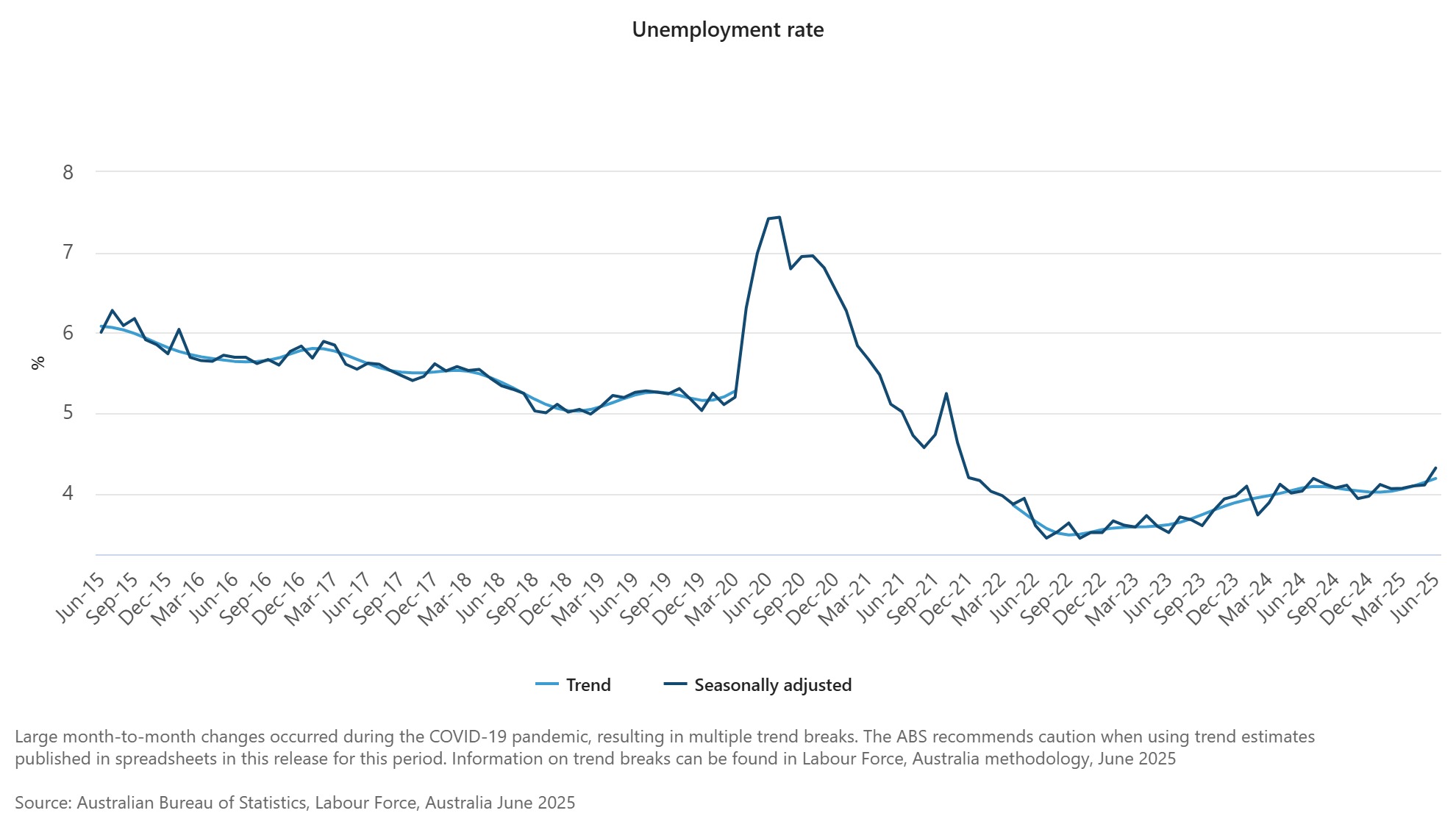
Employment growth also underperformed, with just 2,000 jobs added in June, well below the anticipated 20,000 increase. This, coupled with a shift towards part-time work — 40,000 more part-time jobs but a 38,000 drop in full-time roles — highlights the broader signs of deceleration in the labour market. The employment-to-population ratio held steady at 64.2%, while the participation rate ticked up to 67.1%.
Key trends and impacts
Employment grew by around 23,000 people in trend terms, and the underemployment rate remained largely unchanged at 5.9%. Trend unemployment rose slightly.
“The trend unemployment rate has risen to 4.2%, after remaining at 4.1% over the previous three months,” noted ABS head of labour statistics Sean Crick.
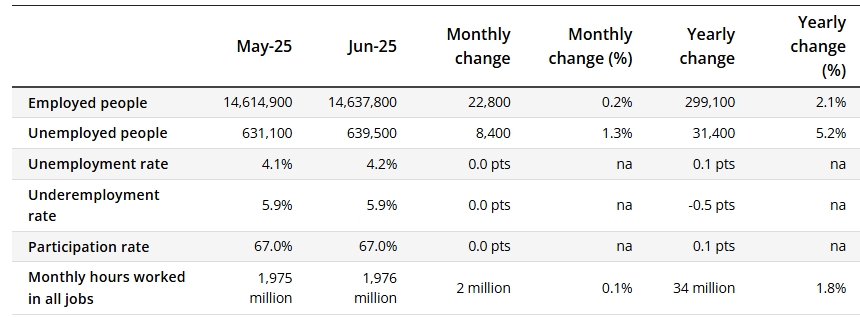
Key Statistics - Trend (Source: ABS, Labour Force, Australia June 2025).
The decrease in full-time employment and the rise in part-time work point to continued caution among businesses as they face persistent cost pressures and subdued demand.
Tony Sycamore, market analyst at IG, noted that the rise in unemployment suggests emerging signs of a slowdown in the labour market, which may challenge the Reserve Bank of Australia’s (RBA) approach of prioritising inflation control over growth.
“With the unemployment rate making a concerning lurch higher, growth at subpar levels and inflation back within the RBA’s target band, the RBA will no doubt be keen to make amends at its meeting in August,” he said.
Following the release, markets fully priced in a 25-basis-point rate cut in August, with 65 basis points of cuts anticipated by the end of the year.
Sector-specific insights
Employment CEO Ben Thompson pointed out that businesses appear hesitant to expand their workforces amid rising cost pressures, including recent increases to the minimum wage and superannuation contributions.
"Many are choosing to stretch existing teams or reduce headcount," he said, reflecting the broader trend of businesses opting for flexible employment models rather than committing to long-term hires.
Further evidence of this trend is found in the rise of part-time and casual employment, especially among younger workers and casual staff. Martin Herbst, CEO of JobAdder, noted that while more Australians are re-entering the job market, not all are finding work.
“A rise in both unemployment and participation is a sign of growing jobseeker confidence, but also a sign that hiring demand hasn’t caught up,” he said. “The shift from full-time to part-time work, along with a dip in hours worked, shows that while demand hasn’t disappeared, employers are cautious and looking for flexibility in their workforce.”
Economic outlook and market reaction
The labour market data has added to concerns about the broader economic outlook. With signs of a cooling labour market and rising unemployment, the outlook for business investment and economic growth remains uncertain. The latest figures have added to expectations that the RBA may need to implement further rate cuts to stimulate growth.
Following the announcement, the Australian dollar dipped, falling to 0.6480 against the US dollar, Sycamore noted. In contrast, the ASX 200 showed a positive reaction, gaining around 20 points, as investors weighed the potential for further monetary easing.
The shift towards part-time employment and a cautious approach from employers underscore the broader trends shaping Australia's labour market, with more Australians seeking work, but businesses reluctant to increase headcount amid rising costs and uncertain demand.