
First Phosphate Corp. (CSE:PHOS, OTCQB:FRSPF)has achieved a major milestone in its mission to establish a North American supply chain for lithium iron phosphate (LFP) batteries.
Speaking from the OREBA3 conference in Montreal, CEO John Passalacqua joined Proactive to discuss the company's successful production of commercial-grade LFP battery cells using 100% North American-sourced critical minerals. The accomplishment highlights the potential for domestic manufacturing independence in the energy storage sector.
In this Q&A, Passalacqua outlines the process behind the breakthrough, the strategic importance of local sourcing, and the company’s roadmap to full-scale commercial production by the end of the decade.
Proactive: Tell us about the conference you’re attending. It seems like a major event on the global stage.
John Passalacqua: Yes, OREBA3 is an international conference—now in its third year—taking place in Montreal. The theme this year is producing LFP batteries using Canadian-sourced materials, specifically Canadian critical minerals.
And that’s the key message here—not relying on China or other countries but building out a domestic supply chain. That’s something I know you’ve focused on since becoming CEO of First Phosphate.
Exactly. It’s about building batteries in North America with as little dependency on foreign sources as possible. That’s been our mission from day one at First Phosphate—creating a fully North American supply chain for LFP cathode active material. We’ve now achieved a major milestone: producing two LFP batteries using 100% critical minerals sourced from North America.
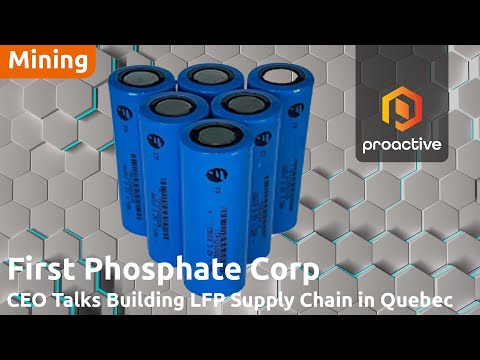
That’s a big announcement—commercial-grade lithium iron phosphate battery cells. Walk us through how you got there.
It’s taken about three years at pilot scale. It all starts with igneous phosphate rock from our property in Saguenay–Lac-Saint-Jean, Quebec. We’re working toward a feasibility study and planning to develop a phosphate mine there by 2029. From that rock, we produce phosphate concentrate, which is then reacted with sulfuric acid to yield purified phosphoric acid—the “holy grail” of industrial phosphate applications. Our deposit is so pure that nearly all of the concentrate converts to purified acid.
We then chemically combine that purified phosphoric acid with iron—also from our Bégin-Lamarche property—to make iron phosphate. That iron phosphate is combined with lithium carbonate sourced from Century Lithium in Nevada to create LFP cathode active material. For the battery’s anode, we use graphite provided by Nouveau Monde Graphite, also based in Quebec. So three of the four key elements—phosphate, iron, and graphite—are from Quebec, and the lithium is from Nevada.
So now you’ve made these batteries. Obviously, there are many potential uses for them. What are the next steps as you move forward?
Well, the first thing we’ve proven is that we can manufacture LFP battery cells in North America using local partners. For this project, we partnered with Ultion Technologies in Nevada. These cells are suitable for small mobility applications and other electronics, but they can also scale up for large energy storage and EVs. The next step is to move from pilot to commercial scale. Once we get there, we’ll be able to replicate today’s achievement—but at a commercial level. Our LFP cathode plant should be operational by late 2026 or 2027, and our mine and phosphoric acid plant by 2029 or 2030. With the help of our partners, we aim to produce fully North American LFP battery cells—mostly from Quebec—on a commercial scale by that time.
Finally, John, just talk about the importance of this milestone—not just for your company, but for Canada and North America more broadly, especially considering today’s global context.
It’s important for people to realize that LFP technology was originally developed in North America—through partnerships with a university in Texas, a university in Quebec, Hydro-Québec, and a French research center. There was even some production of LFP battery cells here in the early 2000s. But then it all shifted to China. For nearly two decades, we haven’t been able to manufacture these cells in North America using our own critical minerals. Now we’ve shown it can be done again—and done at scale. It’s time to reclaim our energy storage independence in North America.
Quotes have been lightly edited for style and clarity