
- FTSE 100 closes 48 points higher
- Markets largely shrug off new US tariffs
- Gold stocks up as M&A returns to the sector
- Gilts rise after OBR report on UK public finances
4.55pm: FTSE powers higher
London’s FTSE 100 rose 0.5% to close at 8,854 on Tuesday, buoyed by gains in mining stocks as investors digested fresh US tariff announcements and corporate updates.
Precious metal miners climbed 2.3% amid steady gold prices, with Hochschild up 4.1%, while copper’s rise lifted Glencore 2.9%.
Markets responded to news that Britain and Vietnam had secured exemptions from new 25% US tariffs affecting 14 other nations.
Looking ahead, investors are watching for May GDP data on Friday—expected to show a slight contraction—and key policy updates from the Bank of England and the OBR later this week.
3.55pm: Precious metals stocks in the shop window
UK precious metals giants Fresnillo and Endeavour Mining PLC (LSE:EDV, TSX:EDV, OTCQX:EDVMF) have been leading the charge on the FTSE 100 on Tuesday as M&A activity re-ignited interest in the sector.
The catalyst? Royal Gold, which agreed to splash out $3.7 billion on two deals, buying Sandstorm Gold and Horizon Copper.
Last year saw plenty of big gold deals, like AngloGold Ashanti’s $2.5 billion buyout of Centamin and Northern Star’s $3.3 billion purchase of De Grey.
So, for investors, the message is clear: with gold shining bright, the big players are on the move.
Fresnillo was up 3%, while Endeavour rose 2%.
2.47pm: US opens slightly higher, FTSE lifted by oil giants
Wall Street is showing mixed signals in early trading, with the Dow Jones down 34 points or less than 0.1%, while the S&P 500 and Nasdaq Composite are up 0.1% and 0.2% respectively.
And back in London, the FTSE 100 is up 31 points now or almost 0.4%, currently the best performer in Europe.
Shell and BP have both moved higher since US stocks started trading.
Also, UK Foreign Secretary David Lammy said if a ceasefire in Gaza is not arranged for the coming weeks and the "intolerable situation continues" then the UK government will "go further in taking measures against Israel".
He said the UK, France and Germany can snap back on sanctions on Iran, which could lead to greater pain for Iranian regime unless they get serious on stepping back from their nuclear programme.
2.20pm: Shein IPO game-playing
Chinese fast fashion retailer Shein has filed for an IPO in Hong Kong in an attempt to put pressure on the UK regulator to approve its London listing, according to an FT story.
The company, which is registered in Singapore, filed for a London IPO 18 months ago but has still not received the regulatory green light.
Concerns around its Chinese supply chain and human rights abuses are regularly cited by reports as at the heart of the regulatory stumbling block, while Shein also saw earnings fall last year amid competition from Temu, hitting its expected IPO valuation, which was estimated at $66 billion back in 2023.
One argument in favour of London approving the IPO is that the City's listed market has suffered in recent years with the departure of some major businesses like CRH, Flutter and Wise, with the CEO of AstraZeneca last week reported to be keen on shifting the company’s listing to the US from the UK.
With UK fundraising from IPOs plunging to a 30-year low this year, Victoria Scholar, head of investment at Interactive Investor says: "Cheerleaders of the London market will be desperate that Shein’s much talked about IPO can overcome these regulatory hurdles.
"The hope would be that this could mark the start of a more positive chapter for the City of London, reigniting its status as a global financial hub and attracting further flotation interest in future."
1.33pm: Wall St forecasts lifted
Various big investment banks have upped their forecast for the US S&P 500 index.
Bank of America has hiked its year-end target to 6,300 from 5,600, with the 12-month target now 6,600.
"It’s dangerous to underestimate Corporate America," strategists say, while the "US isn’t exceptional ... Corporate America might be".
Last night, Goldman Sachs lifted its three-month forecast to 6,400, roughly a 3% improvement from where it finished overnight.
Its 12-month forecast points to an 11% gain at 6,900.
Earlier, the US small business optimism survey was published, with the headline NFIB index falling very slightly to 98.6 in June from 98.8, as expected.
The index is well above its 2024 average of 93.0, but "still well below the immediate post-election peak of 105.1, a clear indication of the hit to confidence from the new tariffs", says Oliver Allen at Pantheon Macroeconomics.
Finally, there was a one-point uptick in the net share of companies who expect to raise prices in the coming months, to 32% from 31%, which "tentatively points to a reacceleration in underlying services inflation in the months ahead, a similar story to that suggested by the ISM services surveys".
Allen says he strongly doubts that underlying services inflation will start rising again, "because most evidence suggests that upward pressure on wages continues to ease, while consumers’ demand appears relatively weak."
He also notes that only 382 companies responded to the survey, the lowest number since 2006 and equivalent to a response rate of just 9.1%, down from an average of 11% in 2024.
The survey's response rate, as with many other surveys, has been gradually drifting lower in recent years.
"We can’t know for sure, but it seems quite likely that many small businesses under intense pressure from the tariffs have stopped responding."
12.29pm: Markets slightly higher, bit mixed
The FTSE 100 remains modestly higher, along with most other European share benchmarks, while US futures are mixed.
Risers are led by Fresnillo, Entain, Glencore and IAG, a broad spread across sectors.
There's a few financial stocks among the leaders too, Stan Chart, Schroders, St James, Prudential and LSEG.
Investors across the continent have "appeared to shrug off the latest US trade developments", says market analyst David Morrison at Trade Nation.
"So much is happening and changing on an hourly basis, investors can only sit back and await some clarity, while hoping that eventually whatever is agreed won’t cause too much damage economically.
"Although the risk of further escalation looms, the early market reaction has been measured."
A small gain for Germany's DAX, which so often behaves as a bellwether for broader sentiment on the Continent, suggests that European markets "could be entering a period of consolidation, with traders looking for signals from economic data and geopolitical updates before committing to any change in exposure levels", Morrison says.
In currency markets, the pound is down against the dollar now having been up earlier, though the euro has maintained its gains.
UK gilts are up around monthly highs after the OBR report earlier.
11.17am: Climate change impact on public finances
The OBR said as well as the sustainability of UK’s system of public and private pensions, and risks to assets and liabilities on the balance sheet, the third major pressure is climate change.
By the early 2070s, climate-related damage could reduce UK GDP by 8% in a scenario where global temperatures rise to just below 3°C.
The impact on GDP is three percentage points more than estimated in the 2024 report.
By the early 2070s, climate-related damage could increase primary borrowing by 2% of GDP annually, 0.7 percentage points more than our previous estimate. The accumulated impact, including debt interest, could raise public debt by 56% of GDP.
The overall fiscal impact of climate change is uncertain and depends on temperature paths, economic damage and who bears transition costs.
Our scenarios estimate that the impact of climate change on debt in 50 years’ time could range from 40% to 140% of GDP.#OBRfiscalrisks pic.twitter.com/oP51AFAIIW
— Office for Budget Responsibility (@OBR_UK) July 8, 2025
10.47am: UK public finances warning
UK gilt yields are rising after the Office for Budget Responsibility warned that public finances are in "a relatively vulnerable position", with a "daunting" scale and array of risks to the fiscal outlook.
This is the OBR's Fiscal Risks and Sustainability report.
As a result of the "limited and temporary" success of efforts to fix government finances in recent years there has been "a substantial erosion of the UK’s capacity to respond to future shocks".
"Underlying public debt is now at its highest level since the early 1960s and is projected to rise further over the medium term.
"Arresting this increase has become considerably more challenging as economic growth has slowed and interest rates have risen.
"Despite the tax-to-GDP ratio rising to the highest level in the period since 1950, borrowing is still 3 per cent of GDP above the level that would be needed to durably stabilise debt."
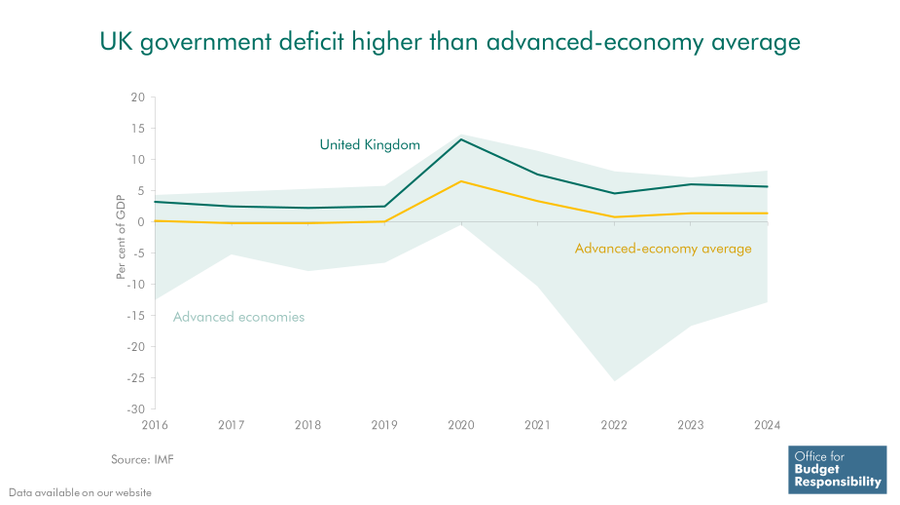
The government, through Rachel Reeves' self-imposed tight level of fiscal headroom, has "left itself very small margins against its objectives of restoring the current budget to balance and getting net financial liabilities to fall by the end of the decade".
Against this more vulnerable backdrop, "the risks to the fiscal outlook are mounting", the OBR says, including the sustainability of state and private pensions and the sector’s demand for government debt; risks to assets and liabilities on the public balance sheet and the government’s new net financial liabilities target; and the combined costs of climate damage and the net zero transition.
The triple lock has cost around 3x more than expected.
In our central projection, the triple lock explains 1.6pts of the 2.7% of GDP rise in state pension spending. If recent volatility persists, it could add a further 1.5pts; a steadier path could reduce it by 1.3pts. pic.twitter.com/GvtPn1nsnC
— Office for Budget Responsibility (@OBR_UK) July 8, 2025
10.18am: Monzo fined
The City watchdog has fined Monzo £21 million for "inadequate" controls of financial crime in recent years, and repeatedly breaching requirements preventing it from opening accounts for high-risk customers.
Amidst a period rapid growth, where the digital bank went from 600,000 customers in 2018 to almost 6 million in 2022, the Financial Conduct Authority said its "financial crime controls failed to keep pace with its customer and product growth".
The main portion of the fine relates to the period from October 2018 to August 2020, with the controls of high-risk customers lacking between August 2020 and June 2022.
"Monzo fell far short of what we, and society, expect," said Therese Chambers, FCA joint executive director of enforcement and market oversight, noting that banks are "a vital line of defence in the collective fight against financial crime" and "must have the systems in place to prevent the flow of ill-gotten gains into the financial system".
She explained that Monzo onboarded customers on the basis of limited and sometimes implausible information, such as customers using well known London landmarks as an address.
9.56am: REIT petite
Two real estate investment trusts (REITs) have had their tax-exempt status revoked by HMRC, and a growing number are in breach of their REIT status.
This is according to analysis by law firm BCLP, which has obtained data from the tax authority showing 26 breaches of the REIT tax regime were notified in 2023/24, up from just seven the previous year.
To gain REIT status, where property investment trusts are exempt from paying UK tax on the income and gains from their property rental businesses, they must distribute at least 90% of taxable rental income to shareholders as property income distributions (PIDs), which are taxed at the shareholder level.
A requirment for REITs to be listed on the stock exchange was removed last year, which has led to the number of new REITs having more than doubled.
9.26am: Funding for major road and rail schemes
Costain Group PLC (LSE:COST), Kier Group PLC (LSE:KIE) and Balfour Beatty plc (LSE:BBY) have received a boost as the UK government announced £92 billion of funding for major road schemes and rail upgrades.
More than 50 road and rail upgrades were given the green light, including the Simister Island junction upgrade near Greater Manchester, an expected £138 million contract for Costain.
The Department for Transport also gave a green light for the (apparently long-awaited) widening of the A66 Northern Trans-Pennine route, a contract where Balfour Beatty and Kier are two of the three contractors.
Rail projects getting funding include the restoration of the Portishead to Bristol city centre rail line, which has been closed since the 1980s, upgrades to the East Coast Main Line, a new Midlands Hub and three new stations in the South West and Yorkshire.
8.55am: Victrex tumbles
On the FTSE 250, Victrex PLC (LSE:VCT) fell 13% in early trades, now off around 9%, as the polymer producer posted a weak quarterly update and revealed that chief executive Jakob Sigurdsson is stepping down after almost eight years in the role,
Numbers for the third quarter of its financial year showed weaker sales volumes and further decline in selling prices led to a 3% fall in revenue to £71.5 million.
Sales into the medical sector were lower than expected, especially polymer products for spinal implants.
The board has appointed Dr James Routh, currently boss of AIM-listed AB Dynamics, as his replacement. AB Dynamics shares are down 1.2%.
8.15am FTSE opens little higher
The FTSE 100 has inched up around four points in the opening few minutes of trading to 8,810.
Miners are prominent among the risers, with precious metals pair Endeavour and Fresnollo up 2.1% and 1.5%, followed by Glencore, Anglo American and Antofagasta.
The reports of Rio Tinto's interest in pursuing M&A is adding some juice to the sector, it seems.
Bookmaker Entain is top of the early leaderboard, up 2.8%, while China-focused Prudential and Standard Chartered are also up there.
"Financial markets have reacted to news of higher US tariffs in sanguine fashion," says ING analyst Chris Turner.
US futures have recovered most of their initial losses from overnight, bond markets have "barely budged" and in FX, Asian currencies have bounced back, he adds.
"The market seems to be taking the view that nothing is final and that these letters merely mark another iteration on the journey towards a trade deal."
Using Japan as an example, Turner notes that Prime Minister Shigeru Ishiba is fighting a crucial upper house election on 20 July and "does not want to be seen to be rolling over and accepting more US rice imports. That position could potentially change after the election."
"That US equity markets can seemingly cope with this ongoing trade uncertainty is good news for risk assets and suggests that current interest in international equities and emerging markets continues."
For the forex market, Turner says that it appears that "investors are more likely to trade based on the broader economic impact of these measures rather than the measures themselves. For example, do these higher tariffs hurt business confidence even more, hit profits and result in lay-offs? Or is the dominant theme a stable labour market, businesses able to pass on costs and higher inflation?"
This latter position is his slight preference for the third quarter in the US, which he says could trigger a modest dollar rebound.
Elsewhere this morning, the Reserve Bank of Australia surprised by leaving interest rates unchanged, citing inflation being a little stickier than it would have liked, and the labour market remains tight.
7.59am: Japan trade negotiator says US deal talks are tough
Japan's chief trade negotiator has been speaking to the press as tariff negotiations with the US continue.
Ryosei Akazawa said the automobile sector is the "core" of Japan's economy and the country "cannot tolerate" the fact that 25% tariffs on automobiles and auto parts are inflicting huge losses on Japanese firms.
He indicated that there is "no point" in striking a deal with the US without it including an agreement on auto tariffs.
But meanwhile, Akazawa said he "won't sacrifice Japan's agriculture sector" for the sake of a US trade deal.
While he is fully aware trade talks with the US won't be easy as President Trump is "very tough", the negotiator says his job is to "garner trust through sincere negotiations with us, try to find common ground step by step and come up with a full package of deal as soon as possible", per translations from Reuters.
7.53am: Work on US steel deal still ongoing
UK steel suppliers are biting their fingernails ahead of the Trump's tariff deadline, as Downing Street indicated last night that a deal to protect the industry from the 50% US tariffs on the metal has not yet been sealed.
As part of the UK trade agreement signed last month at the G7 summit, Keir Starmer arranged a reduced rate of 25% but officials are continuing to work on cutting this to zero.
Number 10 would not confirm whether or not it was confident that the steel tariffs would be eliminated before the 9 July deadline.
7.43am: Rio open to big deals
Reuters is reporting that Rio Tinto Ltd (LSE:RIO, ASX:RIO, OTC:RTNTF) is nearing the appointment of a new chief executive officer, with a decision expected later this month, following CEO Jakob Stausholm's announcement in May that he is stepping down.
Chair Dominic Barton is prioritising candidates who are open to major merger and acquisition opportunities and focused on improving internal cost discipline, according to the report, which cites sources familiar with the search process.
Barton has discussed the possibility of “big ticket M&A” with stakeholders. Rio Tinto was previously approached by Glencore over an asset combination, but the talks ended quickly.
Analysts have speculated that such deals could be back on the table, and say any acquisition strategy may depend on the company’s share price performance, with RBC Capital Markets estimating that capital spending of between $30 billion and $35 billion over the next decade, with lithium growth projects perhaps pushed aside in favour of copper.
7.36am: Trump letters seen as negotiating tactic
Markets seem to be perceiving that President Trump's tariff letters are a "negotiating tactic designed to create urgency", says analyst Kyle Rodda at Capital.com. "There’s certainly merit in that idea."
The White House has given trading partners until 1 August to unilaterally cut their tariffs on the US or strike a better deal with the US to avoid the tariff hikes.
"There appears to be wiggle room that the US is extending to finally broker some sort of agreement. Nevertheless, given the markets were pricing-in effectively deals across the full universe of US trading partners, or at least an extension without further tariff hikes, risk appetite has diminished significantly," Rodda says.
Wall Street stocks fell across the board last night, with cyclicals leading the declines.
With so much good news already baked into prices, "there’s fear that equities could have further to fall if the tariff letters today are an omen of things to come", he adds.
"Unlike Liberation Day however, the US dollar has rallied across the board, largely at the expense of those currencies belonging to countries at the wrong end of tariff hikes today. Gold prices have still managed to climb despite the resurgent US dollar, indicative of the global growth risks and diminished confidence in US assets."
Yesterday it was oil prices shrugging off the production hike. Today's it's stocks ignoring Mr Tariff Letter in the expectation that TACOs are still being served.
— Chris Beauchamp (@ChrisB_IG) July 8, 2025
7.15am: FTSE 100 called slightly lower as Trump sends tariff letters
The FTSE 100 has been called lower again on Tuesday after Donald Trump sent letters to 15 nations, including Japan, South Korea and South Africa, warning that they will face 'reciprocal' tariffs of between 25% and 40% from next month.
Futures for London's blue-chip index, made up of many multinationals exposed to world trade, have dropped only 10 points though, on top of the 16 points lost the day before that saw the benchmark close at 8,806.5.
US stocks closed lower overnight, with the Dow Jones and Nasdaq Composite falling 0.9% and the S&P 500 slipping 0.8%.
Asian markets are mostly green this morning, with Japan's Nikkei up 0.35%, Korea's Kospi jumping 1.7% and the Hang Seng rising 0.8%.
"We’re back to square one in terms of the US tariff disaster," said market analyst Ipek Ozkardeskaya at Swissquote Bank, "the rates don’t look much different from those announced on the so-called Liberation Day."
She added that "markets remain on a surprising wave of optimism that defies the renewed tensions Asian tariffs will place on supply chains and prices."
6.15am: What to watch on Tuesday 8 July
In Tuesday's City diary, the only FTSE 250 reporter scheduled is Unite Group PLC (LSE:UTG), the student accommodation developer that has seen its shares struggling to break away from their lows this year amidst changes in stamp duty, concerns over energy efficiency regulations and a slowdown in international student numbers.
At this update, shareholders and analysts will be looking for any comments on the guidance for this year, having previously indicated 97-98% occupancy, 4-5% rental growth for the 2025/26 academic year and adjusted earnings per share growth of 2-4%.
Among the macroeconomic data, there are no significant UK releases until Thursday and Friday this week.
Announcements expected:
Interims: Synectics, Unite Group
Finals: Celebrus Technologies, DSW Capital, Optima Health, Solid State
Economic announcements: Balance of Trade (GER), NFIB smaller companies survey (US)