
archTIS Ltd (ASX:AR9, OTCQB:ARHLF) is ramping up its global presence with a suite of secure information-sharing tools tailored for the world’s most sensitive data environments — from classified defence systems to tightly regulated enterprise networks.
These environments demand more than conventional cybersecurity. Defence, intelligence and critical infrastructure organisations must protect mission-critical information from insider threats, foreign interference, and cross-jurisdictional data exposure. In this context, dynamic, policy-driven access control is not merely an advantage — it is essential.
Operating within the fast-growing data-centric security segment of the $225 billion global cybersecurity market, archTIS is targeting a $2 billion opportunity across defence, government and enterprise sectors. Its software suite delivers zero-trust data-centric security, enabling sensitive data to be accessed and shared only under strict, context-aware conditions.
With annual recurring revenue up 26% last year and a scalable, high-margin software model, the company is leveraging growing demand for sovereign, compliant collaboration platforms across the Five Eyes alliance, critical infrastructure, and Fortune 500 firms.
Backed by a network of global partnerships and a strategic focus on zero-trust architecture, archTIS is gaining traction as a security-first alternative to mainstream collaboration platforms.
A clear niche in secure collaboration
Founded in Canberra and led by a team with deep roots in national security, archTIS has carved out a defensible niche in the global cybersecurity market: securing the collaboration of classified, regulated and sensitive data.
Unlike many cyber vendors focused on perimeter defence or endpoint detection, archTIS zeroes in on how sensitive files are accessed, used and shared — both within and between organisations.
Its three flagship platforms are designed to address specific challenges in data sharing:
- Kojensi: A multilateral secure content platform purpose-built for use in classified environments. Kojensi enables agencies to share Top Secret and Protected-level files across government, defence, and allied partners, and is in use across Australian national security and defence agencies.
- NC Protect: A dynamic access and data protection platform for Microsoft 365, SharePoint, Teams and file shares. NC Protect allows enterprises and military clients to automate content access and encryption based on user role, device, location, and data sensitivity.
- Trusted Data Integration (TDI): A policy-based access orchestration tool built from the recently acquired Direktiv technology, designed for use across classified environments, defence contractors and critical infrastructure networks.
These platforms share a core architecture based on Attribute-Based Access Control (ABAC), which enables data owners to apply dynamic, risk-based security rules to each file or message. This allows for highly granular and context-aware control over sensitive information.
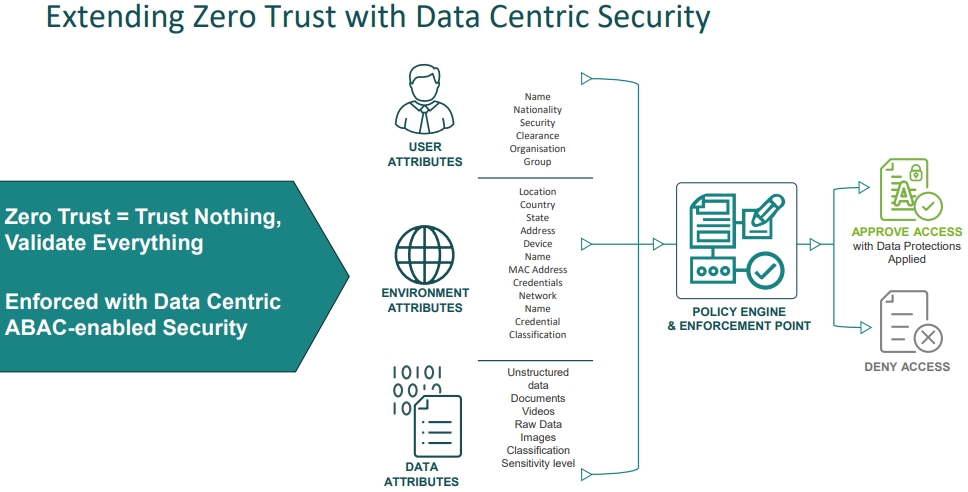
“Trust, not technology, is the greatest obstacle to sharing and collaborating on information,” the company said in a recent investor presentation. Its mission is to empower information owners to control their own policies governing data access and use. “We implement zero-trust, data-centric security to deliver dynamic, risk-based access to share and collaborate on sensitive and classified information.”
Expanding global footprint and high-value contracts
archTIS’s recent wins underscore its rising profile in the defence, intelligence and security sectors. Major milestones include:
- US Department of Defense contract for NC Protect: In June 2025, archTIS secured an initial contract to provide 1,000 user licenses of its NC Protect software to the US Department of Defense (DoD), valued at A$38,500 over six months. The agreement serves as a precursor to a potential broader rollout, with discussions under way for a first-phase deployment to 150,000 users across the DoD's warfighter network. A successful expansion would increase archTIS’s global NC Protect user base sixfold and support long-term revenue growth into the 2026 financial year (FY).
- Australian Department of Defence expansion of Kojensi: Following the March 2025 quarter, the Australian Department of Defence renewed and expanded its commitment to archTIS's Kojensi platform through a sole-source contract valued at about A$1.3 million. This renewal includes a 75% increase in user licenses, underscoring Kojensi's critical role in secure information sharing within the department.
- First major TDI sale in Japan: archTIS licensed its Trusted Data Integration (TDI) platform to a Japan-based customer for A$390,000 annually. This deal, the first TDI transaction following archTIS’s integration of Direktiv technology, also represents the company’s entry into the Japanese market. Notably, the sale was sourced through Microsoft’s Defence and Intelligence team and a large channel partner, highlighting the growing reach and influence of archTIS’s strategic alliances.
These projects build on a growing portfolio that includes clients such as:
- Australian Attorney-General’s Department
- Australian Federal Police
- Thales, Northrop Grumman and SAP
- National security agencies across the US, UK and Australia
Such relationships — many of which involve multi-year, scalable contracts — provide a solid base of recurring revenue and lend the company credibility in other regulated sectors.
Financial momentum and strategic focus
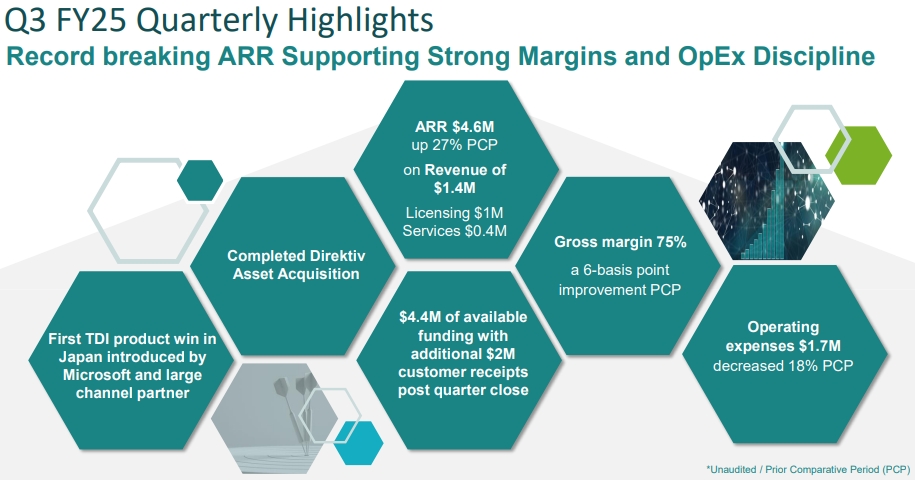
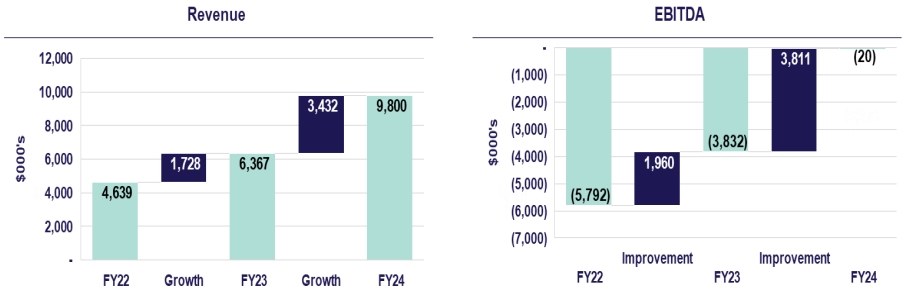
archTIS is coming off a period of strong revenue growth and tightened operational discipline. Annual recurring revenue (ARR) reached A$4.6 million in the third quarter of FY25, up 27% on the prior corresponding period, supported by quarterly revenue of A$1.4 million — including A$1 million from licensing.
Gross margins improved to 75%, with operating expenses reduced 18% year-on-year to A$1.7 million. The company ended the quarter with A$4.4 million in available funding and received a further A$2 million in customer receipts post-quarter.
archTIS has also announced a $7.5 million equity placement to accelerate its US expansion, scale post-sales support systems, and deepen its investment in strategic partnerships and product development. Use of funds is split across:
- US expansion and customer onboarding (A$3 million)
- Strategic partnerships and co-marketing (A$1.5 million)
- Product roadmap development, artificial intelligence (AI) capabilities and security certifications (A$3 million)
This capital will support the company’s ambition to grow its footprint in the US, UK, and allied markets while embedding advanced analytics, automation and sovereign control into its product suite.
Positioned in a fast-growing market
archTIS operates within the rapidly growing data-centric security segment of the broader $225 billion global cybersecurity market. Management estimates its available market at around $2 billion, with a target addressable opportunity of $200 million.
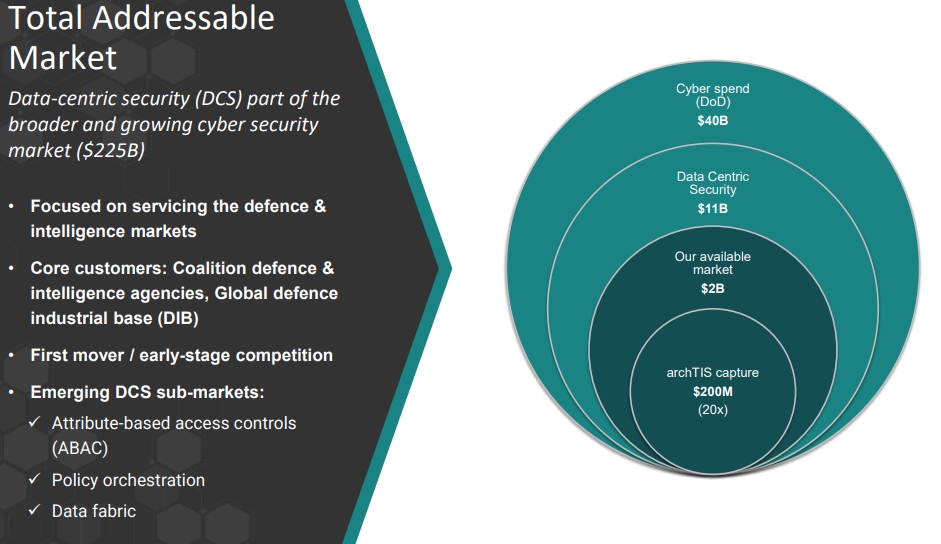
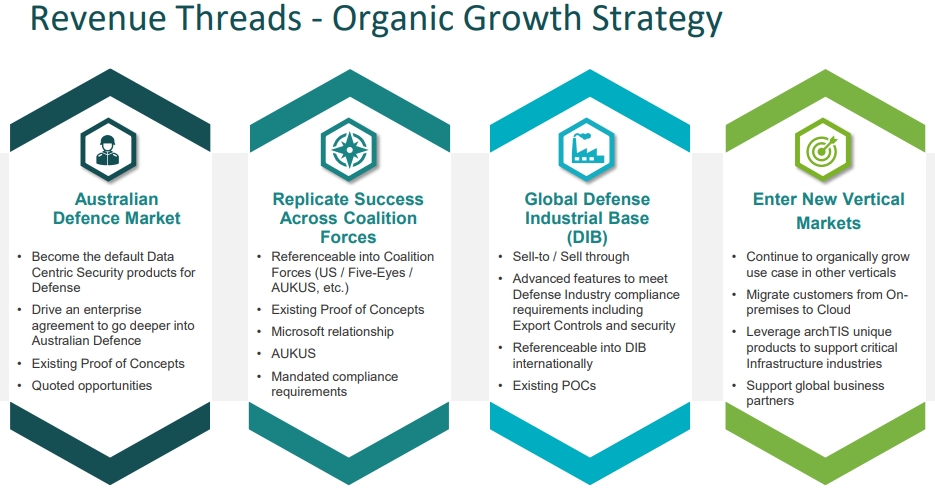
Defence and intelligence remain core focus areas. The company is positioning to become the default provider of data-centric security solutions to the Australian Department of Defence, and to replicate this model across coalition forces and global defence industrial base (DIB) contractors. Its current roadmap includes expanding proof-of-concepts with US and UK agencies, NATO, and Japanese defence industry partners.
The architecture of archTIS’s offerings — particularly ABAC and policy-driven access control — also aligns with compliance frameworks like AUKUS, CMMC, and JADC2, which govern how sensitive and classified data is handled across jurisdictions.
While government and defence remain its foundation, archTIS is also targeting adjacent commercial verticals such as banking, critical infrastructure, and IP-intensive industries, where the need for dynamic, policy-based access control is growing.
A platform built for strategic growth
With a focused product suite, a strengthening financial profile and active expansion into high-trust global markets, archTIS is gaining traction as a trusted provider of secure, compliant collaboration.
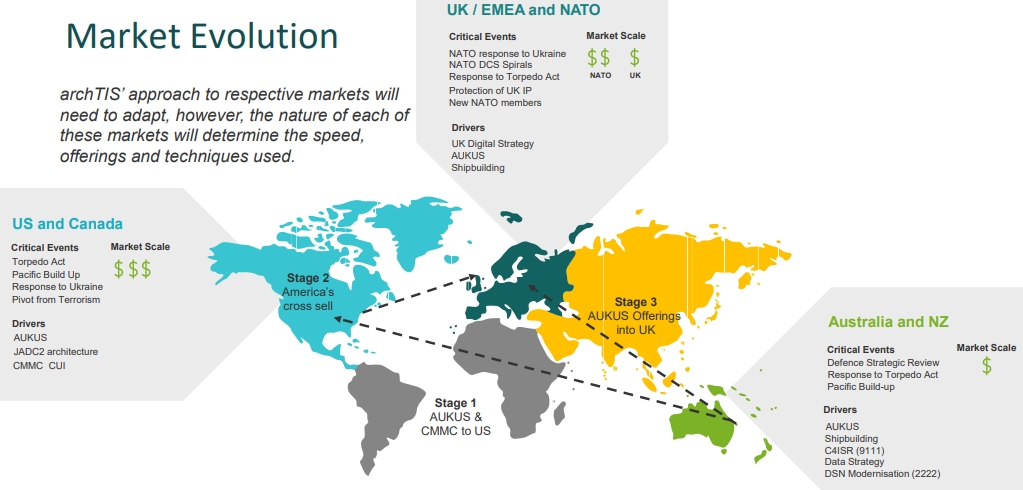
Its value proposition lies in how it treats data security not as a static firewall or permissions problem, but as a dynamic policy-driven ecosystem. By putting control in the hands of information owners and enforcing access through contextual policies, archTIS offers an architecture well suited to modern zero-trust mandates.
With governments and enterprises seeking out sovereign, scalable and standards-compliant alternatives to legacy collaboration systems, archTIS is poised to expand its global footprint and capture a meaningful share of the growing market for data-centric security.