
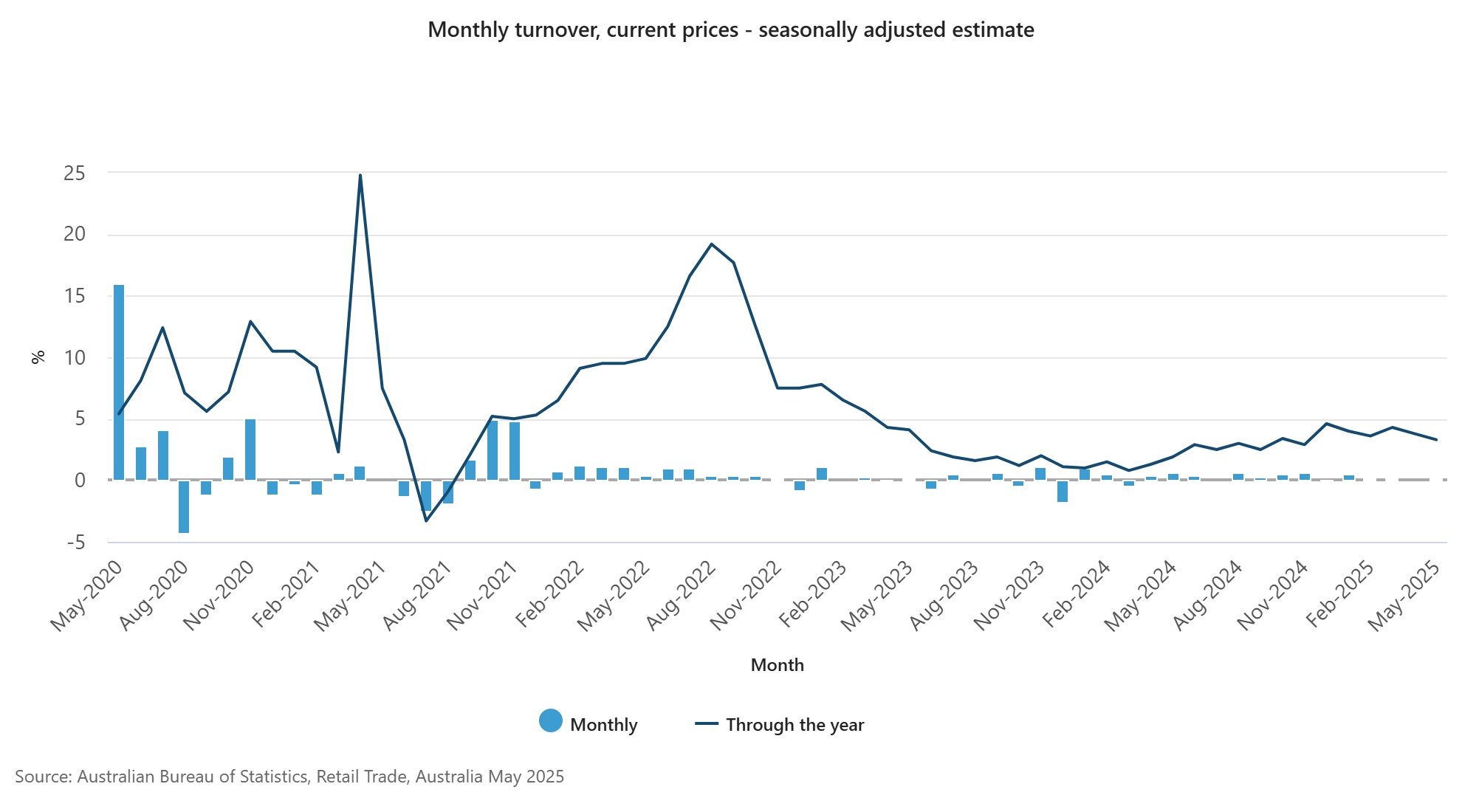
Retail sales in Australia rose by just 0.2% month-on-month in May 2025, according to data released on Wednesday by the Australian Bureau of Statistics (ABS). The result, which fell short of market expectations, underscores a continued trend of consumer caution as the nation grapples with cost-of-living pressures, analysts said.
Although sales were 3.3% higher compared with the same month last year, the annual growth rate has steadily eased through 2025, highlighting a slowing pace of retail activity.
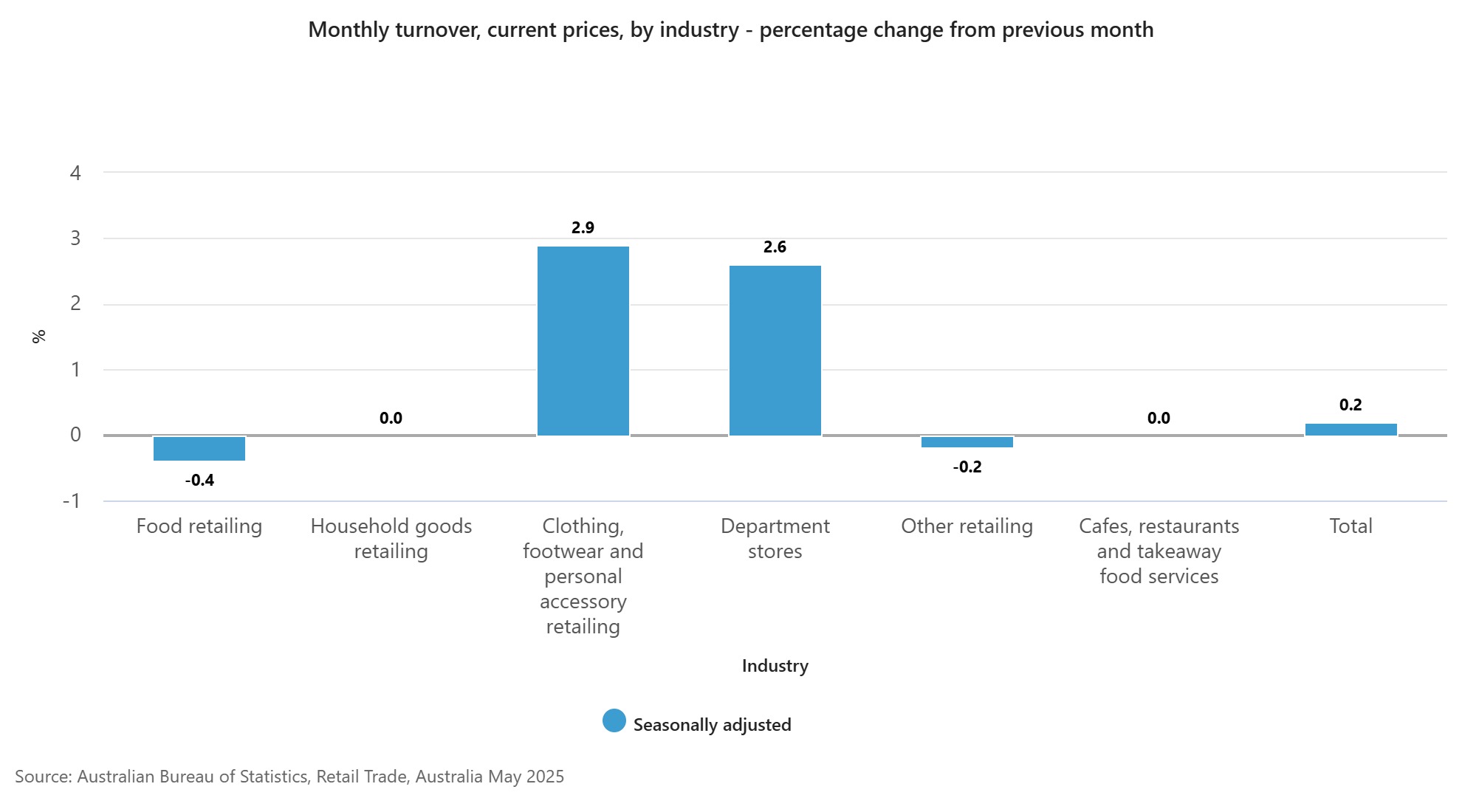
The modest rise in May was primarily driven by seasonal winter clothing purchases, which helped boost clothing and department store sales. These categories recorded increases of 2.9% and 2.6%, respectively.
However, food retailing experienced a decline of 0.4%, marking the second consecutive month of weakness in this sector, which had previously been a strong contributor to growth in early 2025. In addition, household goods and cafes & restaurants remained flat, further indicating subdued consumer spending across multiple categories.
Retail outlook: Consumer behaviour and RBA rate cuts
Despite the slight uptick in May, retail sales growth remains well below the rates seen earlier in 2025.
"Retail sales remain soft, with trend growth at just 0.1% month-on-month, suggesting ongoing consumer caution," noted Ivan Colhoun, chief economist at CreditorWatch. "Most categories recorded weak or no growth this month excluding clothing, footwear and accessories (+2.9% m/m) and department stores (+2.6% m/m), both of which bounced back from very weak April sales due to warmer-than-seasonal weather in that month.”
The ongoing weakness in retail spending has heightened expectations of further interest rate cuts by the Reserve Bank of Australia (RBA).
"The case for an RBA interest rate cut is strengthening, with another 25-basis-point cut to 3.6% likely at next week’s meeting," Colhoun said. "This is in response to subdued retail data and flat household spending trends."
Westpac economist Neha Sharma also weighed in on the retail outlook, highlighting the significant gap between expectations and reality.
"Retail trade rose a mere 0.2% month-on-month in May, following an upwardly revised flat outcome for April," she noted. "Spending continued to disappoint through the second quarter, with turnover up just 0.4% across the first two months of Q2 compared to the same period in Q1."
Sharma also pointed out that consumer sentiment, particularly regarding family finances, has trended lower throughout the year. This suggests a cautious spending mindset may persist for even longer, despite the lower rate profile and a healthy labour market.
Looking ahead: EOFY sales and broader consumption trends
The end-of-financial-year (EOFY) sales period is expected to bring a boost to retail activity, as consumers seek discounts to alleviate the ongoing cost-of-living pressures. Colhoun anticipates strong EOFY results, particularly in categories like clothing and department stores, which could help lift overall sales figures in June.
"One thing I’m looking for is much stronger-than-normal EOFY retail sales in June as consumers seek discounts to counter the cost-of-living pressures they are experiencing," he said. “This was in evidence in strong results in Black Friday and Cyber Monday sales promotions last year.”
While May’s retail sales showed a slight improvement, the broader trend remains one of consumer restraint.
With the RBA expected to continue easing monetary policy in the coming months, the hope is that these measures will support a gradual recovery in consumer spending through the second half of 2025 and into 2026. However, as Colhoun and Sharma noted, the path to recovery may be slow and dependent on more sustained improvements in consumer confidence and sentiment.