
Constellation Resources Ltd (ASX:CR1) has confirmed significant natural hydrogen (NatH₂) potential at its Edmund-Collier Project in Western Australia, following reprocessing of historical seismic data and receipt of the final batch of Total Organic Carbon (TOC) results.
The Edmund-Collier Project is the first serious attempt to explore for natural hydrogen across a vast and largely underexplored basin that has yet to see any deep drilling activity.
The absence of deep drilling to date positions Edmund-Collier as a new frontier for natural hydrogen exploration. Recent seismic cross-section interpretations indicate that the organic-rich Blue Billy and Discovery Formations extend across the Edmund-Collier Basin and may offer strong potential for large-scale natural hydrogen generation, supported by favourable source rock quality and thermal maturity analysis. Notably, the Edmund-Collier Project spans 37,288 square kilometres and is flanked by gas transmission infrastructure.
The company is now looking to start a basin-wide soil gas survey to detect potential microseepage of hydrogen and related gases.
Seismic interpretation reveals key formations and structural targets
Reprocessed seismic data has delivered enhanced geological clarity across the Edmund-Collier Basin.
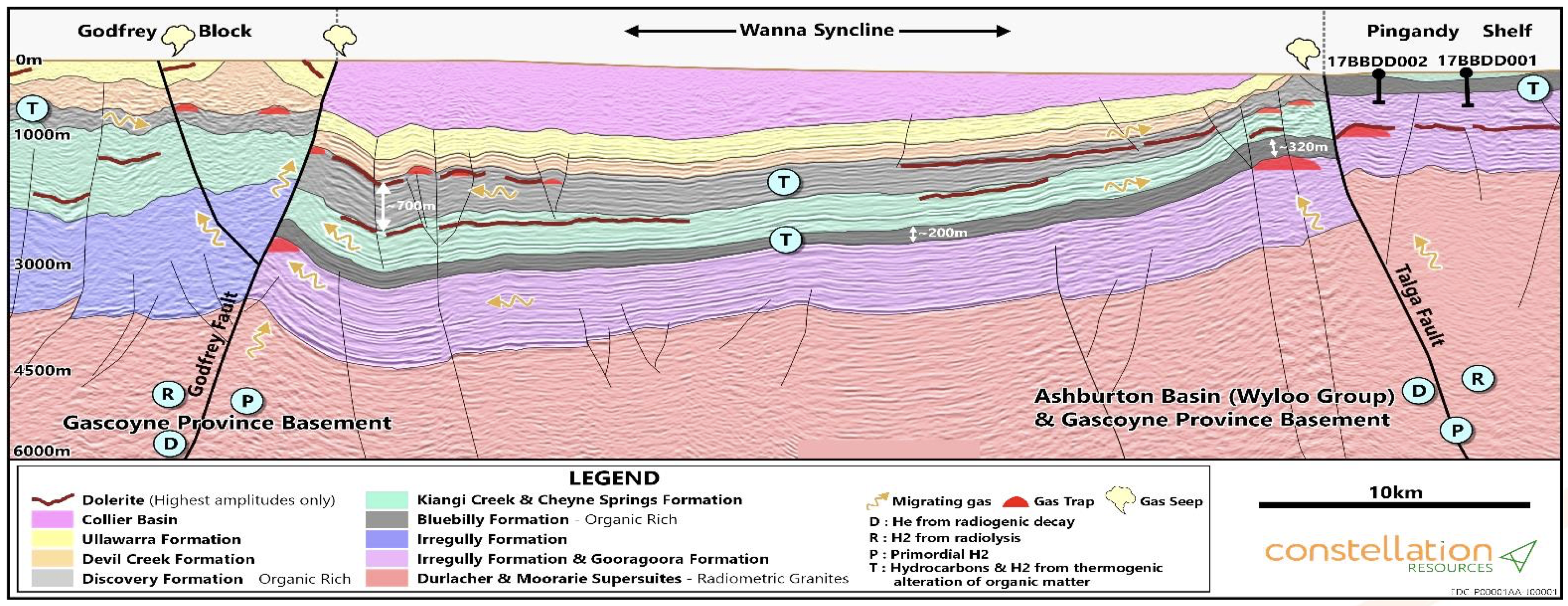
Edmund Collier Conceptual Hydrogen System Against Reprocessed Seismic Image.
Seismic line 10GA-CP2, originally acquired in 2010 by Geoscience Australia and the Geological Survey of Western Australia (GSWA), transects the entire Edmund-Collier Basin and the project area. The reprocessing of this open-file dataset — led by Howman Seismic and Thunderstone Energy — aimed to optimise resolution within the top 4 kilometres. Geological interpretations were completed by Good Earth Geological Consulting and Thunderstone Energy.
The revised imaging reveals a maximum basin depth of approximately 4.2 kilometres within the Wanna Syncline, overlying the Ashburton and Gascoyne Province basement units. Notably, the organic-rich Blue Billy and Discovery Formations are interpreted to extend across the basin, thickening up to 700 metres within the syncline. These formations are considered prospective for large-scale NatH₂ generation based on favourable source rock quality and thermal maturity.
Structural targets and hydrogen system elements
The reprocessed seismic data also highlights the Godfrey and Talga Faults — deep, regional structures interpreted to extend from basement to surface. These faults represent key targets for surface soil gas sampling to assess the presence of hydrogen seepage.
Collectively, the structural and stratigraphic features identified confirm that the Edmund-Collier Project area contains all necessary elements for a viable NatH₂ system: suitable source rocks, migration pathways, reservoir rocks, sealing units and structural traps.
Hydrogen generation is anticipated from two primary sources:
- Basement rocks via radiolysis (potentially co-generating helium); and
- Thermogenic processes within organic-rich shales, further boosting the project's exploration potential.
Thermogenic hydrogen potential
The final batch of Total Organic Carbon (TOC) results from eight diamond drill holes across the Edmund-Collier Project reaffirm for Constellation the presence of highly organic-rich shale units suitable for thermogenic hydrogen generation.
High TOC values across broad intervals
Analysis by Core Laboratories on the second batch of core samples — taken systematically from organic-rich intervals — delivered strong TOC values across several formations, notably the Discovery Formation. Key intercepts include:
- DDH2: Five samples across a 141 metre interval (0–186 metres) returned TOC values from 0.92% to 8.40%, averaging 5.24%.
- DDH3: Eight samples over 74 metres (0–115 metres) yielded 2.06% to 7.56%, averaging 4.17%.
- DH13: Five samples across 57 metres (0–78 metres) returned 2.15% to 4.29%, averaging 2.81%.
- ISBD2: Eleven samples from a 193 metre interval (0–291 metres) through the Discovery or Kiangi Creek Formation reported values between 0.49% and 5.17%, averaging 2.33%.
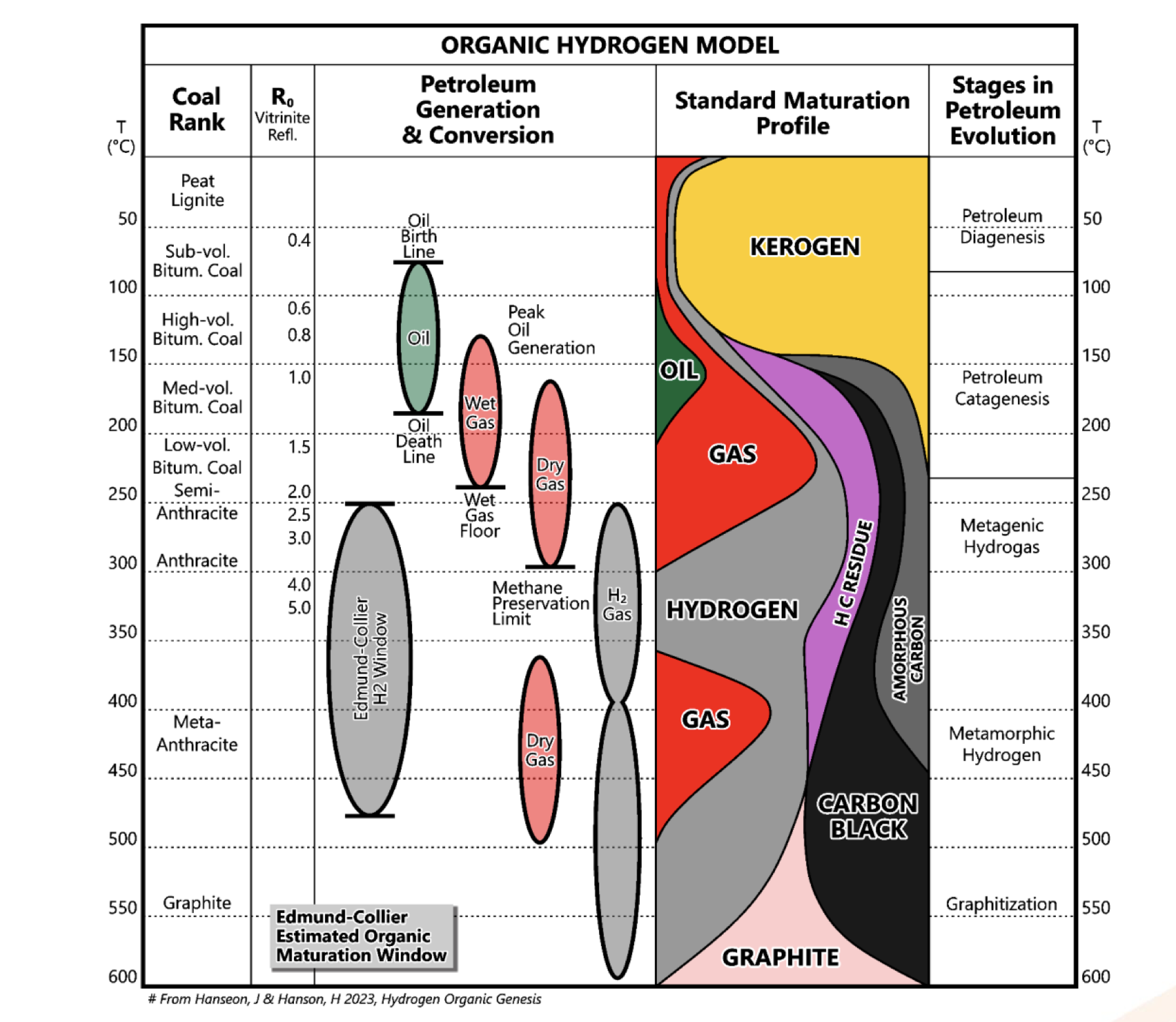
Hydrogen generation model (Hanson & Hanson, 2023) with interpreted Edmund-Collier Maturation Window Plotted.
Favourable conditions for thermogenic hydrogen generation
The Edmund-Collier Basin, particularly within the 4 kilometre-deep Wanna Syncline, presents the thermal maturity required for hydrogen production. Scientific studies, including work by Hanson and Hanson (2023), indicate that hydrogen can be generated from the degradation of organic matter in shales subjected to temperatures between 250°C and 500°C — conditions likely met in this basin.
Underexplored hydrogen frontier
The Wanna Syncline, a major structural feature extending more than 300 kilometres east-west and 40 kilometres north-south, remains undrilled at depth. Its scale and thermal profile support its potential as a new frontier for natural hydrogen exploration in Western Australia.
Porosity results support reservoir potential across formations
Initial porosity measurements on 63 core plugs show highly variable but locally strong results across key formations. The Blue Billy Formation returned porosity values up to 6.84%, while the Discovery and Kiangi Creek Formations recorded maximums of 13.24% and 32.23% respectively. Irregully and Gooragoora Formations also yielded encouraging results up to 10.91%.
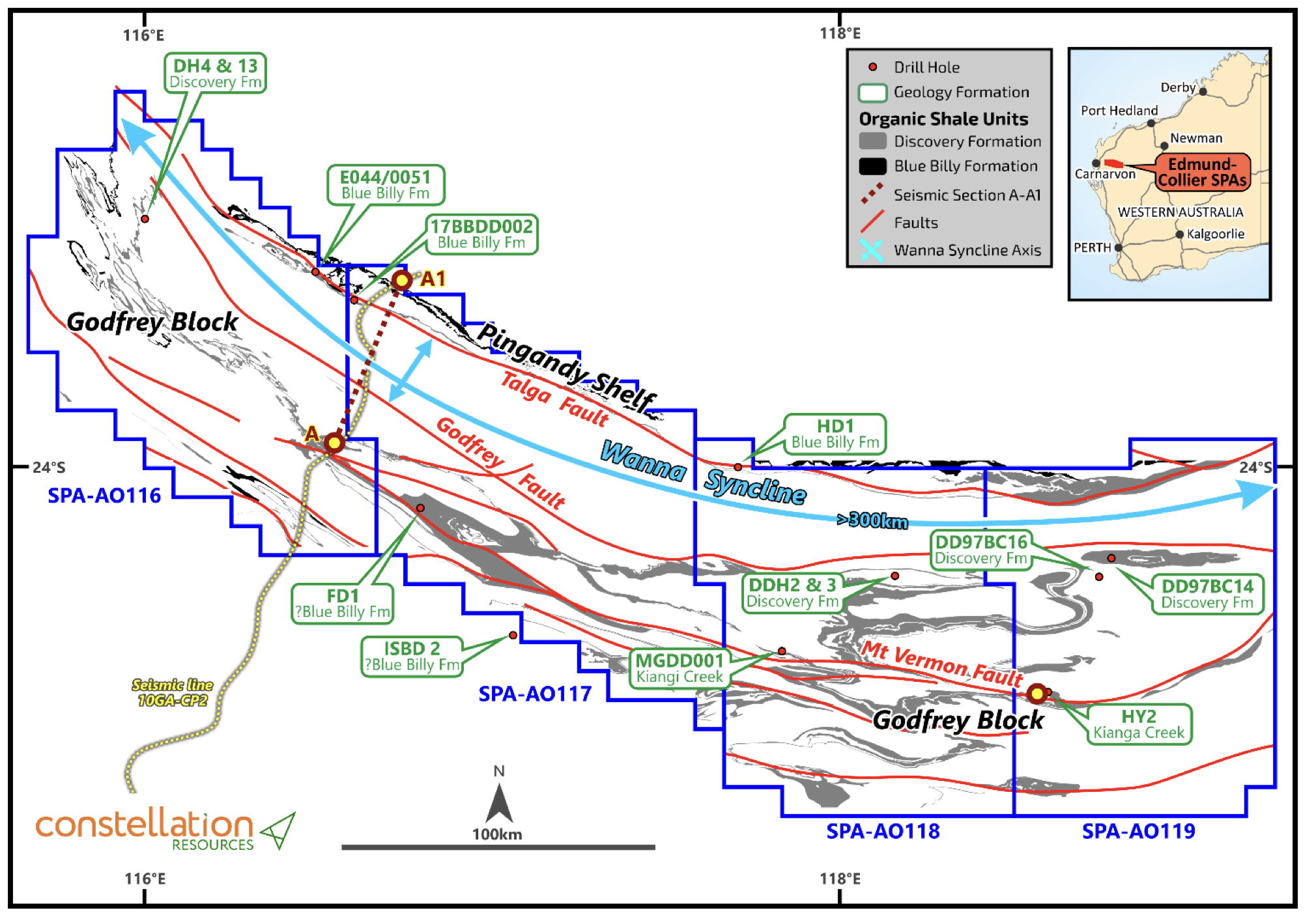
Edmund-Collier Basin outcropping organic-rich shale units and drill hole sample locations.
While the porosity is heterogeneous, these values indicate potential for viable hydrogen storage reservoirs. Additional sampling and analysis are planned to better understand spatial variability and connectivity within these formations. The porosity data complement TOC and seismic results, further supporting the viability of a working hydrogen system in the basin.
Forward work plan
Future work includes a basin-wide soil gas survey aimed at detecting microseepage of hydrogen and helium, followed by potential deep drilling.
The company will also progress regulatory and native title processes for its SPA-AO applications, ahead of converting tenure to a Petroleum Exploration Permit (PEP) for advanced exploration.