
St George Mining Ltd (ASX:SGQ) has launched a new phase of geophysical exploration at its 100%-owned Araxá Niobium and Rare Earth Elements (REE) Project in Brazil. The program, which includes high-resolution magnetic and seismic surveys, is designed to pinpoint additional high-grade mineralisation and structural controls at the project.
Enhanced geophysical approach to support resource expansion
The ongoing geophysical work aims to support an expansive drilling campaign currently under way at the Araxá Project. The initiative follows previous drilling results that confirmed high-grade zones, including assays of up to 8% niobium pentoxide (Nb₂O₅), 33% total rare earth oxides (TREO), and 32% phosphorous pentoxide (P₂O₅).
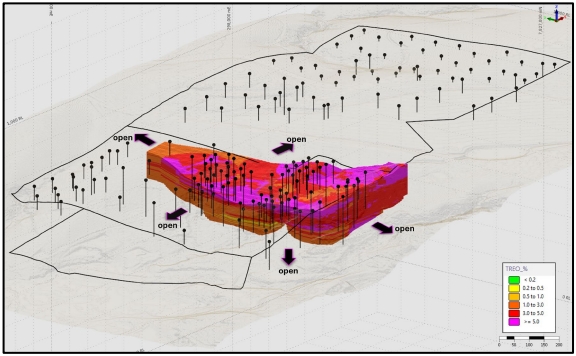
3D perspective of the Araxá Project MRE – TREO% grades (looking north-east). The MRE remains open in all directions, with the new geophysical data aimed at identifying priority areas for resource expansion drilling.
The new surveys are expected to improve the targeting of these high-grade mineralised zones, with results directly influencing future resource definition drilling.
The geophysical program includes two key components: an airborne magnetic survey and a passive seismic survey.
The magnetic survey, which is already in progress, is being conducted with a tight 25-metre line spacing across key target areas. This high-resolution approach is designed to reveal detailed magnetic variations associated with mineralisation, lithological boundaries and structural features.
The seismic survey, set to begin in the coming weeks, will employ Horizontal-to-Vertical Spectral Ratio (HVSR) techniques to map the depth to fresh, unweathered basement rock. This is particularly crucial as the higher-grade mineralisation tends to occur within the weathered regolith.
Resource potential remains open
John Prineas, St George Mining’s executive chairman, noted the potential of the geophysical data to unlock further value at the Araxá Project.
“With less than 10% of the project area effectively tested by drilling and very limited drilling beyond 100 metres from surface, the new geophysical dataset will give invaluable information for exploration targeting and resource definition drilling,” he said.
The Araxá Project remains open in all directions, and the company expects that the high-resolution data will significantly enhance its geological model and exploration strategy.
The integrated use of drone magnetics, passive seismic surveys and the ongoing 10,000-metre drilling campaign will provide a multi-dimensional view of the project’s geology.
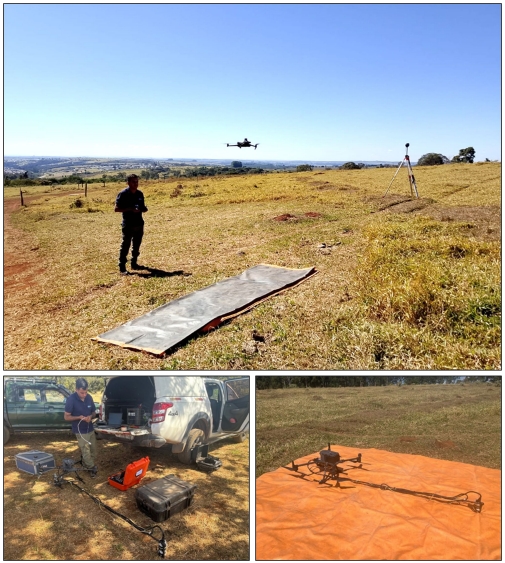
First flight marking the commencement of the drone airborne magnetic survey at the project.
Together, these techniques will help define mineralisation more accurately and identify new high-priority targets for drilling.
Resource and infrastructure advantages at Araxá
The Araxá Project, located in Minas Gerais, Brazil, is adjacent to CBMM’s world-class niobium mining operations, with high-grade niobium and rare earths confirmed by past drilling results. St George’s maiden JORC-compliant mineral resources estimate, announced in April 2025, confirmed the project’s potential as a globally significant source of niobium and rare earths, with a total resource of 41.2 million tonnes at 0.68% Nb₂O₅ and 40.6 million tonnes at 4.13% TREO.
The project benefits from excellent access to infrastructure, a skilled workforce, and government support for expedited approvals, all of which provide a strong foundation for continued exploration and future development. The combination of new data from the geophysical surveys and ongoing drilling will be key to expanding the resource base and advancing the project toward development.