
Australian businesses are facing ongoing challenges, with retail and manufacturing sectors reporting deteriorating conditions to post-global financial crisis (GFC) lows. Although inflation is easing, the broader business environment remains sluggish, exacerbated by rising energy costs earlier this year and ongoing uncertainties in global trade.
While the unemployment rate remains at a low 4.1%, which is supportive of consumer spending, business activity is still struggling to gain momentum, CreditorWatch has warned in a recent economic update. According to the company’s chief economist, Ivan Colhoun, the outlook remains weak despite these positive employment figures.
RBA set to deliver third rate cut of 2025
With inflation figures coming in lower than expected in May, the Reserve Bank of Australia (RBA) is poised to implement a widely expected third interest rate cut in 2025, Colhoun noted. The anticipated 0.25% reduction, expected at the bank’s July 7-8 meeting, would bring the cash rate to 3.1%–3.35% by year-end.
The move would aim to stimulate business activity and ease the pressure from ongoing cost concerns, especially in light of rising energy prices earlier in the year. Colhoun noted that these rate cuts should provide much-needed relief, even as broader economic conditions remain weak.
Oil prices stabilise after Middle East volatility
Oil prices, which spiked to nearly US$80 per barrel in June amid geopolitical tensions in the Middle East, have since stabilised at around USD $68.
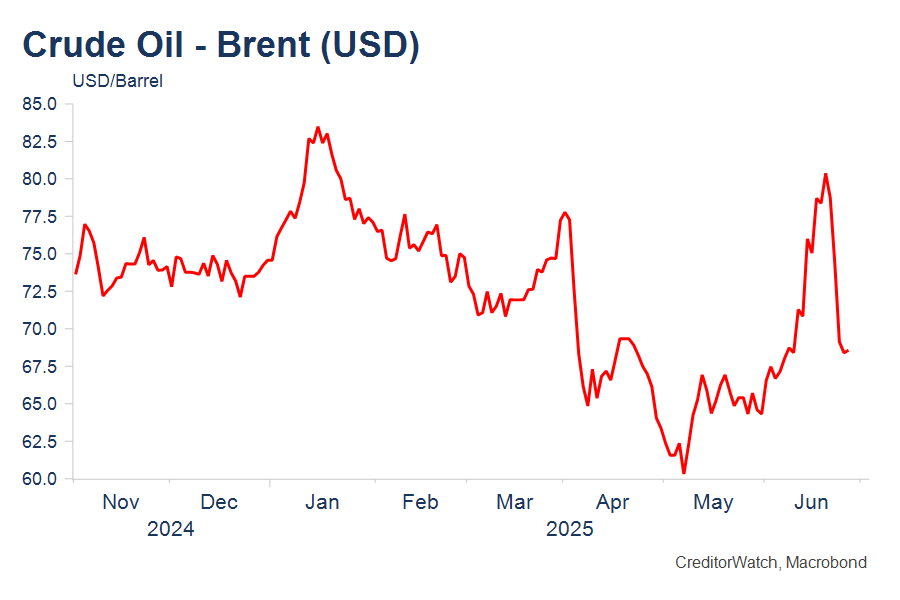
“Like the April tariff announcements, which were relatively quickly reversed or paused temporarily, the hostilities between Iran and Israel also relatively quickly de-escalated into a ceasefire following the US’ targeted attacks on Iran’s nuclear facilities,” Colhoun said.
The return to more stable prices provides some reprieve for businesses that have been grappling with the rising cost of energy inputs.
While the short-term shock has passed, Colhoun noted that the overall geopolitical situation continues to create uncertainty for global markets.
“Geopolitical pressures and related uncertainties are one of the five megatrends we see dominating the longer-run evolution of businesses and economies in the coming decade (the others are AI and technology, the ageing population, climate change and the energy transition, and rising inequality),” he said. “Reflecting the increased geopolitical uncertainty, defence spending is a key growth area in the economy globally and, along with AI spending, is currently a support for growth as tariffs work in the other direction.”
Business conditions worsen despite low unemployment
Although Australia’s unemployment rate remained steady at 4.1% in May, supporting consumer confidence, business conditions have deteriorated sharply. According to the NAB business conditions index, conditions have fallen to post-GFC lows, excluding the pandemic period.
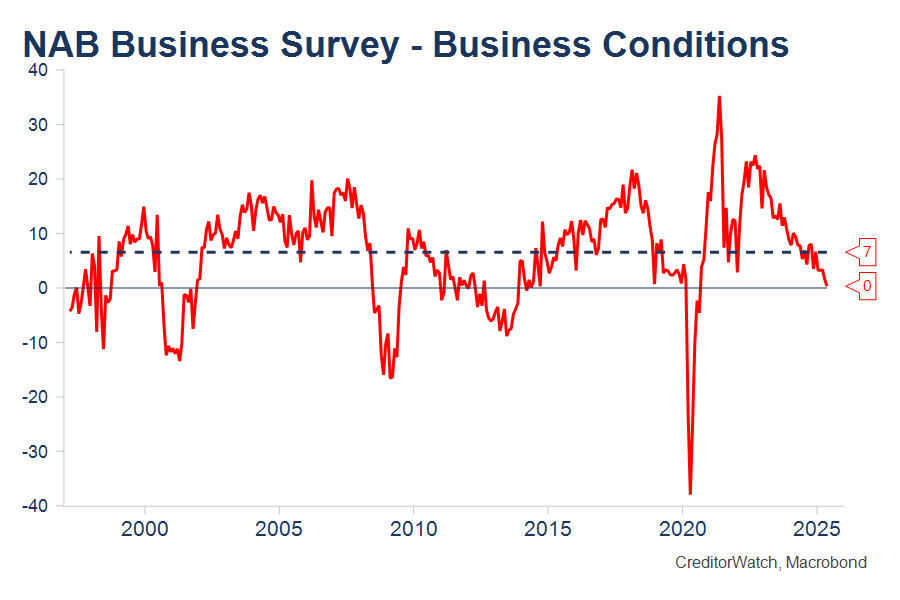
Retail and manufacturing sectors are particularly struggling, facing significant pressure due to rising costs and ongoing uncertainty about global trade conditions.
Colhoun acknowledged that while the unemployment rate supports consumer spending, business sentiment has worsened, and further support may be needed from the RBA’s rate cuts to help reverse the trend.
Insolvencies plateau at elevated levels
Insolvencies and business-to-business (B2B) payment defaults have levelled off at elevated levels in recent months, according to CreditorWatch data. Colhoun attributed this stabilisation to mid-2024 tax cuts and ongoing government support measures aimed at alleviating cost-of-living pressures.
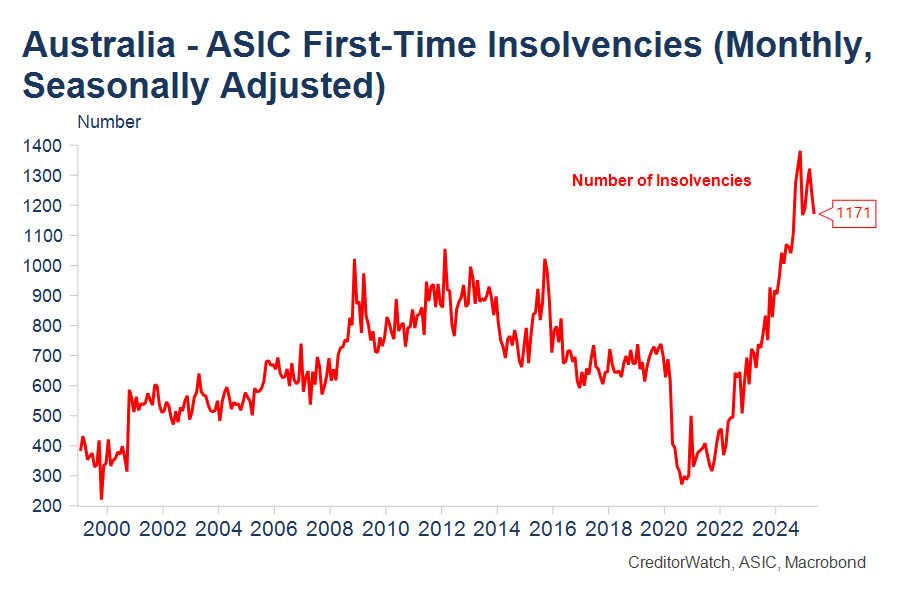
However, despite the easing in insolvency rates, Colhoun warned that elevated levels of business failures may persist in the short term. Further interest rate cuts are expected to provide additional relief to businesses and offset some of the negative impacts of tariffs and other external pressures.
Geopolitical and trade uncertainties persist
The outlook for Australian businesses remains clouded by ongoing geopolitical risks, including tensions in the Middle East and the looming risk of tariff hikes.
As trade deals between the US and other nations approach the July 9 deadline, Colhoun noted that Australia’s trading partners, including China and Japan, could face higher tariffs if agreements are not finalised.
While there is hope for tariff relief in the longer term, businesses may continue to face pressures from higher costs and global economic uncertainty.