
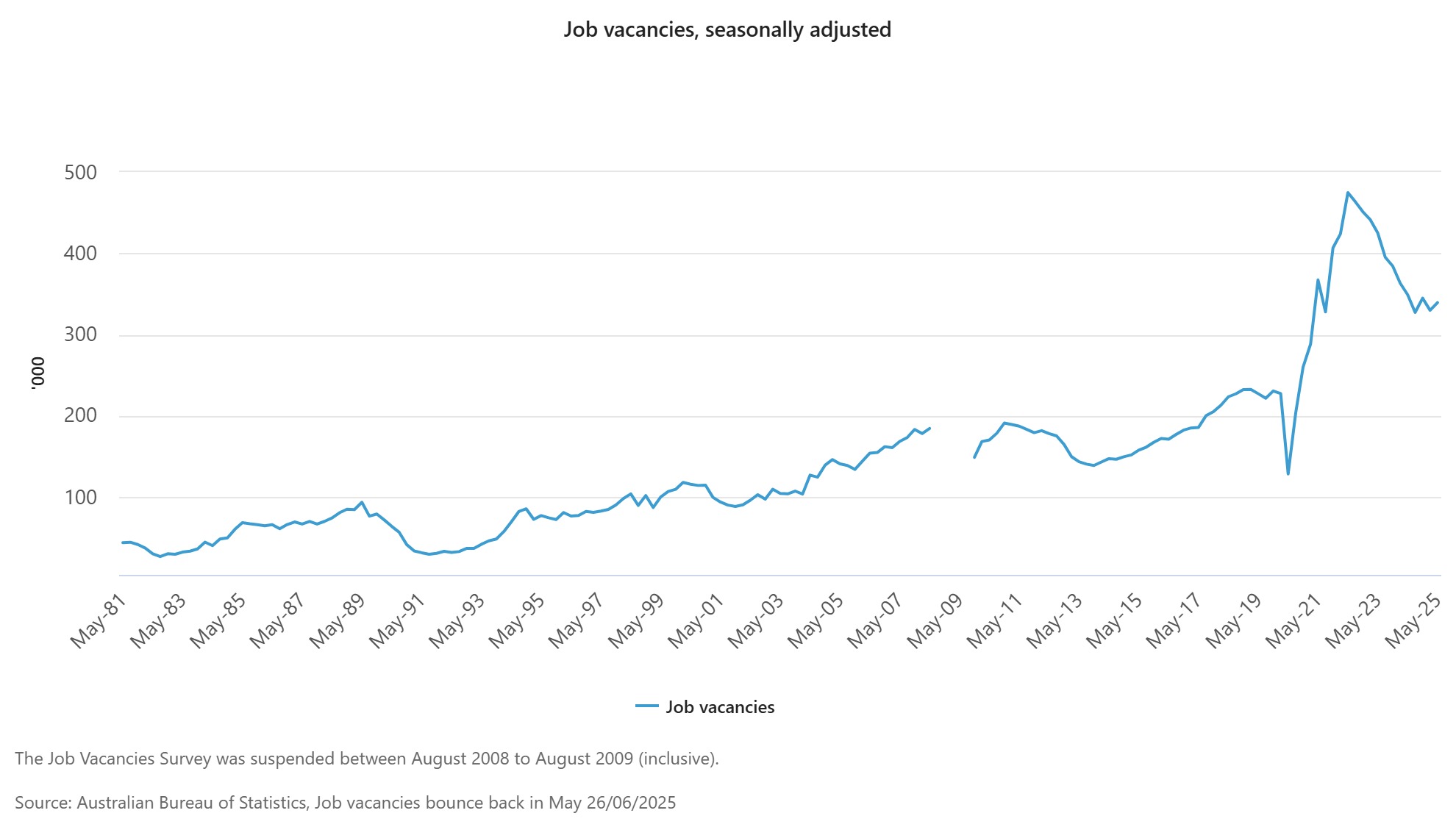
Job vacancies in Australia surged by 2.9% in the May quarter, reaching 339,400, according to new data released today by the Australian Bureau of Statistics (ABS).
This rebound follows a 4.5% decline in the previous quarter, signalling renewed labour demand, particularly in sectors reliant on skilled workers.
Key highlights from the ABS report
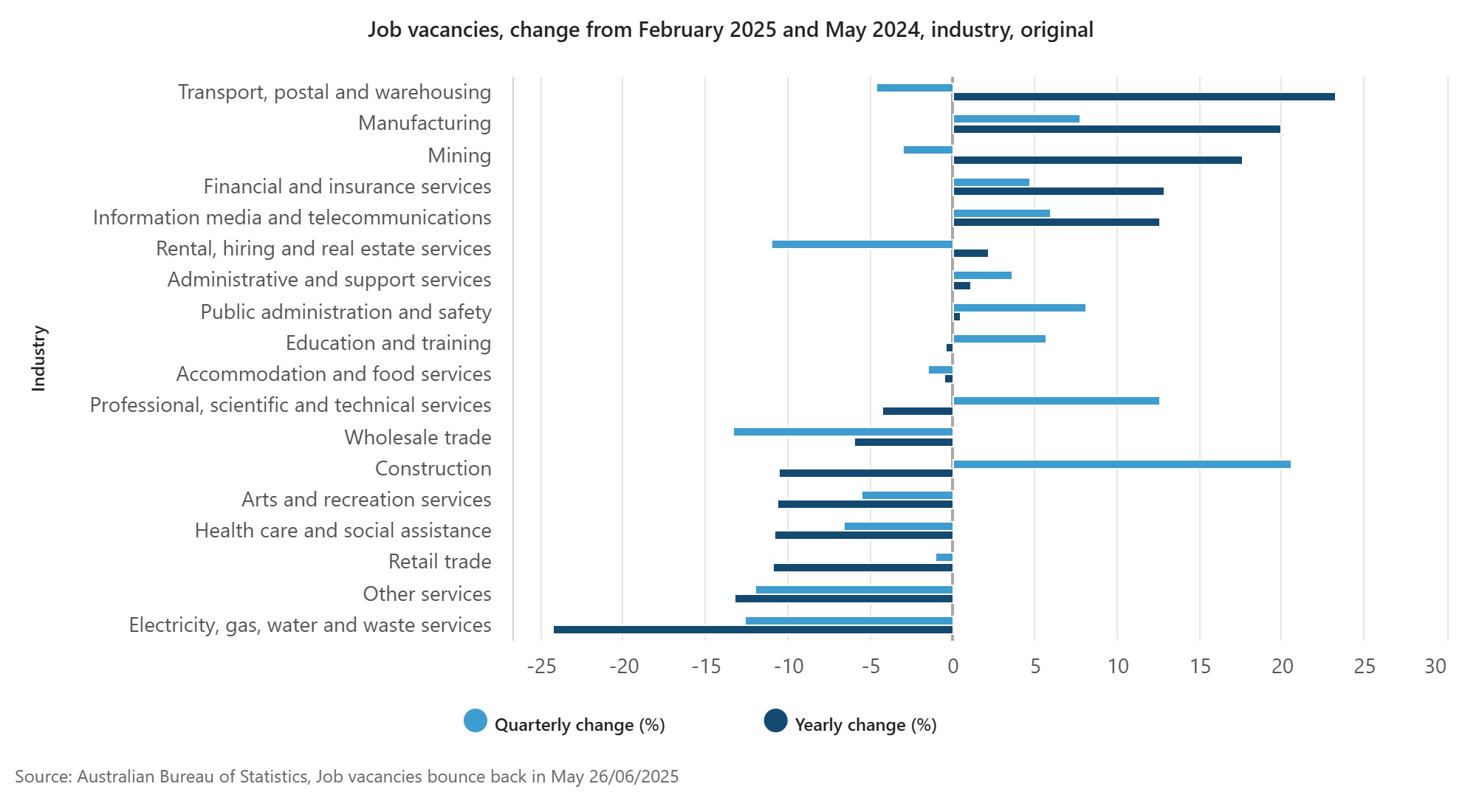
The uptick in job vacancies was primarily driven by significant growth in the Construction and Professional, scientific, and technical services sectors, which saw increases of 20.6% and 12.6%, respectively. These industries have led the recovery in hiring activity, underscoring sustained demand for skilled talent.
However, the data also revealed mixed performance across other sectors. While job vacancies rose in eight of the 18 industries, Wholesale trade saw a 13.3% drop, and the Electricity, gas, water, and waste services sector recorded a 12.6% fall.
On an annual basis, job vacancies decreased by 2.8% from May 2024, marking a reduction of 9,600 vacancies. This represents the smallest annual decline in job vacancies over the past two years, suggesting the labour market is stabilising after more significant falls in previous quarters.
Unemployment-to-vacancy ratio remains low
The unemployment-to-vacancy ratio ticked up slightly, suggesting continued tightness in the labour market.
"Over the year, the number of unemployed people per job vacancy grew from 1.7 to 1.8," said ABS head of labour statistics Sean Crick. "This is still well below the pre-pandemic level of 3.1 in February 2020, highlighting ongoing high demand for workers."
The ratio is an important indicator for the Reserve Bank of Australia (RBA), which has closely monitored labour market conditions as part of its assessment of inflationary pressures.
According to Westpac economist Ryan Wells, this slight increase in vacancies aligns with the RBA’s view that Australia’s labour market remains tighter than what is consistent with “full employment,” maintaining pressure on inflation.
“In our view, wages growth is consistent with maintaining inflation within the target range; therefore, we continue to expect the RBA to deliver rate cuts,” he said.
Regional variations
Job vacancy growth varied significantly by region. The Australian Capital Territory saw the highest increase, with vacancies rising 11.6%, followed by South Australia with a 9% rise.
On the other hand, the Northern Territory and Western Australia saw the largest declines, with vacancies falling 12.2% and 6.3%, respectively.
Employers cautious on productivity concerns
Ben Thompson, CEO of Employment Hero, noted the positive overall trend but pointed out that employers remain cautious in their hiring.
“Casual and entry-level roles, especially for teenagers, are seeing a massive spike, which tells us SMEs are prioritising flexibility, speed and cost-efficiency in a volatile economy," he said.
However, he also raised concerns about stagnant productivity, with employers still facing the broader challenge of how to lift productivity while remaining agile.
“There is a productivity warning light… as hours worked per employee have barely budged,” he said. “The focus now needs to shift from simply filling roles to enabling every team member to perform at their best. That is how businesses will build resilience and return on investment in the months ahead.”
Industry-specific trends
Conditions are far from uniform across all industries. Wells noted that while sectors like construction and professional services saw solid vacancy growth, industries such as health care and social assistance experienced a second consecutive quarterly decline, down 7,500 vacancies over six months.
This is a notable shift after years of rapid expansion in the sector, potentially signalling that the strong demand for workers in the care economy is beginning to be satisfied.
Similarly, industries like transport, postal, and warehousing and manufacturing have shown signs of stabilisation, while others, like administrative and support services, have returned to pre-pandemic vacancy levels.
JobAdder CEO Martin Herbst viewed the rise in vacancies as a sign of increasing hiring appetite after a challenging 18 months.
“This uptick has broader impact; it’s likely we’ll see more organisations turn to AI to help prioritise candidates, automate admin and speed up shortlisting,” he said. "For candidates, this is a positive shift, but also a reminder that competition is still strong, and employers remain focused on making the right hires," he added.