
Lithium Universe Ltd (ASX:LU7, OTC:LUVSF) is expanding its clean energy credentials with the acquisition of exclusive global rights to a microwave-based solar panel recycling technology developed by Macquarie University, as the sector braces for a coming wave of end-of-life solar waste.
The patented Microwave Joule Heating Technology (MJHT) is designed to recover critical materials — including silver, silicon, gallium and indium — from discarded photovoltaic (PV) panels using a more efficient, lower-impact process than conventional recycling methods.
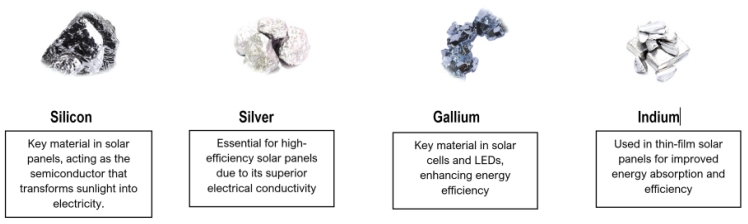
Critical metals used in PV cells and their function
“I am thrilled about the acquisition of Macquarie University’s Microwave Joule Heating Technology and the opportunity to potentially extract critical metals such as silver from solar panel recycling,” said executive chairman Iggy Tan.
Technology offers a cleaner alternative
Developed by Macquarie’s School of Engineering, the MJHT platform uses microwave energy to selectively heat silicon within solar panels. This causes the ethylene vinyl acetate (EVA) encapsulant encasing the PV materials to soften and enables room-temperature delamination, allowing intact recovery of materials without high heat or toxic chemicals.
Traditional processes rely on mechanical shredding and smelting at temperatures up to 1,400°C — methods that typically destroy or contaminate high-value materials like silver and silicon, leading to poor recovery rates and environmental concerns.
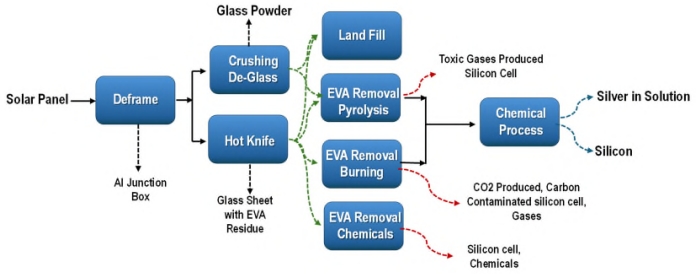
Conventional Crushing PV Solar Panel Recycling Flow Sheet
MJHT, by contrast, avoids hazardous chemicals, operates at low temperatures, and generates no toxic effluent — a key advance for scalable and decentralised solar panel recycling.
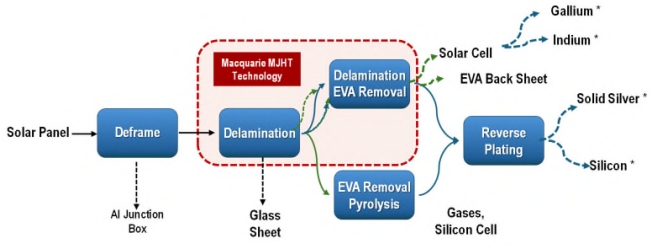
MQU “Microwave Joule Heating Technology” (MJHT)
“The need for effective PV recycling has never been greater, with only 15% of panels currently being recycled,” said Tan. “The mass accumulation of solar panel waste in landfills is a growing problem, as valuable critical metals like silver, silicon, gallium, and indium are left behind, contributing to both resource depletion and environmental harm.
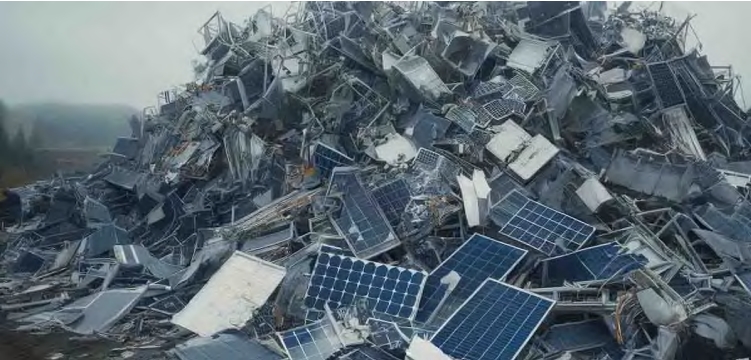
The accumulation of PV solar panels in landfill
“Microwave technology offers a promising solution to these challenges, enabling higher recovery rates and more sustainable recycling processes. We firmly believe that this technology represents the future of solar panel waste management.”
Commercial deal and strategic placement
The deal announced on Wednesday will see Lithium Universe acquire 100% of New Age Minerals Pty Ltd, the Australian-incorporated entity holding the Macquarie licence. Completion is subject to due diligence and a revised licensing agreement reflecting the change of ownership.
To support development of the recycling technology, the company has raised $1.7 million via a two-tranche placement to existing and new sophisticated and professional investors. The first tranche of $600,000 is expected to settle on June 26, with the second subject to shareholder approval at a meeting scheduled for July 23.
“Now that we have completed our lithium refinery DFS [definitive feasibility study] and secured all necessary components — including land and partnerships — we are positioned and ready for a lithium price recovery,” Tan said.
“We are confident in our counter-cyclical strategy and firmly believe that LU7 will benefit significantly when the lithium market rebounds. While awaiting this recovery, we have been presented with an exciting opportunity to acquire a cutting-edge photovoltaic recycling technology.”
Tan added: “We are pleased with the outcome of the placement in a challenging market, which reaffirms support for the company’s strategic direction and the acquisition of photovoltaic solar panel recycling technology.”
Looking ahead
Lithium Universe will work with Macquarie’s engineering team to further develop and commercialise MJHT, including exploring applications for its lithium refinery in Quebec. The company is particularly interested in using the microwave platform to reduce energy costs in spodumene calcination and sulphation processes.
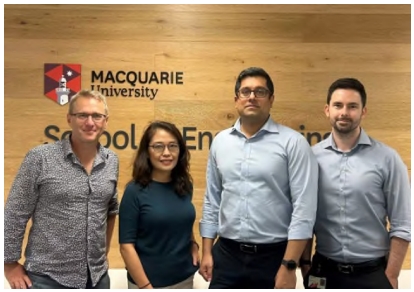
MJHT Tedam: From Left, Prof. Darren Bagnall, Prof. Shujuan Huang, Dr. Binesh Puthen Veettil and Dr. David Payne
“We are eager to collaborate with the Macquarie team to develop a more efficient and cost-effective recycling process,” Tan said.
The company sees the acquisition as a natural extension of its broader clean energy strategy — one that supports both the recovery of critical minerals and the emergence of circular supply chains across the energy transition.