
- FTSE 100 closes at 8,834
- Markets hit by new Israel-Iran worries
- US signs UK trade deal
- Ashtead and Morgan Sindall rise on upbeat trading
4.58pm: FTSE trims losses
The FTSE 100 closed slightly lower on Tuesday, trimming earlier losses as gains in energy stocks helped offset geopolitical jitters sparked by escalating conflict between Iran and Israel.
The blue-chip index fell 0.5%, or 41 points, to finish at 8,834, recovering from steeper declines earlier in the day as investors initially reacted to rising tensions in the Middle East and a broader risk-off mood.
4.15pm: Footsie loses ground
The FTSE 100's losses are little changed from where they were five minutes into the session. (Has it all been a waste of typing since?!)
BA owner IAG and bookmaker Entain are the leading fallers, down 4.5% and 3.5% respectively.
Rising oil prices and geopolitcal tensions hit IAG, as well as sending easyJet down 2.6% and Wizz Air 6.8% lower on the FTSE 250.
Distributor Bunzl fell 3.1% after a downgrade from RBC, citing concerns over growing competition.
Banks are down, possibly in reaction to stories that one of their number is looking to buy TSB from Spain's Sabadell, implying increased competition, maybe.
US stock losses have been trimmed slightly since the opening bell in New York.
The Oil, Gas and Coal index climbed 1.5%, driven by rising oil prices amid heightened Middle Eastern tensions, with BP and Shell leading the gains among London blue-chip stocks, each advancing over 1%.
"Investors’ attention this week will turn to central bank meetings, with both the Bank of England and the U.S. Federal Reserve expected to hold interest rates steady," said market analyst Patrick Connely at TickMill.
"Market participants will closely monitor any signals of potential rate hikes, especially after the Bank of England’s quarter-point rate cut in May. Additionally, trade-related announcements are set to draw interest as Trump’s early July tariff deadline approaches."
3.30pm: Poundland restructuring plans announced
B&M rival Poundland is planning to shut around 150 of its shops and two distribution centres, its new US owners have said.
An initial 68 shops are shuttering, it has been revealed, with plans to close at least 80 more, after US investment group Gordon Brothers bought the chain last week for £1 from Pepco.
Gordon Bros wants to cut the store estate from the current 800 or so to 650-700 outlets.
As part of a planned restructuring process, it has told creditors that it wants landlords to cut rents to zero on up to 180 stores and cut rents by up to 75% on many more.
3.06pm: Retail barometer readings
Analysts at Jefferies have noted recent theme in the UK retail sector of a "notable improvement in trading trends" through spring.
"Many retailers, particularly those across the Home space, have explicitly flagged this uplift as being very much supported by favourable warm weather conditions."
Data collected by the investment bank are consistent with this theme, with a 'barometer' aggregating B&M, Kingfisher and Wickes running at an average decline of circa 8% from Sepember to March before stepping up to around +1% in April.
"However, this positive move looks to have been short-lived, with May slipping back to an average of c.-6%. This provides further support to the view that the April boost may have been largely weather-driven, rather than reflecting a sustainable uptick in underlying trading conditions."
The Jefferies retail team have also reintroduced a Games Workshop barometer following an extended hiatus, which shows a negative average reading of -11 since the start of the year that is thought to reflect the lapping of the strong Warhammer 40k comparatives a year earlier.
"Interestingly, this trend diverges from the company’s strong reported core revenue growth (FY25 +13%) - we suspect the outperformance reflects the extraordinary success of the Space Marine 2 video game, that has driven footfall and revenue growth in the store channel, as alluded to by management at the half year."
2.49pm: Wall Street opens lower
US stocks have opened lower, with the Dow Jones down 0.3%, the S&P 500 dropping 0.4%, the Nasdaq falling 0.5% and the small cap Russell 2000 softening 0.6%.
Biggest fallers on the Dow are Nike, Merck, Verizon and P&G, with risers led by Chevron.
The FTSE 100 and other European markets are also slightly weaker since the New York opening bell.
2.09pm: Citi cuts gold targets
Gold could fall to below $3,000 an ounce by the end of this year or early next, Citi has forecast, as investment demand wanes, from the current spot price of $3,391.
A price target for the precious metal over the next one-to-three months was cut to $3,300 from $3,500, with the bank's 6-12 month target cut to $2,800 per ounce from $3,000.
Citi's base case is that gold prices remain between $3,100 and $3,500 in the third quarter, amidst continued elevtated geopolitical tension, Trump's tariff policy updates and US budget concerns, before a downward trend begins later in the year.
"We see investment demand for gold abating in late 2025 and 2026, as ultimately, we see the President Trump popularity and US growth 'put' kicking in, especially as the US mid-terms come into focus," the US bank said in a note.
1.24pm: Oil prices still climbing, IAE report issued
Oil prices are continuing to climb, with Brent crude now back up to $74.8 a barrel.
Recent developments include China's president calls for de-escalation between Israel and Iran as soon as possible.
The International Energy Agency (IEA) has also issued its new medium-term outlook, which sees global oil supply increase "set to far outpace demand growth in coming years".
In the report, which acknowledges that the Israel-Iran conflict is focusing attention on immediate energy security risks, the IEA says: amid intensifying geopolitical strains and heightened uncertainty about global economic prospects, "oil markets are undergoing structural changes as the key drivers of supply and demand growth of the past 15 years start to fade".
Several trends are highlighted that the agency says "could considerably reshape global oil markets over the medium term", including that China is set to see its consumption peak in 2027, following a surge in electric vehicle sales and the continued deployment of high-speed rail and trucks running on natural gas.
"At the same time, US oil supply is now expected to grow at a slower pace as companies scale back spending and focus on capital discipline – although the United States remains the single largest contributor to non-OPEC supply growth in the coming years."
Global oil demand is forecast to increase by 2.5 million barrels per day (mb/d) between 2024 and 2030, reaching a plateau of around 105.5 mb/d by the end of the decade.
At the same time, global oil production capacity is forecast to rise by more than 5 mb/d to 114.7 mb/d by 2030, dominated by gains in natural gas liquids and other non-crude liquids.
12.36pm: US stocks to join sell-off
US stocks are predicted to open lower, joining Europe in the red as the back-and-forth reassessments of Middle Eastern risk continue.
Futures for the S&P 500, Dow Jones and Nasdaq are all down around 0.5%.
This is off their worst, and likewise, the losses for the FTSE and DAX have also been trimmed.
The German index is still down 0.9%, compared to 1.4% in the morning part of the session, while the Footsie's down less than 0.3% now, versus 0.7% in early trading.
Spain's IBEX is down 1.3% as the worst of the European markets, with banks selling off and travel stocks weighing too.
11.10am: Trump on Iran, silver vs gold
Donald Trump issued a social media post in the past hour saying he has "not reached out to Iran for 'peace talks' in any way, shape, or form".
He said if Iran want to talk, "they know how to reach me" and "should have taken the deal that was on the table - would have saved a lot of lives".
Oil and gold are both continuing to creep higher as the morning goes on.
Market analyst Daniela Sabin Hathorn at Capital.com noted that the moves in gold in the past few days have been overaken by silver.
The initial uptick in gold at the end of last week found resistance just below the all-time highs from earlier this year, while silver's dual natiure has seen a different narraive, she says.
Silver has shown "surprising strength" since the start of June and "saw a shift in momentum".
"While initially buoyed by both safe haven flows and improving risk sentiment," silver retreated on Friday as geopolitical concerns dampened the 'risk-on' appetite.
"This dual nature of silver – as both an industrial metal and a partial safe haven – makes it especially sensitive to broader economic narratives," says Sabin Hathorn.
"Its price had been supported not just by market optimism and improving equities, but also by ongoing supply tightness and structural shortages that have gained renewed attention."
Silver is up 2% today to $37.1 per troy oz, while gold is up 0.3% at $3,395 an oz.
10.40am: TSB up for sale
UK high street lender TSB's Spanish owner Banco de Sabadell says it has received bids, a decade after taking it over.
The Catalonia-based banking group said it has received approaches and would "assess any potential binding offers".
This followed a report from the Financial Times that it has granted limited access to its books for buyers to carry out due diligence.
Sabadell bought TSB in 2015, a year after it was spun out by Lloyds Banking.
10.17am: FTSE 250 boosts
While the FTSE 100 is in the red, the FTSE 250 a few mintues ago popped into positive territory and is now just below flat.
There may be some boost for the more domestically focused UK mid-cap index from the US trade deal signed overnight.
Also, there is there is now a 17% gain for Morgan Sindall (see below), plus gains for oil and gas producers and the wider sector, with Harbour Energy, Hunting and DEC all up between 3% and 5%.
Ocean Wilsons Holdings Limited (LSE:OCN) is up 7% after announcing a tender offer.
Shares in B&M European Value Retail SA (LSE:BME) are up 2.3% after new CEO Tjeerd Jegen bought £523,559 of shares as he got his feet under the desk.
9.17am: Markets more risk averse today
Stock markets are in risk-off mode across Europe, with the DAX down 1% in Frankfurt, the CAC 0.8% lower in Paris and FTSE 100 dropping 0.5% as oil heavyweights offset other losses.
"The market’s insouciance on Monday has been replaced by a more risk-averse timbre today," says Saxo strategist Neil Wilson.
"After rallying on Monday on hopes that the Israel and Iran conflict would remain contained, stock markets have lurched lower again on Tuesday after US President Trump left early from the G-7 summit in Banff and told Iran to evacuate Tehran, signalling potential escalation of the conflict."
While Israel and Iran meanwhile traded missile and drone strikes for a fifth day, French leader Emmanuel Macron indicated that a ceasefire offer had been made to help "kickstart broader discussions", with reports suggesting Iran is open to talks.
Trump denied he was pursuing a ceasefire and said his early departure from the summit was due to something "much bigger" than discussing a ceasefire, while Israeli PM Netanyahu said on Monday his country was “not backing down” from eliminating Iran’s nuclear programme.
While reports have indicated that Tehran is willing to negotiate, Wilson says "it takes two to tango and Israel won’t stop until it feels like it’s done enough".
The price of gold is flattening off after falling to below $3,380 yesterday on Middle East optimism, before climbing to $3,385 overnight.
Oil prices are climbing again, with Brent crude up 1.4% to $74.3 a barrel.
8.53am: Morgan Sindall surges to all-time high
Shares in Morgan Sindall Group PLC (LSE:MGNS) are up 15% at the head of the FTSE 350 risers this morning after a positive trading update.
The construction and fit-out group said it anticipates profits for this calendar year will be "significantly ahead" of its previous expectations.
Trading has improved at its fit-out division and construction arm, while all other divisions remain on track with previous guidance.
8.41am: US trade deal is 'music to the ears' of auto and aerospace sectors
Reacting to news of the executive order signed by Trump on the UK trade deal, William Bain, head of trade policy at the British Chamber of Commerce, said this "will be music to the ears of affected sectors. They are desperate for tariff relief and lower costs, and this new Executive Order should deliver that."
He said it has been "tough" for the automotive sector to operate under the higher US tariffs over the past two months.
"However, for steel and aluminium firms the wait goes on," he says. "They have faced 25% US tariffs for the past three months and are still awaiting the resolution of outstanding issues on the new US quotas."
He noted that the deal implements zero tariff arrangements on UK Rolls Royce jet engines by the end of this month.
"Both Governments should now build upon this current deal to secure an agreement on digital trade to make trans-Atlantic trade cheaper, speedier and more efficient," Bain added.
"We also need to make the case for further tariff relief in other goods sectors affected by the US reciprocal tariffs, from clothing to food and drink."
8.27am: US-UK trade deal
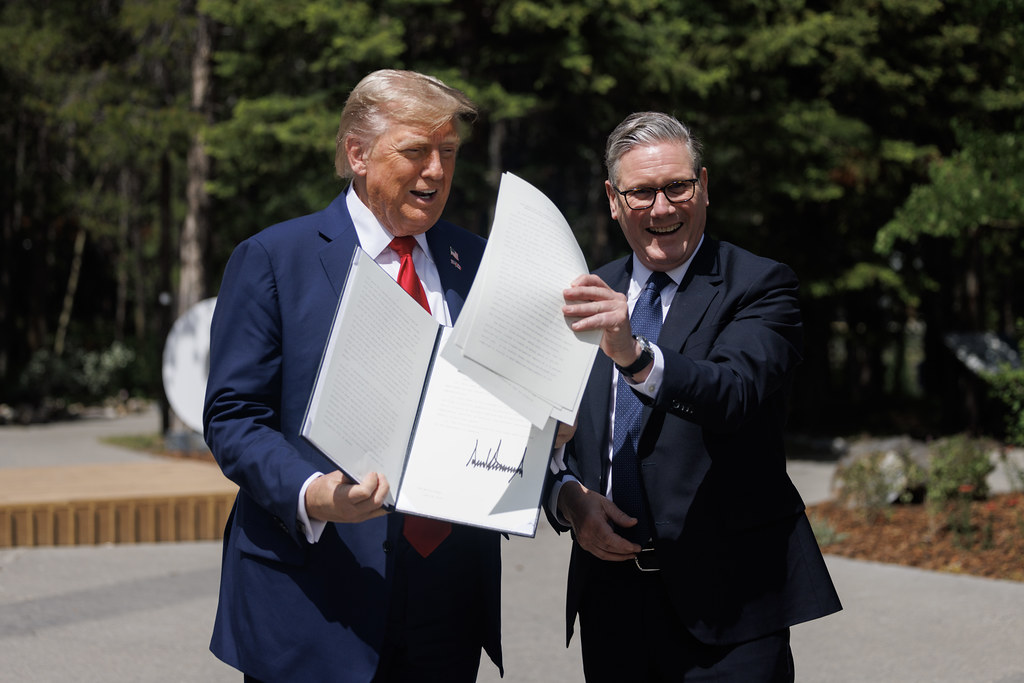
Rather overshadowed for markets by re-escalating worries about the Middle East, last night saw US President Donald Trump sign his first trade deal of this administration.
At the same G7 meeting where he called for the evacuation of Tehran (population circa 10 million), Trump and UK Prime Minister Keir Starmer were pictured showing off the new deal documents.
The deal means that Britain's aerospace sector will face zero US tariffs, while auto exports face 10% tariffs rather than US's 25% global tariff, and the steel industry faces 25% tariffs compared to the 50% global levy on steel and aluminium.
Trump also declared the UK would have protection against future tariffs, "because I like them".
Aerospace suppliers, including Melrose and Rolls-Royce, are showing no reaction this morning, down 0.8% and 1.2% respectively.
8.12am: FTSE 100 opens in the red
The FTSE 100 has dropped 49 points to 8,826.5 in early trading, with all but five companies' shares in red.
British Airways owner International Consolidated Airlines Group SA (LSE:IAG) is bottom of the list, down 1.8%, followed by precious metals miner Fresnillo PLC (LSE:FRES) and insurers Legal & General Group PLC (LSE:LGEN) and Aviva PLC (LSE:AV.).
After its update earlier, Ashtead Group PLC (LSE:AHT) is up 0.9%.
Oil giants BP PLC (LSE:BP.) and Shell PLC (LSE:SHEL, NYSE:SHEL) are up 1% and 0.4%.
7.58am: Capita using cost cutting to invest in AI
Capita PLC (LSE:CPI) has reiterated its full-year guidance after adjusted revenue fell 4.5% in the first five months of the year but it continued to remove costs from the business.
The outsourcing group said it still expects adjusted revenue to remain "broadly flat" this year, with an improvement in operating margin driven by an ongoing £250 million cost reduction programme, where £185 million in annualised cost savings have so far been achieved.
Free cash outflow for 2025 is expected to range between £45 million and £65 million, weighted to the first half. Capita still expects to be free cash flow positive by year-end.
CEO Adolfo Hernandez said a portion of the savings are being invested into new technology solutions, "particularly those underpinned by AI", and marketing these technology solutions to more clients.
7.47am: House prices dip in June
UK asking prices for homes in June have fallen 0.3% compared to a month ago, according to Rightmove data, which is the first decline this month in over a decade, following April’s stamp duty changes and high supply levels.
Compared to a year ago, average asking prices are 0.8% higher as buyer activity continues to be resilient, the property platform says.
Last month saw the highest number of sales agreed in any month since March 2022, with buyer demand now 3% ahead of this time last year and the number of homes coming to market is up 11%.
"Underneath the headline figures, we can see regional variations in price changes this month, which appear closely linked to buyer affordability and supply levels," said Colleen Babcock, a property expert at Rightmove, with higher-priced South West, South East and London regions seeing the largest price drops this month as buyers there were disproportionately affected by April’s stamp duty changes.
7.32am: Ashtead mixed numbers
Ashtead Group PLC (LSE:AHT) has reported a softer revenue and profit performance in its final quarter but strong cash generation for the year and an increased dividend.
As it prepares to leave the FTSE 100 by switching its main listing from London to New York, the construction equipment hire group reported a record year of rental revenue but saw total turnover decline 1% to $10.8 billion, reflecting lower sales of used equipment.
Adjusted EBITDA rose 3% to $5 billion, but adjusted profit before tax fell 5% to $2.1 billion.
The fourth quarter saw revenue fall 4% and adjusted PBT decline 3%.
7.21am: Oil prices choppy
The oil price rollercoaster continues, with yesterday's fall flipped to a rebound overnight and this morning seeing choppy movements.
Front-month Brent crude futures, which spiked above $78 a barrel on Friday, then fell from around $75.5 to below $71 yesterday, rallied to almost $75.5 in the early hours of this morning.
Currently, a barrel will set you back $73.4.
"If the situation starts to calm," say analysts at Danske Bank, "we expect oil prices to fall back further, as focus would shift from the oil market and return to the trade war and the potential for further OPEC+ output increases.
"Yet, tensions remain high as Trump left a G-7 meeting to return to Washington, D.C. to focus on the conflict, while calling for an evacuation of Tehran."
7.15am: FTSE 100 called sharply lower as Trump calls for Tehran evacuation
The FTSE 100 and other European markets are set to fall sharply on Tuesday, the futures market has indicated, as the Israel and Iran conflict became more complicated, overshadowing news that the US-UK trade deal had been signed.
London's blue-chip index was called almost 50 points lower, after it gained close to 25 points the day before to close at 8,875.22.
This followed a retreat for oil and gold price on news that Iran is willing to resume talks on its nuclear program.
"The market interpreted this as a sign that Iran either has no intention – or possibly no means – to escalate the war, easing concerns about potential disruption to the Strait of Hormuz, a critical chokepoint through which around 20% of global oil and gas flows transit," said market analyst Ipek Ozkardeskaya at Swissquote Bank.
US stocks bounced back from losses at the end of last week, with the Nasdaq rallying 1.5%, the S&P 500 adding 0.9% and the Dow Jones up 0.8%.
"However, this is not a classic de-escalation story," says Ozkardeskaya. "While Iran appears to be signalling restraint, former President Donald Trump urged the evacuation of Tehran, and Israel has vowed to continue its strikes.
"This makes it a one-sided de-escalation at best, and keeps risks across energy markets and haven assets tilted to the upside. If Iran fails to find room to manoeuvre diplomatically, it could easily make a U-turn."
Meanwhile, tensions between Russia and Ukraine remain high, with further attacks overnight.
5.15am: What to watch on Tuesday 17 June
There are company numbers scheduled from Ashtead Group PLC (LSE:AHT), the FTSE 100 equipment hire group that is poised to leave the London benchmark as it moves its main listing to New York, though its final results come after a profit warning in December.
Its equipment hire sector is a key gauge of economic confidence, and also a potential early reading ahead of figures from Speedy Hire a day later.
Before trading begins in London, the Bank of Japan will have made its latest policy decision, the first of a central bank trio this week, coming a day before the US Federal Reserve and ahead of the Bank of England's meeting on Thursday.
Tuesday announcements expected
Trading update: Capita
Interims: RWS Holdings
Finals: Ashtead Group, IG Design Group
Economic announcements: Bank of Japan policy decision, Rightmove UK house price index (UK), ZEW economic sentiment index (EU, GER), Import and export price indices (US), retail sales (US), industrial production (US)