
Rome Resources Plc (AIM:RMR) CEO Paul Barrett talked with Proactive about the company’s recent drilling success in the Democratic Republic of Congo (DRC), where a new tin zone has been discovered outside known geochemical anomalies.
Barrett explained that their tin exploration project is situated just eight kilometres from the North Mine, known as the highest-grade tin mine in the world. The company resumed drilling in September after a temporary halt due to M23-related activity and is now receiving promising results from the eastern flank of the project.
“We drilled to the east and then under, and actually in the shallow section, there is outside the geochemical anomaly,” Barrett said, noting that the tin potential appears to extend beyond previously defined anomaly boundaries. He added that runoff on steep flanks likely removed surface indicators, meaning other zones could have been missed in earlier surveys.
This unexpected outcome has encouraged the team to continue exploration across the east, northwest, and southeast. Barrett confirmed that three drill rigs are currently active. The campaign initially aimed to test deeper parts of the geological model, which suggested that tin is better developed at depth. However, the discovery of shallow tin is now seen as an additional and valuable result, reinforcing the project's broader prospectivity.
The company has completed just under 800 metres of drilling so far, with hole number 38 being part of the deeper drilling initiative. Despite the shallow tin finding, Barrett emphasised that the geological model and its deep potential remain central to their approach.
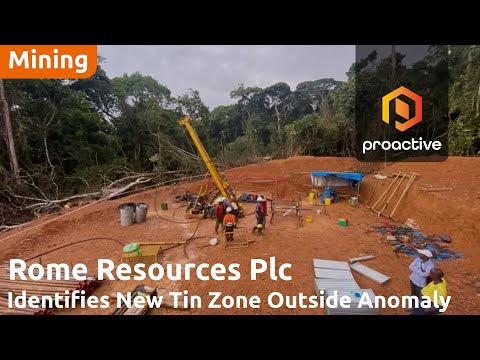
Proactive: Well, you've got some important news out today, and that's because you've got news out that you've uncovered a new tin zone at your project. Let's remind everyone first off about the project itself and then this area that you were looking at.
Paul Barrett: Yeah. So it's a tin exploration project in the DRC. It's right next door to South Main, just about eight kilometres from North Main. Most people know this as the highest-grade tin mine in the world. So we're chasing the same play, and we've got a lot of copper and a lot of zinc—so there are kind of secondary and tertiary commodities we may be chasing. But the primary goal is tin. We’ve been exploring this particular campaign since September. We had a little pause because of the M23 activity, but now we're back to drilling, and we’re getting some interesting results.
Proactive: Yeah. So this was in the eastern flank of the project. Was it surprising that you were able to find some tin here? And obviously, this is just the start of it. You’ve got to make sure you sort of drill it all out. But it’s a good sign so far?
Paul Barrett: Yes. That’s right. I mean, the original exploration work was the geochemical soil sampling survey, which identified two tin anomalies. We've been drilling on those for about a month. And the thing is, of course, you think the tin in the subsurface is directly beneath where the tin anomaly lies. Whereas in fact, we were drilling to the east and then under, and actually, in the shallow section there—it is outside the geochemical anomaly. So what we're saying now is that the tin potential certainly continues outside the limits of the geochemical anomaly. I think the reason for that is the anomaly is on a ridge where the soil is kind of in situ, but these really steep flanks that we’re drilling at the moment have a lot of runoff, and a lot of the surface tin just gets washed away. That’s why we don’t see an anomaly. But it opens up the idea that we may see several more tin zones continuing to the east, northwest, and southeast as well. So we’ll be chasing that over the next couple of months.
Proactive: Yeah. I know that you’ve done a number of drill holes so far—just under 800 metres. But you’ve got three drill rigs actively turning. Are you looking at that tin portion while the other rigs are doing other things?
Paul Barrett: Yeah. So we initially said when we started this second program—after the temporary shutdown—that we would be looking at the deeper part of the play because the geological model suggests that as you go deeper, the tin is better developed. So the original plan was to drill deeper holes and offsetting holes. This hole number 30, which is now being redrilled as hole 38, was part of this program of drilling deeper. But we just happened to encounter the tin at a really shallow level. So it’s definitely additional. It doesn’t really change our view in terms of the geological model and the deep potential, but it’s certainly telling us there’s more to the northeast along the flank.
Proactive: Paul, thanks very much. Great update. I look forward to hearing more about the drilling as it continues. I know there's a lot of it happening, so we expect more news flow coming soon.