
As the world’s electric vehicle boom accelerates, so too does the global competition to secure the critical minerals that power it. And while much of the attention has centred on established mining jurisdictions, a new player is emerging in one of the world’s last underexplored frontiers — Mongolia.
Among the companies at the forefront is Asian Battery Metals PLC (ASX:AZ9), which is steadily building a portfolio of copper, nickel, graphite and lithium projects to help feed the growing demand for electric vehicles, batteries and green energy infrastructure.
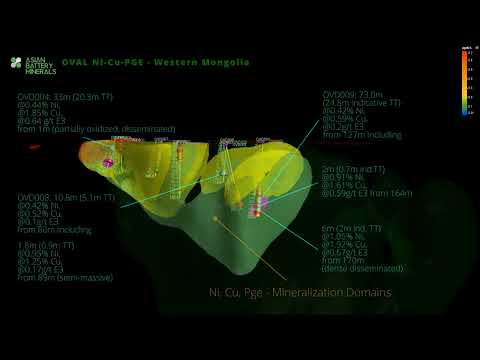
The company’s flagship ground position is the Yambat Project, located in Mongolia’s Gobi-Altai Province. Covering more than 106 square kilometres, Yambat hosts multiple high-potential targets, including the company’s key Oval Cu-Ni-PGE discovery as well as emerging prospects at Copper Ridge, MS1, MS2 and CR Far East. The project area lies just north of existing road and rail infrastructure, offering both geological prospectivity and logistical advantages as exploration advances.
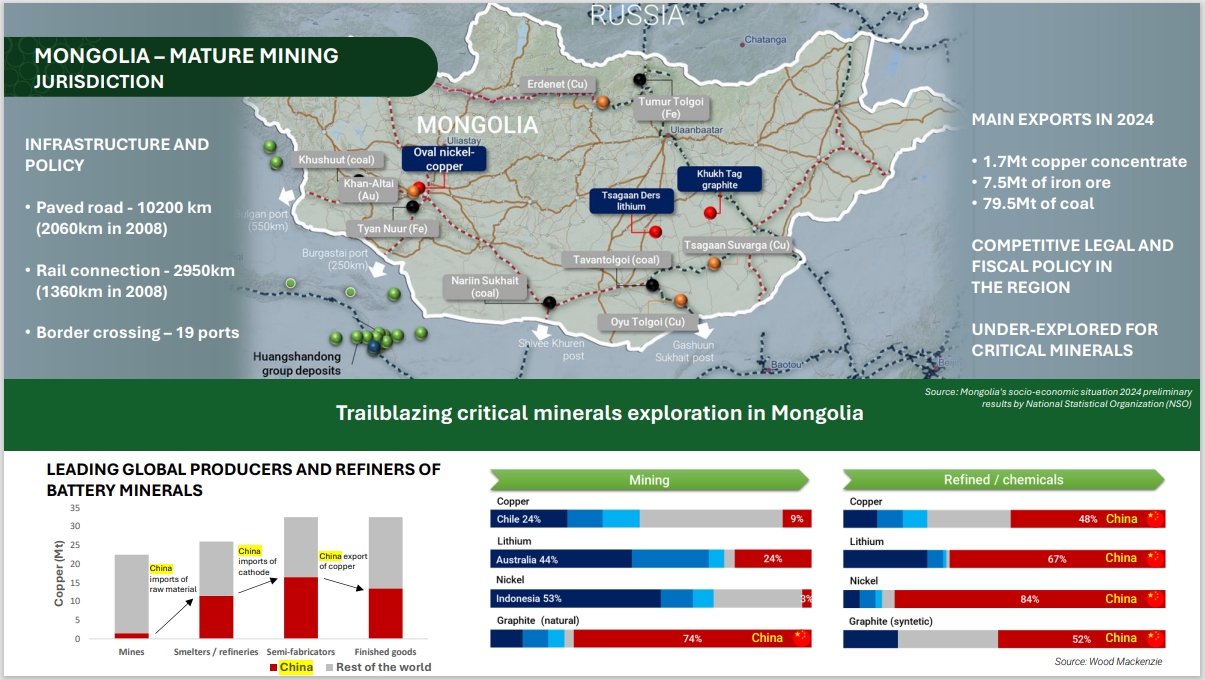
Oval currently sits at the heart of the company’s green energy ambitions — a discovery that is rapidly shaping into a potentially significant magmatic sulphide system offering high grades of copper, nickel and platinum group elements (PGEs), all critical to global decarbonisation efforts.
An emerging battery metals hub next door to China
Asian Battery Metals’ strategy hinges in part on geography. Mongolia’s location directly north of China places it next to the world’s largest producer and consumer of electric vehicles, battery raw materials and energy transition infrastructure. That proximity offers logistical advantages, as well as strategic positioning at a time when many countries and companies are increasingly seeking new sources of supply outside of China.
Mongolia’s mining sector is already home to several major projects — including Rio Tinto’s Oyu Tolgoi copper-gold mine, Xanadu Mines and Zijin Mining’s Kharmagtai copper-gold development, and Erdenet Mining Corporation’s longstanding Erdenet copper-molybdenum operation. But while the country is known for its copper and gold, its critical minerals potential remains largely underexplored — something Asian Battery Metals hopes to change.
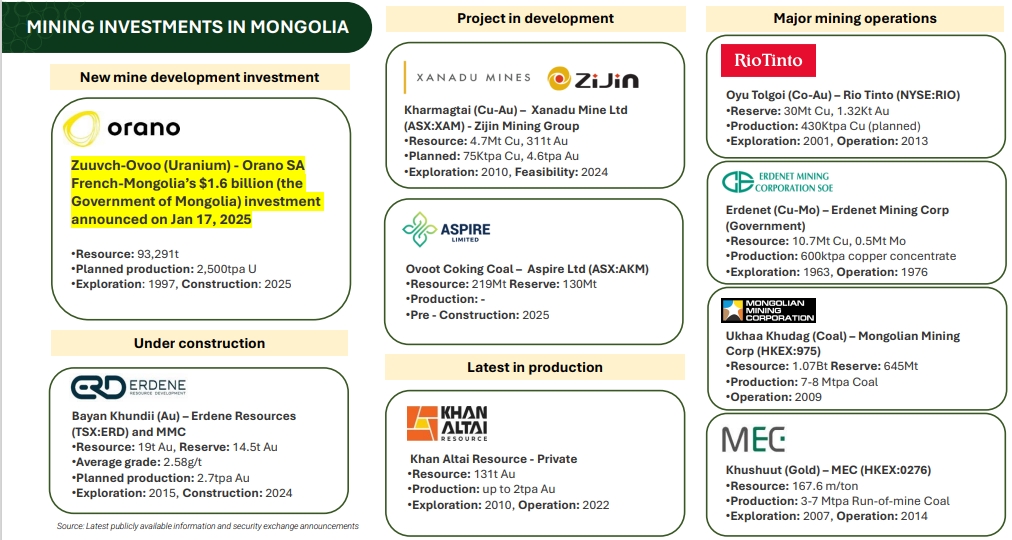
Backing its play, it sees Mongolia’s mature legal, policy, and fiscal regime for mining, established infrastructure network of roads, rail, and border crossings, and the government’s strong appetite to attract new investment into its critical minerals sector.
High-grade copper-nickel-PGE discovery at Oval
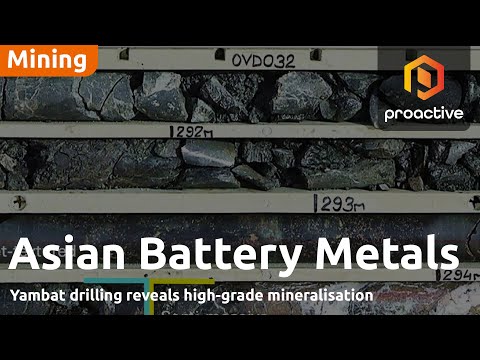
At the centre of Asian Battery Metals’ exploration success so far is the Oval Cu-Ni-PGE Project, where the company has intersected multiple zones of high-grade massive sulphide mineralisation through its ongoing drill programs.
The headline intersection to date — drillhole OVD021 — returned 8.8 metres at 6.08% copper, 3.19% nickel and 1.63 grams per tonne (g/t) E3 (platinum, palladium and gold combined) from 107.2 metres depth. The broader mineralised envelope around OVD021 included dense disseminated and net-textured sulphides, with surrounding intercepts including:
- 7.85 metres at 0.75% Cu, 0.78% Ni and 0.15 g/t E3 from 99.35 metres; and
- 15.8 metres at 1.36% Cu, 1.0% Ni and 0.44 g/t E3 from 116 metres.
Further drilling confirmed multiple additional massive sulphide intersections:
- OVD025: 3.6 metres at 3.85% Cu, 3.82% Ni and 1.55 g/t E3 from 48.2 metres;
- OVD026: 1.8 metres at 3.21% Cu, 3.32% Ni and 0.69 g/t E3 from 105 metres; and
- OVD027: 6.1 metres at 4.16% Cu, 3.51% Ni and 0.93 g/t E3 from 98.2 metres.
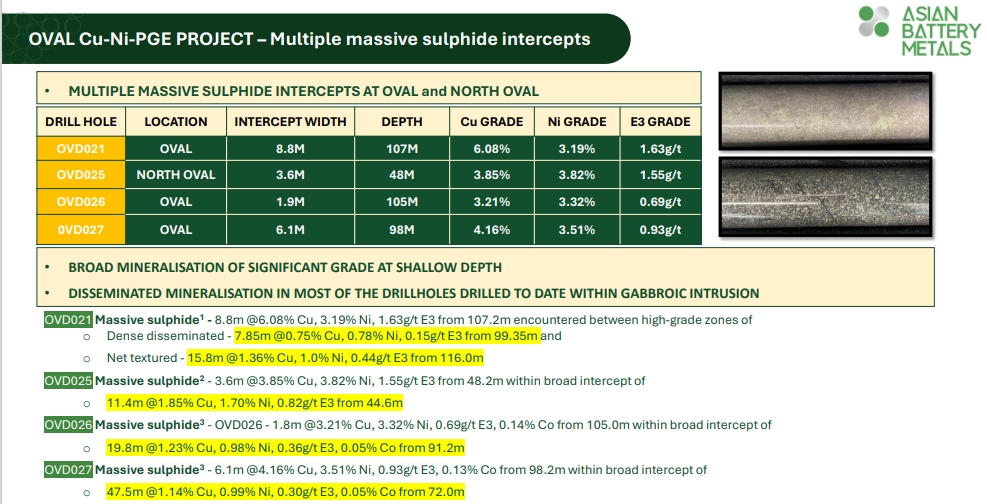
These zones sit within broader disseminated mineralised packages, suggesting a sizeable intrusive system. Importantly, most of the mineralisation encountered to date sits at shallow depths, with significant untested potential remaining at depth.
Phase 3 drilling, launched in early 2025, has now intersected additional promising zones as the company tests deeper and along-strike extensions of the mineralised system.
Potential district-scale upside beyond Oval
While Oval remains the flagship, Asian Battery Metals sees broader opportunity across its regional licences, with multiple additional targets now emerging for systematic follow-up.
Roughly 8 kilometres north of Oval lies the Copper Ridge Cu-Au prospect, where scout drilling has confirmed copper-gold mineralisation across broad widths. Initial drill results have returned more than 140 metres of mineralisation grading between 0.1% and 0.3% copper and from 0.1 to 0.8 g/t gold, with surface rock chip samples reaching up to 0.4% copper and 0.18 g/t gold. These early results suggest the potential for a separate intrusive-related copper-gold system.
Several additional high-priority geophysical and geochemical anomalies have been identified across the project’s MS1, MS2 and CR Far East target areas. Soil geochemistry, stream sediment sampling and detailed magnetics indicate that multiple mineralised systems may be operating across the larger 106-square-kilometre tenure.
Scout drilling on these regional targets is now under way or scheduled for the coming months as part of the expanded 2025 program.
Funding secured for 2025 exploration
Asian Battery Metals heads into the second half of its 2025 exploration program well-funded. In addition to its existing $3.4 million cash balance at the end of 2024, the company completed a $3.96 million capital raise in early 2025, leaving it fully funded to execute its expanded 2025 campaign.
The remainder of the 2025 work program is expected to include:
- Ongoing follow-up drilling at Oval, targeting deeper extensions and untested anomalies identified through new DHEM and gravity data;
- Maiden drilling at regional MS1, MS2 and Copper Ridge targets;
- Additional ground-based geophysical surveys, including a Gradient Array IP survey at CR Far East; and
- Ongoing metallurgical optimisation and flotation test work on Oval Cu-Ni mineralisation, expected to complete mid-July 2025.
Government approvals and licence renewals have also been secured, providing a clear operational runway through to 2028.
Diversified exposure to multiple critical minerals
Beyond copper, nickel and PGEs, Asian Battery Metals has also built early-stage exposure to graphite and lithium through additional projects in its Mongolian portfolio.
At the Khukh Tag Graphite Project, the company holds a JORC-compliant resource totalling 12.2 million tonnes at 12.3% total graphitic carbon (TGC). Metallurgical test work completed to date has returned recoveries of up to 94.9%, with high-grade concentrate purity between 94% and 97% TGC — potentially suitable for battery anode material, subject to further processing and development studies.
Meanwhile, the Tsagaan Ders Lithium Project has returned promising trenching and rock chip samples from pegmatoid dykes, with assays of up to 1.47% lithium oxide, as well as associated rubidium, beryllium, tin and caesium mineralisation.
While still early-stage, these results add a further layer of potential optionality to Asian Battery Metals’ diversified exploration platform.
Veteran board and technical leadership
Backing Asian Battery Metals’ work on the ground is a board and management team with decades of combined Mongolian and global mining experience.
Non-executive chairman David Paull brings more than 30 years’ experience in the sector, including a decade working in Mongolia as managing director and chairman of Aspire Mining Ltd. Managing director Gan-Ochir Zunduisuren has more than 22 years of mining experience, including leadership roles with Oyu Tolgoi LLC and Aspire.
The board also includes experienced policy and development specialist Kirsten Livermore and energy executive Neil Young, who serve as non-executive directors.
Their work is supported by a local technical team experienced in major discoveries across gold, copper, uranium, coal, molybdenum and nickel throughout Mongolia — giving Asian Battery Metals both the operational depth and in-country expertise needed to progress these complex systems.
A clear window of opportunity
As the battery minerals sector continues to evolve — and as geopolitical tensions increasingly drive supply chain diversification — Asian Battery Metals sees Mongolia’s underexplored terrain as one of the few remaining frontiers with genuine world-class discovery potential.
With the 2025 exploration season progressing and multiple drill programs advancing on both the Oval and regional targets, the company may soon have the chance to demonstrate whether its growing pipeline of projects can translate into commercial scale.