
Leeuwin Metals Ltd (ASX:LM1) has launched Phase 2 of its drilling program at the Marda Gold Project in Western Australia, with the goal of expanding the high-grade gold mineralisation discovered during Phase 1.
The Phase 2 program will involve 3,000 metres of reverse circulation (RC) drilling, continuing the promising work carried out in the earlier phase that returned multiple shallow, thick, high-grade gold intercepts.
Phase 1 success fuels optimism
The results from the initial drilling campaign at Marda have exceeded expectations. The Phase 1 program of 2,000 metres uncovered a series of high-grade gold zones that are expected to significantly expand the potential of the Marda Gold Project. Notable intersections from Phase 1 included:
- 16m at 2.00 grams per tonne (g/t) gold (Au) from 134m in hole MGRC0006
- 22m at 1.25 g/t Au from 123m, including 3m at 6.3 g/t Au, and 8m at 1.01 g/t Au from 137m in hole MGRC0004
- 21m at 1.09 g/t Au from 98m in hole MGRC0005, and 9m at 2.45 g/t Au from 190m
These intersections validate the geological model for the area and point to a significant, underexplored gold system.
Phase 2 focus: extending mineralisation
The new drilling will primarily focus on extending the mineralisation along strike and down-dip. Leeuwin Metals plans to drill a total of 10,000 metres at Marda over the course of 2025, with Phase 2 being just the first step towards expanding the resource potential.
The Phase 2 program will cover high-priority targets, including infill drilling and step-out extensions in the most promising zones.
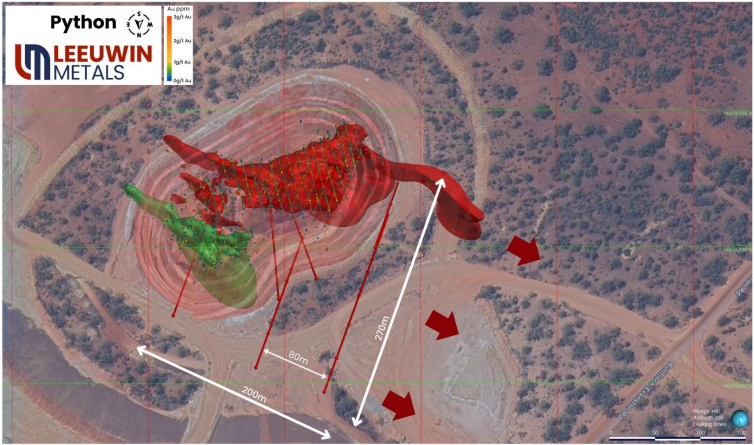
Plan view of the Python area within the Marda Central prospect showing Leeuwin planned drill holes (red) and previously reported intercepts defining mineralisation over >200m of strike and plunge extent
Leeuwin Metals executive chairman Christopher Piggott said the results confirmed Marda Central’s “immense exploration upside”.
“Given the strength of those results, we have moved quickly to start Phase 2, which is aimed at creating shareholder value by extending this known mineralisation and ultimately establishing a significant gold resource,” he said.
“We are also starting to explore the wider project area, which we believe has huge potential and has been subjected to little or no modern exploration.”
In addition to the Phase 2 drilling program, Leeuwin has commenced regional geophysical surveys and field mapping to test for further extensions of the mineralised trend. This wider exploration work will begin this month and is expected to yield valuable insights into the full potential of the Marda Gold Project.
Strong infrastructure supports development pathways
The Marda Gold Project is strategically located in the Goldfields region of Western Australia, about 120 kilometres north of Southern Cross and 400 kilometres northeast of Perth. The area benefits from established infrastructure, with easy access via the sealed Evanston-Bullfinch Road and proximity to several regional service centres.
The project’s location within trucking distance of multiple processing facilities also adds optionality for future development.
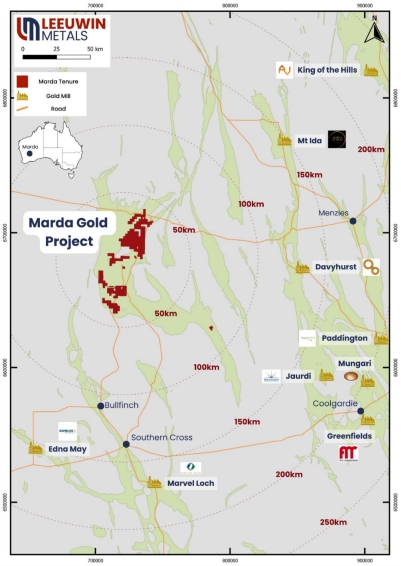
Marda Regional Location showing greenstone belt extents. Map projection: MGA94 z50.
Leeuwin Metals also sees significant potential for regional exploration across its 500km² landholding, which includes eight historical open pits and numerous high-priority targets. With minimal modern exploration conducted on the project area to date, the company believes there are substantial growth opportunities to unlock.
Results from the Phase 2 program are expected in the September quarter, and the company will evaluate the next stage of work based on those outcomes. Further exploration, including geological modelling and resource estimation, is planned, depending on the success of the current drilling campaign.