
The US economy contracted at an annualised rate of 0.2% in the March quarter, the first quarterly decline since mid-2022, as gains in business investment, consumer activity and exports only partly offset a jump in imports and reduced government spending.
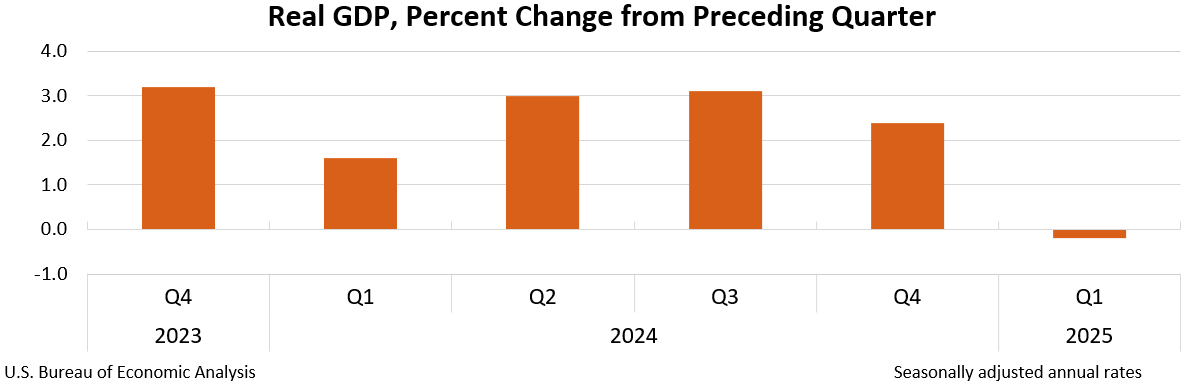
While the gross domestic product (GDP) reading, updated on Thursday by the US Bureau of Economic Analysis, is a slight upward revision from the government’s initial -0.3% estimate, it is a stark reversal from the 2.4% expansion recorded in the final quarter of 2024 – reinforcing concerns about waning economic momentum in the world’s largest economy.
Imports drag on growth
The GDP downturn was largely driven by a sharp increase in imports – a reaction to tariff uncertainty – alongside a decline in government spending resulting from the Department of Government Efficiency-led cuts.
These were only partly offset by moderate gains in investments, consumer spending and exports.
Digging deeper, the revisions showed a mixed bag:
Private inventory investment was revised up, particularly in chemical manufacturing and information sectors;
But consumer spending was revised down (to 1.2% annualised from 1.8%) especially in healthcare, recreation and food retail, reflecting fresh data from the Census Bureau’s quarterly surveys.
Another red flag came from corporate earnings: Profits from current production dropped US$118.1 billion, reversing a US$204.7 billion increase in the previous quarter.
Meanwhile, real gross domestic income (GDI) – another key measure of economic activity – also fell 0.2%, reinforcing the sense of broad-based softness.
Inflation still sticky
Despite the growth weakness, inflation pressures remain elevated:
The personal consumption expenditures (PCE) price index – the US Federal Reserve’s preferred gauge – rose 3.6%, unchanged from the prior estimate.
Core PCE, which excludes food and energy, was revised slightly lower to 3.4%, but still sits well above the Fed’s 2% target.
That leaves policymakers in a bind – with slower growth but little room to ease just yet.
Stagflation threat looms
For Australian investors, the weaker US data injects further caution into the global outlook. ASX-listed exporters – particularly in commodities, energy and manufacturing – could face demand headwinds if US consumption and investment continue to falter.
At the same time, renewed US-China trade tensions and tariff threats are still rattling global supply chains, feeding into ASX volatility this week.
The soft GDP print raises the risk of a stagflationary scenario, which could see markets remain choppy in the months ahead – especially for Australian equities tethered to global risk appetite.
The next GDP revision – including industry breakdowns and updated corporate profits – is due June 26.