
Standard Uranium Ltd (TSX-V:STND, OTCQB:STTDF) has announced the first-ever ExoSphere Multiphysics surveys in the southwest Athabasca Basin at its Davidson River project in Saskatchewan.
The surveys are being carried out in partnership with Fleet Space Technologies Canada across three key exploration corridors.
Davidson River spans 30,737 hectares and is located along trend from several high-grade uranium deposits currently under development.
The survey work is focused on the Warrior, Bronco, and Thunderbird conductors and will involve real-time 3D Ambient Noise Tomography (ANT), Horizontal-to-Vertical Spectral Ratio (HVSR), and ground gravity data collection.
Standard Uranium, with support from Axiom Exploration Group, will deploy survey grids beginning in late May, with the surveys expected to take about 35 days to complete.
The integrated ANT, HVSR, and gravity datasets will be used to develop shear velocity models and custom subsurface density inversions.
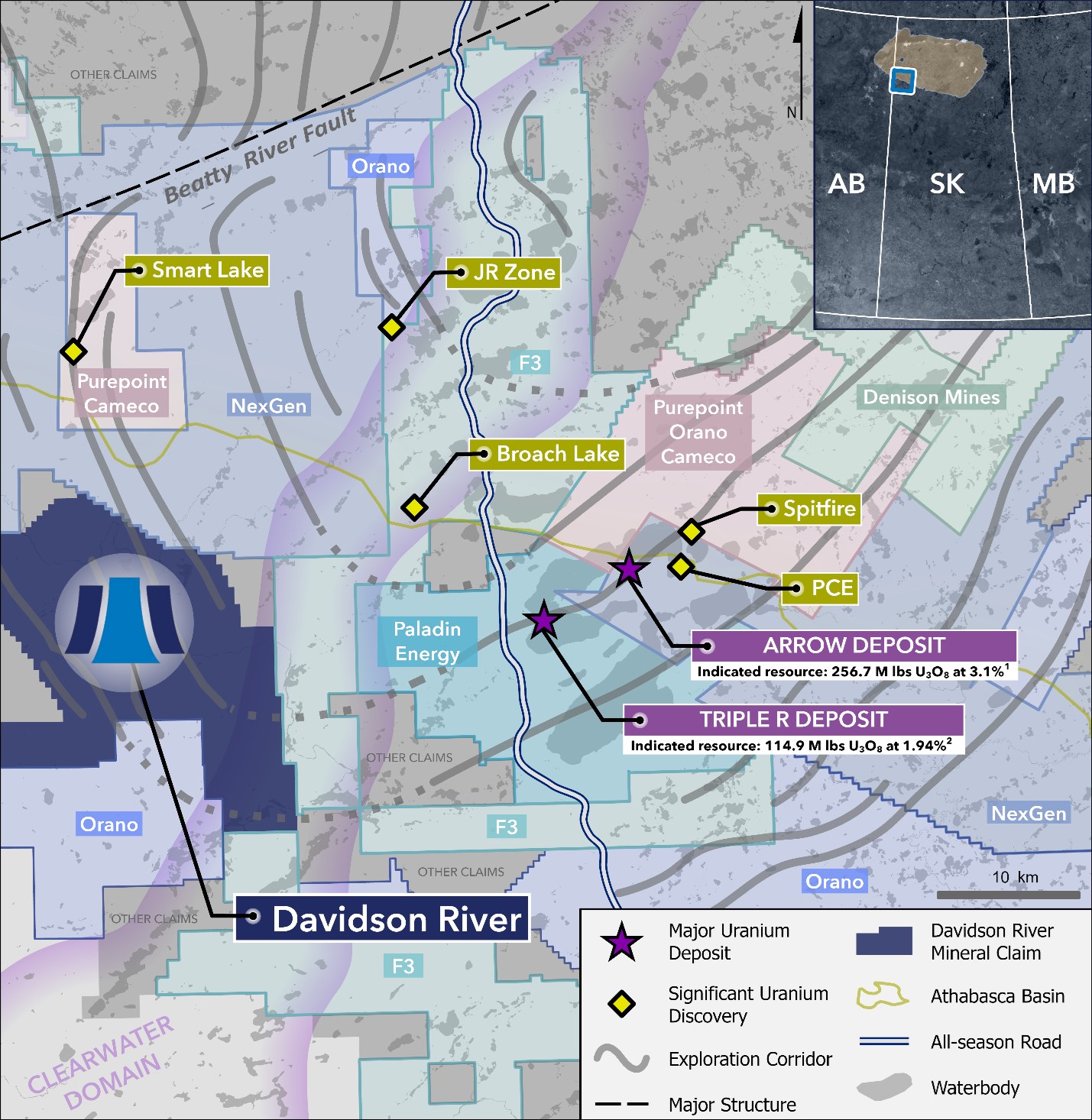
Fleet Space will also apply a proprietary cover depth analysis to generate a cover-corrected gravity dataset, aiming to refine drill targets through the identification of basement density anomalies. These anomalies, when aligned with known graphitic conductors, may indicate hydrothermal alteration zones associated with uranium mineralization, Standard Uranium noted.
Once survey data is analyzed and integrated with previous drilling and geophysical datasets, Standard Uranium plans to begin diamond drilling this summer, which would be the first drill campaign on the project since 2022.
Sean Hillacre, Standard Uranium president and vice president exploration, expressed excitement about kicking off the program at the company’s “crown jewel” project, Davidson River.
"Integrating the 3D density and velocity models to image alteration systems in the basement rock could provide the key data we've been looking for to vector into a new discovery at Davidson,” Hillacre said.
“We have been hard at work developing targets across the project since 2022 and armed with the new datasets from the multiphysics system, we aim to expedite discovery of a new basement-hosted uranium system with drilling this year."