
The Reserve Bank of Australia (RBA) has delivered a widely anticipated 0.25 percentage point interest rate cut, reducing the official cash rate to 4.1%—the second cut since the tightening cycle began in 2022. The move offers some immediate relief for mortgage holders, with NAB the first major bank to announce it would pass on the full rate reduction to its standard variable home loan customers, effective May 30, 2025.
However, Reserve Bank governor Michele Bullock cautioned against premature optimism for further cuts, citing persistent uncertainties. “Uncertainties about the outlook for domestic economic activity and inflation stemming from both domestic and international developments,” she said, contributed to the Board’s decision. “Geopolitical uncertainties also remain pronounced. These developments are expected to have an adverse effect on global economic activity, particularly if households and firms delay expenditure pending greater clarity on the outlook.”
While inflation has moderated to 2.4% after peaking at 7.8% in late 2022, the path back to sub-2% inflation remains unlikely. Strong wage growth, sustained government spending, low unemployment, and weak productivity continue to support inflationary pressures.
Analysts and policymakers alike agree that a return to pre-pandemic interest rates near 2% is improbable in the near term.
Dwyfor Evans, Head of APAC Macro Strategy at State Street Markets: “The RBA eased the cash rate by 25bps, as widely expected. Optimism on inflation was offset to some extent by uncertainty around the tariffs and the still strong jobs market, but projections on prices and rates alludes to a roadmap towards less restrictive policy. Some talk of a ‘hawkish cut’ before the decision, but global uncertainty aside, this was a clearer directional message from the RBA than we have seen for some time.”
Krishna Bhimavarapu, APAC Economist at State Street Global Advisors: “Glad to see the RBA deliver on the widely expected 25 bps cut today. Looking ahead, GDP growth in Q1 could tread water, as indicated by leading indicators. If growth surprises to the downside, we see higher chance for the cash rate reaching our forecast 3.10% by December. Global trade dynamics are looking to be reset with fast paced discussions between many countries and in that regard, we look forward to similar initiations from Australia.”
Will the banks pass it on?
While NAB has said it will pass on the cut in full, Rachel Wastell raises an important consideration: whether all banks will pass on the full benefit of this rate cut to borrowers. “The real question is – will the banks play fair?” she says, pointing to previous cycles in which the pass-through of subsequent cuts became less generous.
“History shows they can be a bit stingy on the second cut,” Wastell explains, referencing declining pass-through rates during past easing cycles.
She also cautions homeowners that lenders may take up to two weeks to adjust their rates—and that not all institutions will pass on the full reduction. In a pattern seen during previous rate changes, banks are expected to move swiftly to lower deposit rates before delivering savings to mortgage holders.
For those looking to make the most of the changing rate environment, Wastell advises vigilance: “The message this cut from us is to keep an eye out for the underdogs. In the home loan space, it’s the smaller lenders that have been leading the charge with competitive rates while the Big Four lag behind.”
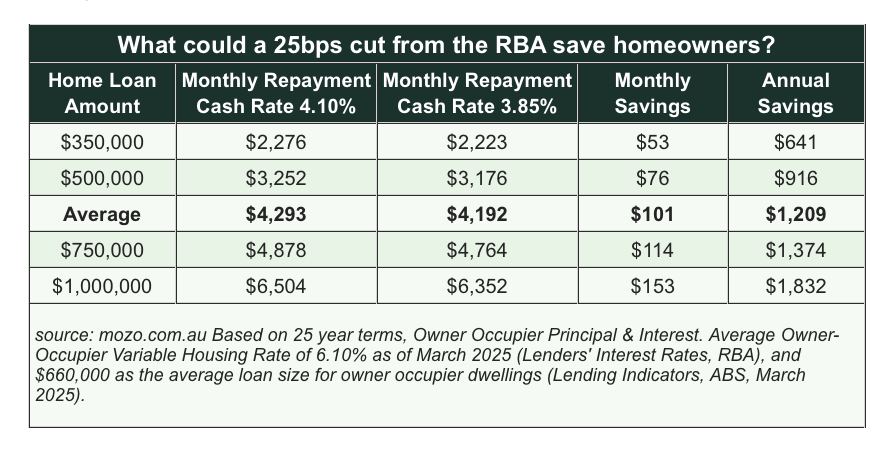
With today's cut, the average Aussie with a $660,000 home loan could save about $101 a month.
RBA rate cut offers relief but won’t fix Australia’s productivity woes, says CPA Australia
The RBA’s decision has been welcomed by households and small businesses, but CPA Australia warns it will do little to address the nation’s underlying productivity challenge.
According to the country’s largest accounting body, the rate cut is a short-term boost for mortgage holders and business owners grappling with elevated living costs and subdued confidence, yet it is not a solution for Australia’s structural economic issues.
“Today’s decision will be met with a sigh of relief from households and businesses who have been counting on another rate cut to boost their cashflow,” said CPA Australia’s Business Investment Lead, Gavan Ord.
“After multiple rate rises, persistent inflation and cost-of-living pressures, consumer and business confidence remain subdued. This cut should lift sentiment slightly and put a bit more money back into people’s pockets.
“But rate cuts will not get Australia out of its productivity straitjacket. Significant reforms are needed to move the needle on economic growth.”
CPA Australia is calling on federal and state governments to advance reforms that stimulate business investment and innovation, including reducing regulatory burdens and initiating broad tax reform discussions.
“We need to revitalise the business environment by removing unnecessary regulatory burdens and supporting entrepreneurship,” Ord said.
“If governments can shift away from regulation as the default response to every problem, and instead embrace practical solutions like education and better enforcement of existing laws, this will go a long way to creating the business-friendly environment that is so crucial to Australia’s economic success.”