
NanoViricides (NYSE-A:NNVC), a US company, targets the unmet medical need for an effective, broadspectrum acute oral antiviral therapy with NV-387. NV’s lead indication is for MPox, an endemic virus related to smallpox. Ethics approval for a Phase 2 trial in Congo has been gained; the next stage is a formal Phase 2 application that might be completed by mid-year enabling the trial to start in H2CY25.
A successful African trial could lead to possible development funding from the US biodefense agency (BARDA). Meanwhile, NV has the advantage of its flexible and adaptable anti-viral platform opening potential new opportunities in measles with treatment of bird flu in humans as a possible further indication.
A possible opportunity is in the treatment of Measles. Measles is very well controlled by childhood MMR vaccination; this also guards against other nasty childhood diseases. However, vaccine take up varies between US states and has reduced creating pools of at-risk children. This led to disease reoccurrence (1,001 US cases in 2025 to 9 May with three deaths, CDC). A recent theoretical epidemiology study (JAMA) showed that a drop in vaccination rates could lead to an epidemic.
An effective therapy could therefore be useful as a biosecurity asset. European cases also rose in 2024. In bird flu, NV continues to evaluate the potential for NV-387 as a human therapy against the strain H5N1.
Cases of poultry to human, and some dairy cow to human) transmission are rare but could be a potential threat if human to human transmission occurs. NV’s nano-polymer, micelle technology is designed directly to bind and destroy virus particles in the blood preventing them entering and infecting cells.
NV’s focus is on acute treatment of diseases like Mpox, RSV, flu (including potentially “bird flu”) and COVID-19. NV’s lead molecule NV-387 completed a Phase 1 study in 2023 showing safety and tolerability.
Background
In 2023, NV-387 successfully completed a Phase 1 Indian study with various oral single and multiple doses using health y participants. The full data is still being processed and the results to date show that oral NV-387 is safe and well tolerated with no adverse events.
Mpox, is related to smallpox but with low mortality. Smallpox, although eradicated, is a major potential biosecurity risk hence the US government stockpiles drugs and vaccines. NV plans to run an African Mpox Phase 2. There are MPox cases in the US at a low level and of a milder strain (CDC MPox). Biosecurity contracts can be worth US$ 100+ mln.
RSV remains as an ongoing preclinical program. This will progress when funds allow with a US IND application then a proposed US Phase 2. Preclinical research into measles is a promising new project, discussed below.
The core NV-387 patents expire between 2026 and 2028. A 2020 application has limited designation. On an FDA approval, NV can rely on US exclusivity of five years plus six months for a pediatric indication or seven years if an orphan drug. Exclusivity is longer in Europe.
Financial – March cash of US$2.5mln with further funding needed
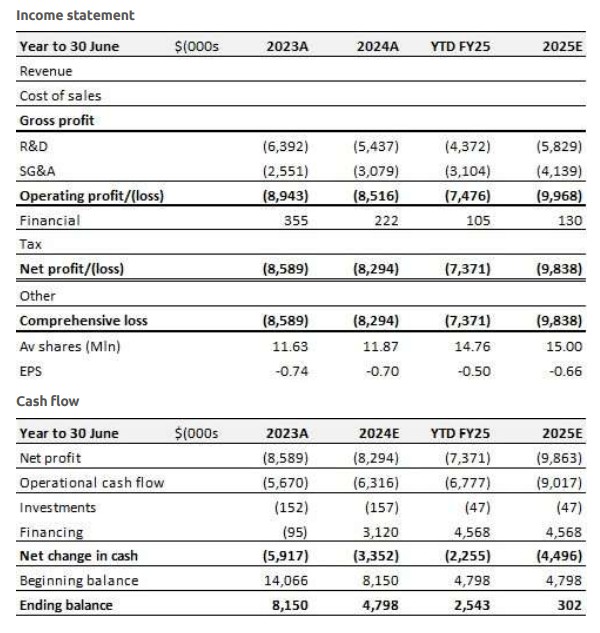
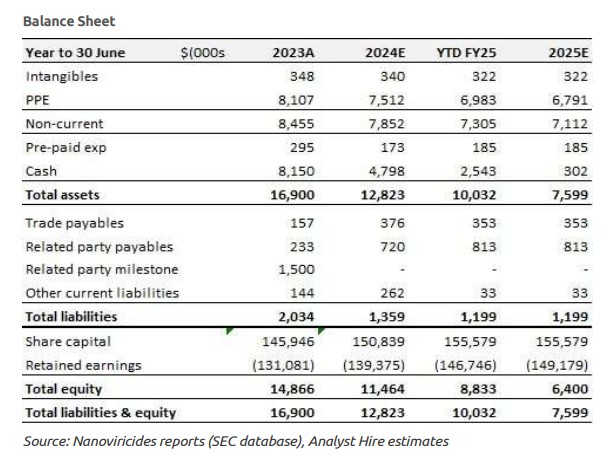
YTD to 30 March, NV had operating costs of US$7.5mln; about US$9.7mln annualized. Over FY 24 (12 months to 30 June 2024) costs were US$8.5mln. The higher FY25 YTD costs were driven by increased G&A expenditure (+66%) due to increased investor outreach activity; YTD R&D costs rose by 2.7%. On March 30 2025, cash was US$2.54mln after YTD equity funding of US$4.6mln net. The Q3 FY25 10-Q report stated that cash resources are insufficient to fund a further 12 months. We project YE cash (30 June 2025) at under US$0.5mln without further funding. An At-The-Market facility is in place.
As of March 30 2025, there were 16.1 mln ordinary shares, a rise of 2.9 mln since 30 June. In addition, there are 0.9mln Series A convertible shares but these only convert on a change of control.
NV was not affected by April’s market turmoil and that the company is not affected by tariffs, other than any general impact on US inflation. A weaker US dollar rate could increase non-US clinical costs.
MPox trial application progress and possible further opportunities
Alongside the existing focus on MPox with a planned Phase 2 in 2025, two new openings have arisen recently. The Mpox $100 mln+ opportunity was extensively discussed in our 28 February 2025 note.
Clinical development of NV-387 in Mpox – Congo trial
NV has been granted by the National Ethics Committee for Health (CNES) of the Ministry of Public Health (MSP), of the Democratic Republic of Congo (DRC) approval to submit a Clinical Trial Authorization (CTA) for a Phase 2 in MPox.
NV expects the CTA to be approved quickly once submitted so the trial might start in the second half of 2025. The trial will be run at the Medical Hospital at the University of Kinshasa for NV by a clinical trial organization.
If the trial results are positive, BARDA might fund development work from CY2026. The Phase 2 data would also facilitate a US IND application to the FDA for RSV. BARDA has agreed pay Shionogi US$375mln to help develop Ensitrelvir, a preclinical US product for COVID-19 prophylaxis, an IND was filed in April. This could act as a deal prototype. Ensitrelvir is approved in Japan.
Measles: spotting a worrying trend
A theoretical paper in JAMA by Kiang et al (24 April 2025) modeled the impact of a 50% reduction in use of the measles mumps and rubella (chicken pox) vaccine (MMR) in the US as a worst case scenario. This indicated that 51.2mln new measles cases would occur over a 25-year period.
At current MMR vaccination levels, measles might become endemic again by the 2040s with 0.8-1.5mln new cases over 25 years. A 5% increase in MMR uptake would virtually eliminate this risk -but would be difficult to achieve consistently. MMR vaccination rates vary a lot by state; for example, New York has a 97.7% update, but Idaho is under79% (CDC MMR data). Two doses of MMR give 97% protection against measles.
Of the 1,001 US cases confirmed in 2025, 30% are in infants under 5 years, but the disease occurs also in unvaccinated young children and teenagers (ages 5-19, 38%) and in adults (31%). Of the infants, 23% had to be hospitalized and there can be life changing infection side effects like deafness. There were only 285 US cases in 2024. In the EU and UK, there were over 37,000 cases in 2024 as the disease bounced back 10-fold after COVID-19 restrictions ended (ECDC and UK Gov).
An avian opportunity could take flight
NV-387 could have efficacy against bird flu; we have no specific data. It has been orally delivered in a Phase 1 so might be used as an emergency treatment in human bird flu cases. Case of transmission from farm animals to humans are rare (70 reported) and human to human has not occurred with this strain.
Science background
MPox, manifested as pustules on the skin and spread by direct and sexual contact, comes in a more severe clade 1 strain (found in Congo) and a less severe, but still nasty, clade II strain which is endemic at low levels in the USA (CDC-MPox). MPox virus is related to smallpox so in theory, If NV-387 treats MPox, it could also be active if a smallpox outbreak occurred – this is a biosecurity risk as smallpox has been eliminated in the wild. There is a vaccine.
Measles is a virus of the Paramyxoviridae family whereas flu is a member of the Orthomyxoviridae. Measles is genetically stable with very specific human receptor requirements. To infect individuals, measles uses two spike proteins: hemagglutinin (H) and fusion (F). The H protein targets signaling lymphocyte activation molecule (SLAM) on a subset of immune cells and nectin4 (a protein that links cells). Once bound, the F protein enables the virus to infect the cell. We currently have no preclinical data on NV-387 against measles, but management is confident of efficacy and has initiated a study in a humanized animal model. As a childhood infection, we envisage this as a possible development following a pediatric RSV indication.
Flu, including bird flu, is genetically unstable and mutates quickly, hence the problem of trying to produce effective vaccines and why NV-387, with is broad spectrum binding capability, could be effective against multiple strains. Flu binds sialic acid sugars on the cell surface and NV-387 carries mimics of these sugars. The human and bird flu strains are different as bird flu targets a different form of sialic acid. As this is also found in cow mammary glands, cases have been reported in dairy cattle with very rare direct transmission to diary workers.
NV-387 – a novel, non-biological anti-viral opportunity
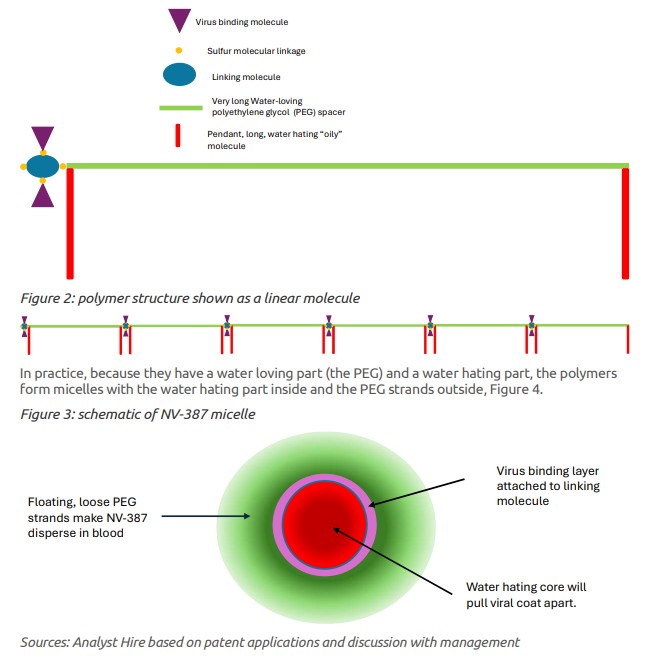
NV has been developing a range of anti-viral polymers for over 20 years. The latest iteration, with a world patent application filed in 2020, is NV-387. The molecule has three linked components:
- A virus binding component, these mimic the natural cell-surface molecules that the virus binds to so in the case of RSV this is a heparin-sulfate-like molecule;
- A water-soluble component (polyethylene glycol (PEG)) to enable the polymer to disperse in the blood and circulate systemically; and
- A water hating component to act as the core of the polymer and to “attack” and disrupt the shells of bound virus particles.
NV-387 is a polymer: it is assembled from multiple copies of the basic monomer (Figure 2). At least five of these are then linked to form the polymer (Figure 3). Note the red, pendant, water-hating chains may may only be 50% present.
Figure 1: Monomer structure
MPox status and opportunity
MPox manifests as pustules on the skin and is spread by direct and sexual contact. It comes in a more severe clade 1 strain (found in Congo) and a less severe, but still nasty, clade II strain which is endemic at low levels in the USA (CDC-MPox). MPox virus is related to smallpox so in theory, If NV-387 treats MPox, it could also be active if a smallpox outbreak occurred – this is a biosecurity risk as smallpox has been eliminated in the wild.
NV had previously announced an African MPox study was being planned. An announcement on 8 May disclosed that the National Ethics Committee for Health (CNES) of the Ministry of Public Health (MSP of the Democratic Republic of Congo (DRC) has approved the trial ethics allowing a trial design to be submitted with data for a Clinical Trial Authorization from the DRC pharmaceutical regulator: Autorité Congolaise de Réglementation Pharmaceutique (ACOREP). NV understands that the trial could start in the second half of 2025. We do not have an exact timescale.
Current therapies and previous studies
There is an approved, effective vaccine, JYNNEOS (Bavarian Nordic); 2024 sales of US$450mln. The vaccine gives high antibody titers and in “real world” studies offered 66-89% Mpox protection. An acute therapy, tecovirimat is approved for smallpox (and by analogy Mpox) and is stockpiled for emergency US use. Sales in 2024 (largely to the US stockpile) were US$130mln; tecovirimat has failed to show efficacy but might be better than nothing in an outbreak.
An analogous study to that probably proposed by NV was run in two sites in the DRC was run by the National Institute of Allergy and Infectious Diseases (NIAD) (NCT05559099); called PALM 007. This recruited nearly 600 patients and tested Tecovirimat. It took about two years to run (Shabil et al (2024)). Mortality was reduced from 3.6% to 1.7% but the study did not meet the primary endpoint of reduced time to lesion clearance. However, patients who received Tecovirimat early and had more severe disease had less severe symptoms.
A US NIAD Mpox study, STOMP (NCT05534984) enrolled over 700 patients in Phase 3 over about two years. The trial stopped early in December 2024 on futility grounds as Tecovirimat failed to show efficacy in reducing the time to clear lesions (NIH STOMP).
Flu and bird flu indications and human risk
Flu is a respiratory viral infection. Apart from vaccination and some largely ineffective anti-viral products, that need to be taken very soon after infection, there are no treatments. If NV-387 or a derivative can bind and neutralize flu virus in the blood, it could limit symptoms and speed recovery. The two proteins on any flu virus surface are hemagglutinin (H) and Neuraminidase (N). Human flu over the 2024-25 season is usually H1N1 or H3N2 (CDC-flu). Bird flu is H5N1, but a recent strain is H7N9.
Hemagglutinin binds to sialic acid sugars on the surface of cells in the respiratory tract. However, the sialic acid forms are different in humans and birds. NV-387 appears to bind both human and bird flu strains though we have not seen data. H5N1 in cattle is found mainly in the mammary gland (which has bird-like sialic acid forms) and is probably spread by milking equipment (Mostafa et al (2024)).
As of Feb 26 2025) CDC assess the risk as low with 70 cases of bird flu in humans; 67 of these worked with poultry or cattle. The concern is that this virulent strain mutates to human to human transmission.
Flu challenge clinical trials are routine. These are when volunteers are infected with flu under controlled, residential, condition and responses to therapies assessed. Hence, If NV-387 gains an IND, it should be feasible to run a challenge study relatively quickly to give a clinical profile. Cost however, is a major factor. Flu also mutates quickly so NV-387 needs to prove efficacy against multiple strains.
In the early 2000’s, several governments started to stockpile anti-viral drugs in case of an epidemic. The ASPR keeps a strategic stockpile of therapeutics like Tamiflu. The US also has the Influenza & Emerging Infectious Diseases (EID) medical countermeasures program focused on vaccines. NV-387 might be included in such programs after appropriate development.
RSV preclinical data and commercial opportunity
Respiratory Syncytial Virus (RSV) poses a serious health risk in newborn and young infants and in older adults. RSV is widespread in most winters and can be lethal in young children with historically 65,000 hospitalizations a year - through this varies widely.. As acquired immunity wanes, older adults (60+) start to be at risk with historically up to 193,000 hospitalizations. Two adult vaccines were approved in 2023: from GSK, Arexvy; and from Pfizer, Abrysvo. Moderna developed an RNA vaccine: mResvia: This was approved in summer 2024 for adults; an infant indication was abandoned.
After combined 2023 global sales of about US$2.5bln, rare side effect was noted for Arexvy and Abrysvo. This led to US medical advice limiting vaccination. This led to a 50% fall in US sales of Arexvy and Abrysvo from a combined US$2.2bln in 2023 to US$1.2bln in 2024; Modena’s mResvia FY24 sales were US$25mln.
For young children up to eight months old, a protective monoclonal antibody, Beyfortus (Sanofi), is available and was widely used over 2024-25. US 2024 sales were US$1.1bln, up 130% from 2023. The adult vaccine Abrysvo can be given to pregnant women to protect the child after birth.
Nanoviricides opportunity for NV-387
Before the vaccines were available, 54,000 individuals over 75 would be hospitalized each winter with RSV in the US. Vaccination should now cut this significantly but an effective acute treatment may still have a key medical role. Other adults do not now get vaccination unless high risk.
In young infants, Beyfortus is given after birth in the RSV season. However, Beyfortus is not routinely given to children over eight months and there are an estimated 19,000 infants aged 12-23 months in the US hospitalized with RSV each winter. Also, Beyfortus reduces RSV by 80% but this still leaves some younger children who may still need hospitalization and possible additional therapy.
Development of NV-387 for RSV in the US will require an IND. A Phase 2 will then indicate efficacy. We have no current timeline as a US pediatric clinical development would be expensive.
Patents and protection
The original patents on the polymer format were filed in the early 2000’s by Dr Divan and co-workers and assigned to AllExcel Inc. AllExcel is funded by Theracour; both appear to be controlled by Dr Divan. Theracour then licenses the IP to Nanoviricides. The core patent was filed in 2007 and will expire in 2027. The US application of this patent was abandoned.
The latest patent application by AllExcel covering NV-387 and its use in drug delivery (as a possible COVID-19 product) was filed in 2020, WO2022272181A1; the designated territories do not cover the US or Europe. The means that US regulatory exclusivity for NV-387 if approved will be five years. If classed as an orphan drug, this rises to seven years. A further six months is added for a pediatric approval.
In Europe, data exclusivity will be granted for six years (currently eight) plus market protection for a further two years. An orphan indication gives 10-year exclusivity. Pediatric use adds another six months.
Given some of the indications have low patient numbers, orphan designation appears possible but needs to be sought by NV.
Corporate structure
Nanoviricides operates as the top, public company for two separate private companies that hold the IP. The President and CEO, Dr Diwan, according to the 2024 10k filing, controls TheraCour. TheraCour carries out research work paid by and licensed to NV. A third owned company, AllExcel holds the patents on NV-387
Financial statements
NV reported its Q3 FY25 financial data on 15 May 2025. YTD to 30 March, NV had operating costs of US$7.5mln; about US$9.7mln annualized. Over FY24 (12 months to 30 June 2024) costs were US$8.5mln indicating a possible 14% rise in FY25. The higher FY25 YTD costs were driven by increased G&A expenditure (+66%) due to increased investor outreach activity. R&D costs YTD rose by 2.7%. On March 30 2025, cash (including prepayments) was US$2.54mln after YTD equity funding of US$4.6mln net (US$4.8mln gross). The Q3 FY25 10-Q report stated that cash resources are insufficient to fund a further 12 months. We project YE cash (30 June 2025) at under US$0.5mln without further funding. An At-The-Market facility is in place.
Investment conclusion - MPox and RSV remain priorities, but measles would be an interesting diversification
Nanoviricides has a novel therapeutic product with much needed acute anti-viral capability. A Phase 1 showed safety and tolerability. The African Phase 2 will give valuable data on the potential efficacy against MPox infection and by analogy on smallpox. We presume that BARDA could be interested in funding NV-387 development to replace Tecovirimat, depending on data. The analogy with Siga, the producer of Tecovirimat, shows that NV-387 as an emergency use, US stockpiled product, could have sales of around US$100+mln a year and a future value of about US$300mln before cash.
However, NV does not have a US IND for NV-387 and is reliant on adequate data from the proposed African study and the completed Indian Phase 1a (when data is complete) to convince BARDA to fund further development. The possibility of NV winning a BARDA award should be tempered by the uncertainty around the Trump administration's policies and the changes in US public sector funding.
RSV, probably as a pediatric indication, depends on gaining a US IND and that needs adequate funding plus the requisite data. Immune therapies have created a sizable market but there remans a need for an effective therapeutic. This remains the obvious commercial market opportunity.
Measles is a more speculative, longer-term indication in our view given vaccine efficacy (if uptake is adequate). For effective eradication, vaccination rates would need to be over 95% which is very hard to achieve consistently across states. Confirmed US cases remain low. However, a measles indication could, assuming preclinical validation, be added onto a pediatric US IND initially for RSV.
Finally, transmission of bird flu to humans, although rare, has the latent potential to become a major risk if human to human transmission develops. This could be a further biosecurity indication.