
The Australian Bureau of Statistics released a strong jobs report Thursday, with unemployment steady at 4.1% and stronger-than-expected jobs growth. While unlikely to alter expectations of interest rate cuts next week, the firmed jobs outlook may mean less aggressive cuts from here.
In seasonally adjusted terms, total employment rose by 89,000 people to 14.62 million in April, a 0.6% increase from March. In trend terms, employment rose by 26,300 people to 14.62 million from 14.96 million, a 0.2% increase.
Full-time and female employment surge
The growth was driven by a surge in full-time employment, which increased by 59,500 to more than 10 million, and a rise in part-time employment by 29,500 to 4.57 million.
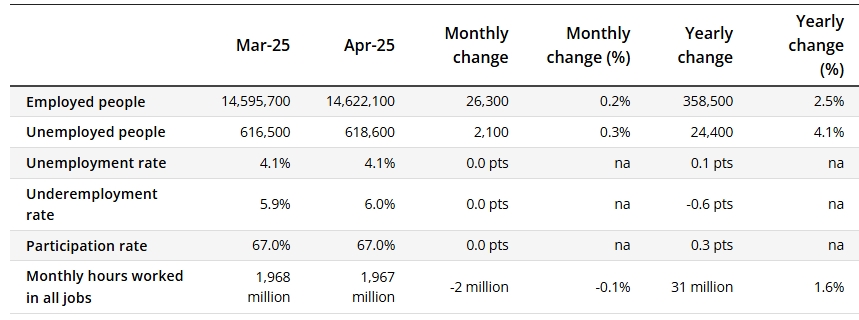
Key statistics - Trend (Source: ABS)
“In trend terms, the employment-to-population ratio remained at 64.3% in April, while the participation rate remained at 67%,” said Sean Crick, ABS head of labour statistics.
The rise in employment was larger for females, up 65,000 or 0.9%, led by 1.1% growth in full-time workers. Male employment rose 24,000 or 0.3%.
“The participation rate for 35-44 year olds had the largest annual growth, up 1.9 percentage points to 88.3%,” Crick said.
Despite the robust employment figures, the underemployment rate edged up to 6%, suggesting that some workers are seeing more hours. Monthly hours worked increased slightly to 1.96 billion, reflecting the overall rise in employment.
Over the year, employment has grown by 390,000 people, or 2.7%, well above the population growth rate of 2.1% for people aged 15 years and older.
“The strength in employment continues to be outsized compared to conditions in the economy,” said Belinda Allen, senior economist at Commonwealth Bank of Australia. “Much of this difference is being driven by non-market employment.”
Disruptions, looking ahead
The ABS noted that flooding in Townsville during February and March led to disruptions in data collection for the region. To mitigate this, the ABS imputed data for April based on previous responses, advising caution when interpreting regional labour statistics for Queensland.
The figures suggest a resilient labour market, which may lead the RBA to be more cautious in adjustments to interest rate policy later in 2025.
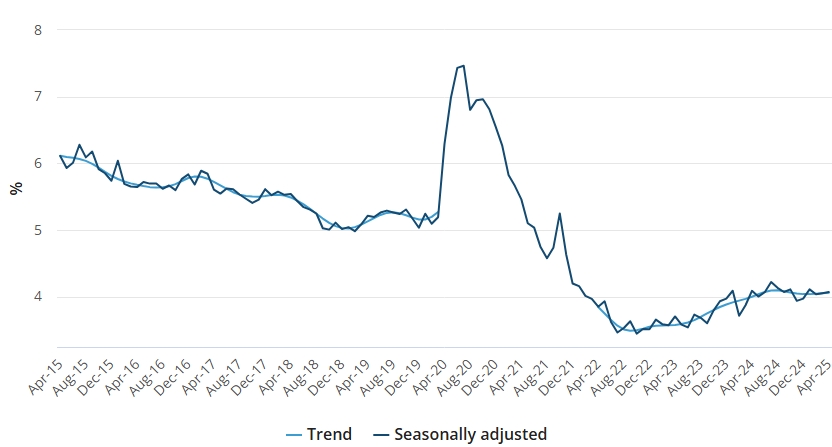
Unemployment rate (Source: ABS)
Following the strong jobs print, markets marginally reduced the probability of a 25-basis-point rate cut at next week’s RBA meeting. The first-quarter wages growth report released Thursday also flagged an upside surprise from administered wages growth and public sector agreements, Allen noted, but there is no evidence yet of a spillover into individual agreements.
“Despite the strength in employment, the key labour market metric for the RBA is the unemployment rate, and we expect this to be front of mind next week for the RBA,” she said.
Expectations of a full percentage point cut by the end of the year have also dropped, with markets now pricing in just 0.73 basis points of cuts.
“The data today shows the labour market remains in a robust position,” Allen said. “Employment growth is continuing, the unemployment rate remains low, but in line with RBA expectations.”