
Australian wages growth picked up over the March quarter, with new data from the Australian Bureau of Statistics showing a 0.9% pickup in seasonally adjusted terms, bringing annual wage growth to 3.4%.
The quarterly increase slightly exceeded market expectations of 0.8%, indicating a modest acceleration in wage growth compared with the December quarter’s 0.7% rise.
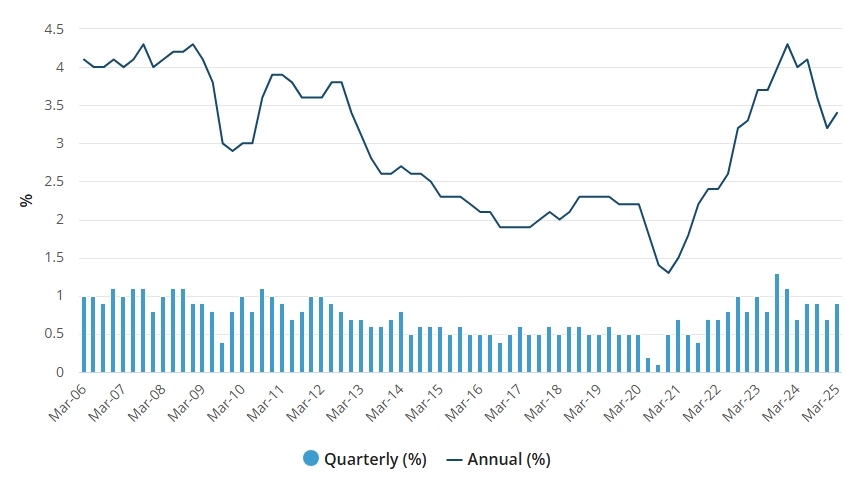
All sector WPI, quarterly and annual movement (%), seasonally adjusted (Source: ABS)
“Annual wage growth ticked up for the first time since the June quarter 2024,” said Michelle Marquardt, ABS head of price statistics. “The 3.4% increase in wages for the year to the March quarter 2025 was higher than the 3.2% to the December quarter 2024, but lower than the 4% at the same time last year.”
Health and education lead the way
The public sector led growth with a 1% increase, while the private sector saw a 0.9% rise. Within the private sector, 15% of jobs recorded a wage change, up slightly from 12% in the March 2024 quarter. Almost two in five private sector jobs recorded a wage change – the highest proportion since 2018.
Notably, industries such as health care and social assistance (+1.4%) and education and training (+1.3%) were significant contributors to the quarterly wage growth. The mining sector, which recorded a 0.5% quarterly rise and a 3.5% annual rise, was among the lesser contributors to growth.
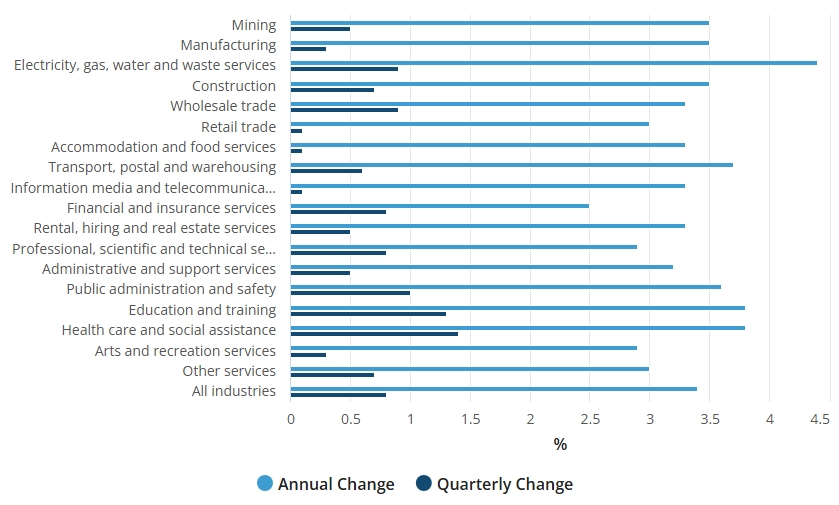
Annual and quarterly movement - industries (Source: ABS)
“Private sector wage growth was also influenced by administrative wage adjustments due to the Stage 3 Aged Care Work Value Case and the Early Childhood Education and Care Worker Retention Payment,” Marquardt said. “It was also impacted by regular March quarter wage and salary review.”
Real wages improve; RBA in focus
The reported wage growth outpaced the Consumer Price Index inflation rate of 2.4% over the same period, suggesting a real wage increase of about 1%, which should provide households with some cost-of-living relief.
With the 3.4% print, the Reserve Bank of Australia also beats its target of reaching that rate of annual wages growth by June 2025. Nonetheless, analysts are still expecting just a 25-basis-point cut from the RBA next week.
“While March was an upside surprise, we do not believe it is enough to prevent a May rate cut as it was still consistent with the moderation in wages we have been expecting,” Westpac senior economist Justin Smirk said. “However, we are very interested to see how the RBA characterises wages in their forward-looking assessment of risks to inflation.”
Growth concentrated in key sectors
Among pay-setting methods, the largest contributor to quarterly wages growth in the latest report was enterprise agreements, which constituted 54% of growth.
By state and territory, New South Wales was the main contributor to quarterly wages growth, and the main drivers were private sector jobs and new state-based enterprise agreements in the public sector. Western Australia recorded the highest quarterly growth, at 1%, and the Australian Capital Territory saw the highest annual growth, at 3.9%.
While the overall wage growth is encouraging, observers emphasised that much of the increase came from specific public sector agreements, particularly in aged care and early childhood education. Wage growth in other sectors, such as retail and accommodation, remains subdued, with increases as low as 0.1%.
In addition, fewer jobs received a wage increase greater than 4% over the last year, continuing a trend of successive quarterly declines since the June 2024 quarter.
SME data hints at blue-collar strength
According to Employment Hero CEO Ben Thompson, platform data covering more than 300,000 small and mid-size enterprises shows even stronger wage growth than the ABS print. He said blue-collar roles have been powering the wage momentum on the company’s platform, where construction led all industries with 8% growth.
“The biggest gains aren’t coming from corner offices or coding hubs; they’re coming from construction sites and small businesses hiring at the coalface of the economy.”
At the same time, he noted, hours worked are not keeping pace as pay packets grow.
“That gap raises big questions about productivity, sustainability, and whether wage growth is being driven by genuine efficiency or short-term competition for labour.”