
- FTSE 100 down 2 points at 8,603
- UK pension fund giants agree to invest 10% in private markets
- Unemployment rises to 4.5%, pay growth slows
- Marston's and Wickes impress, Revolution Beauty plunges
4:58pm: FTSE closes flat
The FTSE 100 Index slipped 2.06 points to 8,602.92, a marginal decline of 0.024% today.
4.15pm: FTSE just below flat
The FTSE 100 is trundling towards a small loss on Tuesday, led by declines for classic defensive stocks, including tobacco, drugs, drinks and utilities.
GSK and AstraZeneca are down, along with Haleon, British American Tobacco, Imperial Brands, Diageo, Severn Trent and United Utilities.
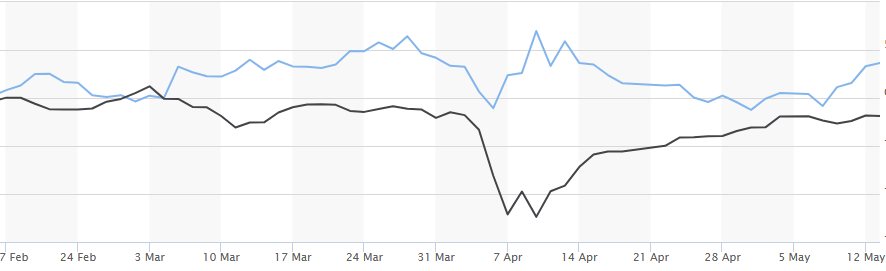
It comes after bond yields climbed sharply in recent days -- with the relationship seen between the 10yr gilt (blue line) and the FTSE (black line) in the chart below, often but not always moving in opposition to each other.
Top of the leaderboard was Ladbrokes owner Entain, despite being hit by a legal action from a group of institutional investors.
The action was filed by US law firm Morgan, Lewis & Bockius, represents 10 firms, over a financial markets matter, The Laywer magazine reported.
Miner Anglo American was next, up 3.5%, followed by British Airways owner IAG and wealth manager St James's Place.
IAG had the wind beneath its wings after its results on Friday, with analysts' views still pouring in.
St James's was lifted by a positive Deutsche Bank note on the wealth manager’s new charging model.
3.44pm: Starling Bank breaches
Starling Bank has been told by the competition watchdog to carry out an external review and improve compliance training, for essentially breaches relating to its customer satisfaction surveys.
The Competition & Markets Authority said the challenger bank had breached rules relating to data it fed into customer satisfaction surveys and for over-reporting the number of accounts held by customers over almost four years.
It was found to have excluded 17% of personal account customers from data it gave to a market research company in 2023 and 2024 on two occasions.
The CMA said excluding a large number of customers from the data was a "material breach", and while the impact on the rankings was likely “negligible”, it risked undermining consumer confidence in the survey results.
"We are not convinced that Starling Bank is capable of preventing further breaches," the CMA said, based on promised initiatives from the bank, and the watchdog also raised concern "that there may be an underlying weakness in Starling Bank’s procedures".
It follows Starling's £29 million fine in October from the Financial Conduct Authority over “shockingly lax” anti-money-laundering controls, including for individuals facing government sanctions.The CMA said it was “concerned that there may be an underlying weakness in Starling Bank’s procedures.” It added:
Starling said it had identified the reporting errors related to the CMA’s customer satisfaction surveys and handed itself, apologised and changed its processes to prevent a recurrence.
2.53pm: US stocks open higher
It's a mixed open for US stocks, with the S&P 500 up 0.3% and the Nasdaq climbing 0.8%, but the Dow Jones down 0.4%.
The Dow is being weighed down by an 11% fall for health insurance giant UnitedHealth Group after it withdrew guidance.
Other health care names are also dragging, with Merck & Co, Johnson & Johnson and Amgen next on the fallers list.
Top risers on the S&P include Super Micro Computer, Palantir and Nvidia.
Back in London, the FTSE 100 is still flat.
1.40am: US futures pick up on inflation data
US inflation has come in as expected, which has seen US stock futures spike higher.
Headline CPI was up 0.2% in April on a month-on-month basis (lower than the 0.3% expected), lowering the yearly rate to 2.3% from 2.4%, a new four-year low.
Core CPI was up 0.2% in April, keeping the YoY rate at 2.8%, as expected.
US stock futures have spiked. The S&P 500 is seen rising 0.2% and the Nasdaq 0.4%.
1.05pm: UK forecasts upped too
Goldman Sachs has also lifted its UK growth forecast.
The US bank now expects cumulative real GDP growth of 0.6% from the second quarter to the fourth quarter, versus a prior forecast of 0.4%.
12.44pm: European shares modestly positive, Wall Street futures in red
The FTSE 100 has dawdled higher as the session has worn on, helped by bond market yields in the US and UK flattening or easing after rises in recent days.
London's blue-chip index and Continetnal peers in Germany and France are all up between 0.1% and 0.2%.
US stock futures are mostly in the red.
S&P 500 fiutueres are down 0.25%, with those for the tech-powered Nasdaq down less than 0.2% and for the Dow Jones down 0.6%.
The Dow is being hit most as UnitedHealth shares are down 10% premarket after the health insurer suspended its 2025 outlook and announced a CEO change.
11.55am: Goldman ups US growth forecast
Goldman Sachs has upped its US growth forecasts, following the Trump administration's agreement of a 90-day pause on tariffs with China, which will leave the US and China with 2025 tariff increases of 30% and 15%, respectively.
"While we had expected a de-escalation, the rate is lower than the +54pp tariff hike we had penciled into our baseline. We expect this move to leave the US effective tariff rate increase at +13pp, assuming that likely sectoral tariffs on pharmaceuticals and semiconductors take effect, slightly below our previous assumption of +15pp."
In light of the pause and the "meaningful easing in financial conditions" over the last month, Goldman has hiked its 2025 growth forecast by 0.5 percentage points to 1% in the fourth quarter, and reduced its 12-month recession odds to 35%, down from 45% just over a month ago.
(There is some criticism on social media about economists using such odds.)
"Under our new economic baseline, the rationale for rate cuts shifts from insurance to normalization as growth remains somewhat firmer, the unemployment rate rises by somewhat less, and the urgency for policy support is reduced.
"We expect the Fed to begin a series of three cuts later than we had previously expected (December vs our prior expectation of July) and to implement them at every other meeting rather than sequentially."
11.20am: Marston's better than expected
The interim results from Marston were viewed as "highly encouraging" by analysts at Shore Capital's Gren Johnson, while Peel Hunt's Douglas Jack says the pubco's profitability is "rising well ahead of expectations".
Indeed, PBT of £19 million reflected better than anticipated operating performance, with net debt falling again, and current trading remaining robust.
"A key pillar of the Marston’s investment case is debt reduction and deleveraging," says Johnson, who was also encouraged to see a further £3 million reduction in net debt to £881 million and free cash flow of £6 million in the seasonally slower first half.
The statement highlights progress against the targets set out at last year’s capital markets day, including a step-up in capex to 6-7% of revenues, along with digital transformation through order & pay by phone from customers' tables, which has led to revenue per transaction rising 10%.
Shore Cap reckons delivery of these targets could see EPS build towards 15p per share over the medium term, "comfortably above current forecasts".
Both analysts say they're keeping their forecasts unchanged.
10.59am: Concerns and praise for Mansion House Accord
On the Mansion House accord, due to be set out in more detail by the Chancellor later, mandating large pension funds to invest around £50 billion in UK assets, Lisa Picardo, chief business officer UK at PensionBee has some concerns.
"If this genuinely offers an opportunity for strong returns with sufficient liquidity, these asset classes will attract capital without the need for compulsion," she says.
"However, the threat of mandation forcing schemes to allocate capital is deeply concerning, especially when it relates to private markets assets, where returns can be opaque, costs can be high and liquidity is limited.
"Whilst we support efforts to boost UK investment and growth, and to improve returns, legislation must not override a schemes’ duty to act solely in the best interests of its members. That principle must be respected and upheld."
Meanwhile, the Investment Association's CEO, Chris Cummings, says he is "pleased to see a broader definition of private market investments, including property and infrastructure," something the IA has advocated for.
"Private markets can play an important role in improving outcomes for investors through greater diversification, while ensuring more capital is directed to the parts of our economy with the most productive potential," he says.
"Alongside measures to boost UK capital allocation by pension schemes, further reforms to improve the attractiveness of UK capital markets for all investors will help the government to achieve its growth objectives."
Still awaited are potential changes in the forthcoming Pension Schemes Bill and the next phase of the Pensions Review, Cummings noted.
10.06am: US equities downgraded
After the US and China agreed to lower tariffs for 90 days while talks continue, UBS says US court challenges to the Trump administration’s tariffs starting this week "could provide another path to lower import levies".
UBS has downgraded US equities to 'neutral' from 'attractive', following the recovery in the S&P but continued volatility expected.
Mark Haefele, chief investment officer of UBS, says: "A growing docket of legal challenges and the steady erosion in presidential approval ratings are leading to gradual but substantial rollbacks in tariffs.
"The upcoming court challenges to the Trump administration’s tariffs could accelerate this process, and the Court of International Trade’s hearing on 13 May regarding the unprecedented use of the International Emergency Economic Powers Act (IEEPA) of 1977 could play a pivotal role in determining the legality of the tariffs.
"While the outcome remains uncertain, these legal developments warrant close monitoring and could become a key force in lowering tariffs in the months ahead."
The UBS view is that the net effect will be an effective US tariff rate around 15-20% by year-end, compared to roughly 25% currently.
If tariffs remain as they are under the US-China 90-day reprieve, UBS estimates the impact on the US economy would be "similar to a 2% VAT hike. It would hurt growth in the near term and push up prices, but should not trigger a full-blown recession."
On the downgrade, he says: "While the 90-day cooling-off period has provided a reprieve, uncertainty is still high, and investors will soon begin to focus on whether this temporary fix can evolve into a lasting agreement."
9.37am: M&S says customer data was compromised
Marks and Spencer Group PLC (LSE:MKS) has confirmed that some personal customer data was compromised during the cyber-attack that has disrupted its online operations for over three weeks.
While payment details and account passwords were not accessed, names, addresses, and order histories were taken.
The company said there is no evidence that the stolen data has been shared and reassured customers that payment information is not stored on its systems.
"For extra peace of mind, they will be prompted to reset their password the next time they visit or log onto their M&S account and we have shared information on how to stay safe online," M&S said.
The company is still working with law enforcement agencies.
9.16am: Jobs data suggests further gradual rate cuts from BoE
Looking at the ONS labour market data, British Chambers of Commerce deputy director Jane Gratton says it "suggests some loosening in the jobs market with vacancies staying below pre-pandemic levels and unemployment nudging up".
Vacancies fell to 783K in the three months to March from 801K in February, the lowest since April 2021 amidst a continuing gradual decline.
Gratton notes that the pace of salary increases has slowed but is still significantly above inflation, with CPI at 2.6% in March.
"The rising cost of employment is a major challenge for employers. Our research has been clear that business sentiment has dropped due to the National Insurance (NI) increase and other changes to employment policy.
"The situation is likely to get worse for employers in the months ahead. Although vacancies are now more than half a million below their pandemic peak, firms tell us recruitment remains a huge challenge."
Economist Rob Wood at Pantheon Macroeconomics says the labour market "continues to ease gradually", which justifies further interest rate cuts from the Bank of England.
HMRC payroll data shows employee numbers fell by 33K month-to-month in April, down from a 47K fall in March (revised up from an estimated 78K fall).
While the collapse in March payrolls was revised up, April’s month-to-month payrolls "leaves a picture of employment falling now", he says.
January-March 2025 Labour Force Survey data from the ONS "should be more reliable because they reflect the full effect of improved ONS data collection introduced a year ago", he adds.
"Importantly, LFS jobs include the self-employed who are excluded from payrolls and are likely rising rapidly in number after Chancellor Rachel Reeves’ tax changes, so payrolls probably underestimates job growth. The upward creep in the LFS unemployment rate to 4.5% in March matches the broad picture of an easing labour market."
However, Wood thinks that April "reflects the low point for job growth as firms finished the major adjustments to workforces ahead of payroll tax hikes in early April", with official redundancies falling to 110K in March from 117K in February and 124K in January.
"There is enough here for the MPC to justify further rate cuts," Wood says. "Rate setters will likely be particularly attentive to vacancies continuing to fall and now suggesting that the labour market is loose."
But he also sees enough to justify the BoE committee continuing with its "gradual and cautious" approach to rate cuts, with PAYE median pay growth still strong and early indicators suggesting the worst of the payroll tax driven labour market shake-out is past.
8.39am: Rev Beauty plunges
Shares in Revolution Beauty Group PLC (AIM:REVB) have plunged 41% following a full-year trading update revealing a 26% drop in revenue and that management is reviewing funding options, with discussions ongoing with banking partners.
Talks have concerned "amending and extending" the current £32 million revolving credit facility (RCF), which is set to expire in October.
"While the board has confidence in the future medium-term prospects for the company, cash management has been tight and it is clear that the delivery of the strategy will benefit from a more robust capital structure with additional capital to invest into the company," the cosmetics brand says.
8.16am: FTSE 100 opens lower, flips higher
The FTSE 100 opened 18 points lower, but has just broken back into positive territory.
Fallers include insurers, tobacco companies and other defensives, including Beazley, Hiscox, Imperial Brands and BAT.
Risers are led by Ladbrokes owner Entain, followed by Kingfisher, parent company of the B&Q home improvement retailer after the good news on UK retail sales this morning.
7.55am: Pension funds commit to 5% investment in UK
Aviva PLC (LSE:AV.), Legal & General Group PLC (LSE:LGEN) are among 17 other pension fund managers that have agreed to allocate 10% of their workplace pension investments into "private assets" by 2030.
The signatories of the new ‘Mansion House accord’, who together hold roughly £219 billion of funds in defined contribution (DC) pensions, have agreed to invest 5% of that into UK businesses, property and major infrastructure projects.
It is an increase on the previous Mansion House compact of 2023 that agreed an allocation of 5% of funds to private assets.
Chancellor of the Exchequer Rachel Reeves said: “We are choosing to back British businesses and British workers. I welcome this bold step by some of our biggest pension funds, which will unlock billions for major infrastructure, clean energy and exciting startups."
Other signatories include Aegon, M&G, Phoenix Group Holdings PLC and the Universities Superannuation Scheme.
7.48am: Marston's and Wickes
In company news, Marston’s PLC (LSE:MARS) has reported 20% growth in profits in the first half of its financial year, while revenues were flat.
CEO Justin Platt hailed the period of "significant momentum", with investment in pub formats and progress in "digital transformation" with data and technology used to improve labour deployment and procurement.
Elsewhere, Wickes Group PLC (LSE:WIX) has provided a trading update for the first 17 weeks of 2025, showing revenue up 6.9% year on year, driven by sales volume growth.
Retail revenue rose 9.6%, while its Design & Installation division saw a 0.4% decline, which it noted was an improvement on the precious quarter.
The weather played a part, with the week of the early May bank holiday seeing the chain's biggest ever week for sales of compost and top soil.
7.22am: Unemployment up, wage growth slows
As well as the UK ILO unemployment rate rising to 4.5% from 4.4%, while wage growth slowed slightly.
Average weekly earnings grew 5.5% in the theree-month period, down from 5.6%. Excluding bonuses, wages grew 5.6%, down from 5.9%.
ONS director of economic statistics Liz McKeown said: “Wage growth slowed slightly in the latest period but remains relatively strong, with public and private sectors now showing little difference.
“The broader picture continues to be of the labour market cooling, with the number of employees on payroll falling in the first quarter of the year. The number of job vacancies has also fallen again, with the rate of decline increasing in the last few months.”
7.15am: FTSE 100 called lower
The FTSE 100 has been called lower ahead of Tuesday's open, as UK unemployment figures were published and following a strong performance at the start of the week following US-China trade talks.
London's blue-chip index was expected to start with a 15-point decline, detracting from the 50 points gained yesterday by the close at just under 8,605.
There were strong gains on Wall Street overnight, with the Nasdaq jumping almost 4.4%, the S&P 500 gaining 3.3% and the Dow Jones 2.8%.
Asian markets are mixed this morning, with Japan's Nikkei 1.7% leading the gains, but the Hang Seng down 1.3% in Hong Kong.
UK labour market data just out shows the unemployment rate rose to 4.5% in the three months to March from 4.4% a month earlier.
What to watch on Tuesday
Bytes Technology Group PLC (LSE:BYIT, JSE:BYI), the FTSE 250 Microsoft reseller, gave its shares a big lift in March as it put fears to rest after a share dealing misconduct investigation into former CEO Neil Murphy last year...read more
The UK jobs market will be in focus, including wage growth, plus retail sector data from the BRC.
Announcements due on 13 May:
Interims: On The Beach Group, Renew Holdings, Treatt
Finals: Angling Direct, Bytes Technology Group, DCC, Diaceutics, IQE
Overseas earnings: Bayer, Ferrovial, Honda Motor, JD, Nissan Motor, Nu, Softbank, Tata Motor, Tencent Music, Under Armour, Yamaha Motor
AGMs: Baronsmead Venture Trust, Henderson High Income Trust, Hutchmed (China) Limited, ITV, James Fisher & Sons, MacFarlane Group, Midwich Group, Phoenix Group Holdings, Serinus Energy, St James’s Place
Economic announcements: Unemployment and Wages (UK), BRC Sales Monitor (UK), ZEW Survey (EU), Consumer Price Inflation (US)