
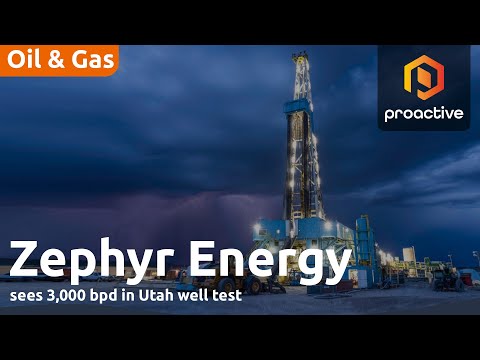
Zephyr Energy PLC (AIM:ZPHR, OTCQB:ZPHRF) earlier this week reported strong production test results from its latest well in the Paradox Basin, Utah.
The company said the test delivered flow rates of up to 3,000 barrels per day, significantly outperforming comparable onshore U.S. wells, despite not undergoing fracking.
Zephyr Energy said the production test followed a highly structured protocol and confirmed performance far beyond expectations, even at low choke settings.
The company noted that comparable wells typically yield between 500 and 750 barrels per day.
Zephyr chief executive Colin Harrington joined the Proactive studio to give more insights.
Proactive: Joining me is Zephyr Energy CEO Colin Harrington. Colin, very good to speak with you.
Could you walk us through the key highlights from this latest well test and what makes these results significant?
Colin Harrington: Sure. Happy to do so. Nice to see you. We're really, really excited about the results of this test.
We were doing something novel — first of a kind in this basin — and things went exactly to plan operationally. The key takeaways are the flow rates.
We saw exceptional flow rates.
These tests are highly structured. You start by cracking the choke just a tiny bit, let the well clean up, and observe it at that small choke setting.
We were well above expectations even at that level.
We saw between 700 and over 1,000 barrels per day consistently, with no pressure drawdown — a great sign.
When we opened it up slightly more, it really took off. We reached nearly 3,000 barrels per day.
We could’ve gone higher, but we were nearing the limits of our production testing infrastructure. So we're very happy with the production levels.
Let me put that in context. In comparable U.S. onshore basins, one-mile laterals with fracking might produce 500 to 750 barrels per day, tailing off quickly.
Our well wasn’t fracked and still outperformed that significantly. It's definitely in the highest quartile for one-mile laterals.
Other highlights include elevated liquid yields, which support strong economics, and very little produced water, which lowers disposal costs.
This was also our second use of the acid design test, and again, it worked exactly as planned. So we’re thrilled with the overall results.
Proactive: You've mentioned clear commerciality based on this production test.
What are the indicators that give you confidence that this well can support a commercial development?
Colin Harrington: For this single well, it’s more than enough to install gas processing equipment and produce commercially. There's a lot of rate here.
There’s no question in our minds — this is a clearly commercial well.
Proactive: The data suggest strong inflow across the full 5,000-foot lateral, especially compared to your earlier test.
What does this mean in terms of reservoir potential and future production upside?
Colin Harrington: We did something unusual in the design. We installed a Halliburton-designed fibre optic cable behind the tubing.
That allowed us to gather a huge amount of data.
This isn’t common, but we’re in full data-gathering mode — not just for our own understanding but also so potential industry partners can evaluate the opportunity with us.
The whole length of the lateral is producing. We can see exactly which fractures contribute most, and it aligns closely with our models. That’s great to see.
We’ve got data on productivity, contributing well length, and reservoir flow from both fractures and matrixes.
All of this will go into our model and lead to an ERS estimate — the total estimated potential of the well.
Proactive: How do these initial results shape your next steps for the broader Paradox project? What should investors expect in the coming months?
Colin Harrington: The next big step is to analyze the data and provide a valuation of the reserves. We’re getting fluid samples now and will have testing back soon.
Then we’ll send everything to a third-party reservoir engineering firm for an updated CPR.
We'll also be working with our gas marketing partners and infrastructure design team to size the processing plant.
The goal is to turn this from a discovery well into one that generates cash flow.
We’ll be speaking with potential strategic or investment partners to help us advance this. It's a big play with a lot of inventory, and we want to move quickly.
Proactive: Colin, I hope you'll keep us updated on any progress.