
Asian Battery Metals PLC has reported further progress in its Phase 3 diamond drilling campaign at the Oval copper-nickel-platinum group element (Cu-Ni-PGE) discovery in Mongolia, with high-grade sulphide intersections logged and assays pending. The campaign has confirmed the geometry of high-grade and massive sulphide zones, and identified potential magmatic feeder systems, enhancing confidence in the prospectivity of the broader Yambat Project.
Significant results include a 1.8 metre high-grade sulphide zone intersected in OVD032, interpreted as a feeder dyke, and 28.7 metres of net-textured sulphide from 91.3 metres downhole in OVD033. Drillhole OVD034 also returned 1.3 metres of massive sulphide grading 12.0% chalcopyrite, 74.0% pyrrhotite, and 6.0% pyrite. A downhole electromagnetic (DHEM) survey has identified new conductive targets to be tested in upcoming drilling.
“The results from OVD032 and the deeper part of OVD033 are a game-changer for the Oval discovery in understanding the potential pathway of the magmatic conduit. The team and technical advisors are reviewing the current geological information and planning the next exploration activity using deeper penetrating geophysics and results from the latest drilling at Oval,” AZ9 managing director Gan-Ochir Zunduisuren said.
“This work will be instrumental not just at Oval and but also regionally, where drilling is currently underway. The continued successful results confirm our belief about the potential emerging scale across the broader Yambat Project.”
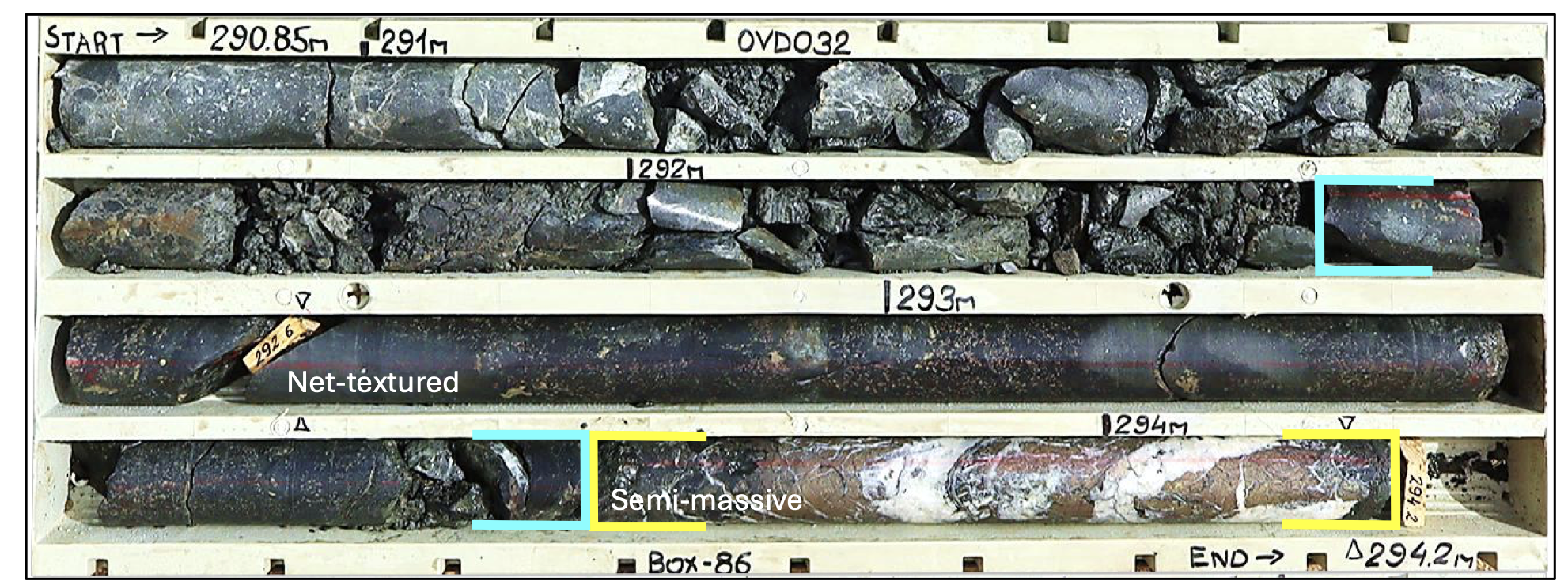
The various textured sulphide mineralisation in drillhole OVD032.
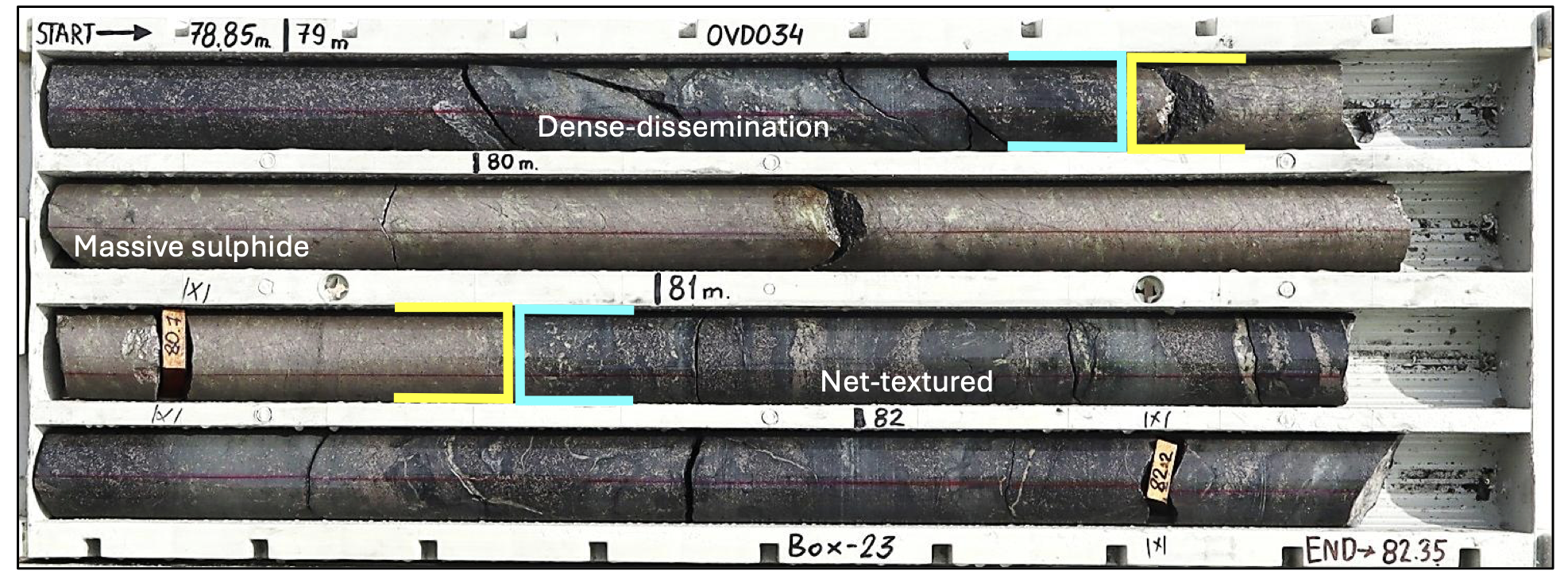
Massive-sulphide intersection from 79.6m to 80.9m in drillhole OVD034.
Possible feeder dyke
OVD032 was designed to test below previous mineralisation and intercepted 1.8 metres of high-grade sulphide from 293.7 metres to 295.2 metres, including 0.5 metres of semi-massive sulphide and 1.3m net-textured mineralisation as well as various magmatic dykes further downhole. This interval, located within a symmetrically zoned composite dyke, suggests a potential conduit system linked to the Oval intrusion. A newly defined DHEM plate (OVD032_C), located approximately 300 metres below the drill path, supports the interpretation of a deeper magmatic source.
Drillhole OVD033 intersects high-grade sulphide zone south-east of OVD0217
Drillhole OVD033 was designed to test the potential south-east to south extension of the high-grade mineralisation intersected in OVD0217. It specifically targeted the OVD021_G8 electromagnetic plate and aimed to verify the mineralisation previously intersected in OVD0229, but at a deeper level where grades may be enhanced.
The hole returned multiple zones of mineralisation between 91.3 metres and 120.0 metres downhole, ranging in intensity and including high-grade, net-textured, and heavily disseminated sulphide intervals. According to Table 1, the texture and spatial positioning of this mineralisation show a strong correlation with that encountered in OVD0217.
A particularly well-mineralised zone was logged from 161.0 metres to 166.5 metres downhole, comprising net-textured sulphides of higher tenor. This zone appears consistent with mineralisation immediately surrounding the massive sulphide intercept in OVD0217, suggesting a continuation of the massive sulphide body encountered in both OVD0217 and OVD02710 at depth along strike.
However, the downhole electromagnetic (DHEM) survey was constrained by ground conditions. A collapse in the fault zone at 135.5 metres prevented measurement beyond this point, despite repeated remediation efforts by the drilling contractor.
OVD034: Broad sulphide mineralisation confirms extension of high-grade zone
Drillhole OVD034 was designed to test the north–south extension of the high-grade zone previously intersected by OVD02613, with a focus on the OVD026_L2_A plate. The hole followed up on mineralisation observed in OVD02612, which returned 19.8 metres of higher-grade material from 91.2 metres depth, averaging 1.23% copper (Cu), 0.98% nickel (Ni), and 0.36 grams per tonne (g/t) platinum group elements (E3).
OVD034 intersected a continuous mineralised sequence comprising multiple sulphide textures:
- 57.0 metres of weakly disseminated mineralisation
- 22.2 metres of moderately disseminated mineralisation
- 10.1 metres of densely disseminated and net-textured mineralisation
- 1.3 metres of massive sulphide mineralisation
OVD035: Magnetic anomaly tested for structural link — no mineralisation encountered
Drillhole OVD035 targeted a magnetic anomaly interpreted as a possible connection between the Oval and North Oval targets. While no significant mineralisation was encountered, the hole intersected spotted rock and gabbro-diorite lithologies, contributing to broader geological understanding.
A downhole electromagnetic (DHEM) survey is planned to identify any off-hole conductors. No sectional view is included for OVD035, as the geology intersected is not considered materially significant to the Prospect at this stage.
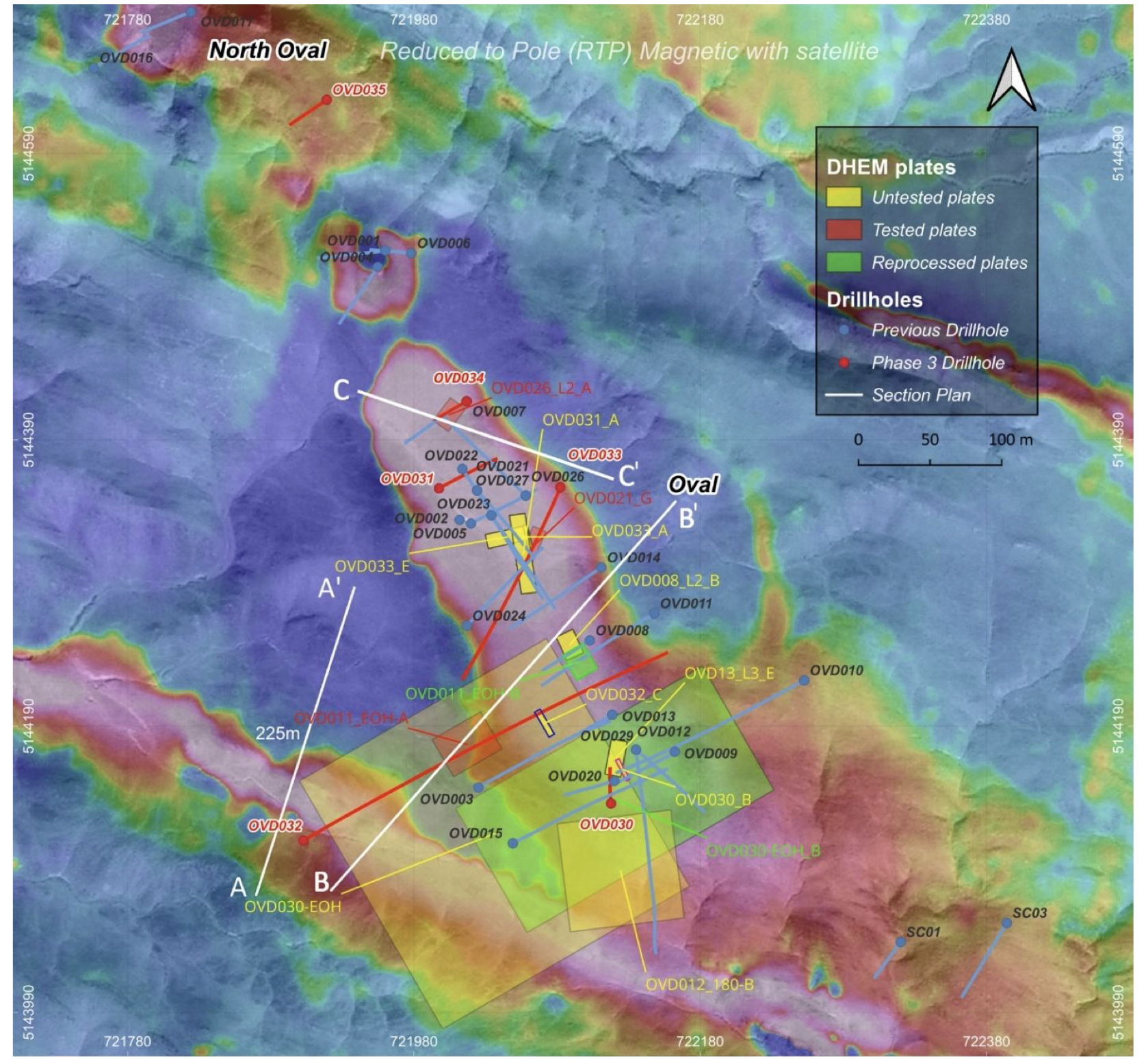
Phase 3 plan map of DHEM plates and completed drillholes on Reduced to Pole (RTP) Magnetic map.
Next steps
Asian Battery Metals has outlined a comprehensive suite of exploration activities aimed at advancing the understanding of the Oval discovery’s magmatic system and expanding the broader regional footprint.
The company is currently reviewing and testing the potential conduit feeder or magma chamber beneath the Oval target through deeper-penetrating geophysical surveys and targeted drilling. This work is designed to delineate the geometry and depth of the mineralising system and refine future drilling priorities.
Drilling of regional step-out targets is already underway, with the first batch of assay results anticipated from late May 2025. In parallel, a ground-based SAMSON Fixed Loop Electromagnetic (FLEM) survey is set to commence shortly to enhance detection of subsurface conductive bodies that may indicate sulphide mineralisation.
Additional regional fieldwork and drilling are scheduled at the Copper Ridge and CR Far East prospects, which lie along the broader structural corridor. These efforts will be supported by ongoing interpretation of downhole electromagnetic (DHEM) data, including a review and refinement of existing plate models to inform next-phase targeting.