
Genflow Biosciences PLC (LSE:GENF, OTCQB:GENFF) outlined recent developments across its pipeline following the release of its 2024 results.
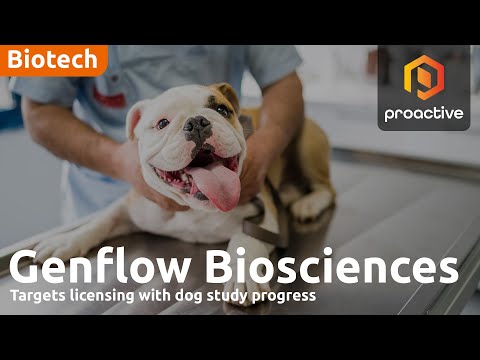
The company said it had made progress on multiple fronts, including its core MASH program, additional indications such as Werner syndrome and sarcopenia, and a newly initiated proof-of-concept study in dogs.
The company said it received positive feedback from the US Food and Drug Administration, which will allow it to initiate clinical trials in MASH patients rather than healthy volunteers.
Chief executive officer Dr Eric Leire told Proactive about it.
Proactive:
Eric, very good to speak with you. You're out with your 2024 results this week. It looks like you've made good progress across your research programs. Take us through some of the highlights.
Dr Eric Leire:
Yes, you're right. We've made some very good progress. We've mostly broadened our portfolio of programs. We are focusing on MASH and decided to also move on with different programs. As you know, the biotech index (XBI) is not doing great. As a biotech company, we have the choice — either to wait for the storm to pass and conserve our cash, or to move forward. Because in preclinical, we got some very encouraging and promising results on a centenarian Sirtuin 6 (SIRT6), we decided to move on. We're progressing not only with MASH, but also with Werner syndrome, sarcopenia with partners, and the dog study.
Proactive:
And in fact, you got some very positive feedback from the FDA on MASH, Eric. So what's the next step?
Dr Eric Leire:
The next step is to prepare for the clinical trial. The bulk of this preparation is about having a product manufactured under GMP (good manufacturing practice) conditions — exactly the same as the commercial product. It’s a long and costly process, and we're doing it with the help of a grant.
The good thing is, rather than starting with Phase 1 in healthy volunteers — which only establishes safety and not efficacy — we’ll be allowed to start directly with MASH patients. That’s very positive because demonstrating safety alone doesn't increase a company’s valuation significantly. A glass of water is safe, but it’s not valuable unless it does something. If it cures cancer, it becomes very valuable. So that’s where we are on MASH.
Proactive:
In fact, you raised €4 million in funding commitment. That was from the Wallonia region for your GF-1002 development. You've also had some equity funding, so you have managed to put the funds in place to take your programs forward?
Dr Eric Leire:
Yes, it's a vote of confidence in the company. Again, we could have decided to freeze everything due to uncertainty in biotech, but the results are so good that we made the decision to move on — also with the dog study. That study is important.
What I’d like to point out for investors is that yes, times are uncertain and we're moving forward. But we’re not moving forward blindly. The MASH program is a long-term investment due to the highly regulated nature of human clinical trials. In animal health, the regulatory burden is lower. So we’re doing a proof-of-concept study in dogs, and the timeline for a potential exit is much shorter.
We’ve initiated the study, which will take six months plus analysis. That means we could have a business development deal, licensing, or sale of the product within a year. It could also be a source of non-dilutive funding — similar to a grant — through an upfront payment.
We’re obviously not an animal health company. We don’t have that expertise. So it makes sense to demonstrate proof-of-concept and then partner or license. The study is being run by Syngene, a major CRO. It’s comparative, randomized, with multiple valid endpoints.
Proactive:
Eric, apart from the dog study, what else should investors be looking out for as 2025 progresses?
Dr Eric Leire:
There’s a very important piece of the puzzle: intellectual property. In biotech, patents are essential. Our patents on MASH and the SIRT6 gene are moving to the national phase. That means we've passed all initial steps and are now filing country by country.
We’ve just submitted the Japanese patent. Once patents are issued at the national level in multiple countries, it puts us in a different category as a company. We expect the company’s valuation to increase accordingly.
Proactive:
Eric, I hope you'll keep us updated on progress with that as well as with the studies. Thank you very much for speaking with us today.