
First Phosphate Corp. (CSE:PHOS, OTCQB:FRSPF) CEO John Passalacqua joined Proactive to discuss the growing recognition of high-purity phosphate as a critical mineral in global supply chains.
Passalacqua highlighted that the mineral has been added to both the Québec and Canadian critical minerals lists, and is under consideration for the U.S. list.
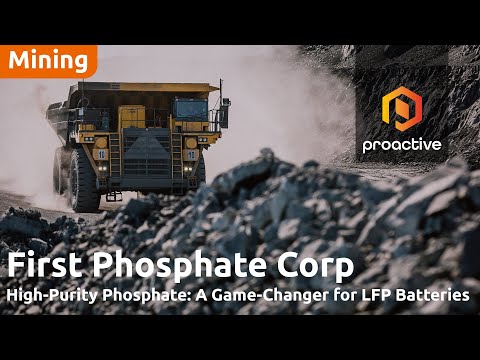
He also discussed First Phosphate’s work at the Bégin-Lamarche project in Saguenay-Lac-St-Jean, Quebec, where the company is developing a mine and downstream supply chain specifically for lithium iron phosphate (LFP) batteries.
Proactive: All right, welcome back inside our Proactive newsroom. Joining me now is John Passalacqua. He is the CEO of First Phosphate. And John, good to see you again. How are you?
John Passalacqua: Great. Thanks for having me.
So, I know phosphate is important to the work that you're doing at First Phosphate, and that was really highlighted recently in some coverage of the election in Canada.
Yes. During the candidates’ debate that took place on Thursday of last week, there was discussion at one point about critical minerals. And obviously, getting critical minerals going in Canada, expediting permitting and all that. So one of the candidates was asked about critical minerals in Quebec. And the first thing that came to his lips was really phosphate and Quebec — and phosphate, pure igneous phosphate in Quebec, being some of the purest phosphate found in North America and a real resource that should be put into place and helped to be developed.
So that's great for us because that's exactly what we've been doing quietly here for the last 2 or 3 years — developing our future mine Bégin-Lamarche in Saguenay–Lac-Saint-Jean, Quebec, and building a whole downstream supply chain around lithium iron phosphate battery, which uses this high-purity phosphate in order to make the cathode active material that goes into the LFP batteries.
And just so people are aware, those batteries would be used in a number of different applications. Correct?
Yes. So the lithium iron phosphate battery is extremely resilient, low cost, and very safe. It’s used in battery energy storage, data center and AI applications. What’s most interesting is it’s also used in robotics and all kinds of optimization on the factory floor, which is what is needed now to reshore manufacturing.
As you know, President Trump has made it his clear mandate that manufacturing should be onshore, short to North America. But how do you do that? You need workforce and tons of automation and optimization nowadays — and tons of robots. And that's all run by LFP batteries. So it’s extremely exciting times for that. The LFP battery and phosphate's prospects — high-purity phosphate's prospects — in this new paradigm that’s forming.
We should mention that there are critical lists all over North America — in the U.S. and in Canada. For instance, phosphate has been put on both the list in Quebec and also one in Canada generally.
Yes. So phosphate — high-purity phosphate — was added to the Quebec critical minerals list last year, and as well to the Canadian list last year. It's currently being considered for the U.S. list. It’s already a critical mineral in Europe. So the value of phosphate, especially in agriculture, but even more so now in batteries — the dual mandate for phosphate, especially high-purity battery phosphate — is very visible and present now. And especially when it's being discussed at the top levels of a debate in Canada amongst the political candidates, that’s very, very important for us.
It shows that we've made it right to the very top of the priority list. So we're really waiting for things to get wrapped up here — for Canada to have some new direction — and then for phosphate to be extremely valuable in terms of a critical mineral to advance in Quebec and in Canada. And we're here. We've been here. And this is kind of the moment we've been waiting for. So it's a real inflection point for this company to see that kind of debate in Canada starting up.
Quotes have been lightly edited for clarity and style