
Solis Minerals Ltd has uncovered additional high-grade copper in assays from its 100%-owned Cinto Project in southern Peru, adding weight to the company’s hypothesis that the project is shaping up as a significant porphyry copper system.
Standout intersection
Results from a new channel, Channel 11, include a standout intersection of 26.5 metres at 0.28% copper, featuring a higher-grade zone of 5.4 metres at 1.0% copper.
These assays build on earlier results from the same project area, which returned 23.4 metres at 0.88% copper and 16.8 metres at 0.52% copper from other channels.
“These results confirm the significant potential at the Cinto Project, where we've substantially expanded Solis’ porphyry copper mineralisation footprint,” CEO Mitch Thomas said.
“Notably, we're seeing mineralisation styles similar to those at the major Toquepala mine, just 15 kilometres away.
“Geophysical data from drone magnetometry supports scale potential and highlights new target areas.
“As a stand-alone project, Cinto is a compelling copper porphyry target. Our on-ground team recently hosted site visits for our technical director Mike Parker and myself across our project portfolio.
“Visible mineralisation at surface at Ilo Este and Cinto was a highlight. The clear, visible prospectivity in our projects very much aligns with our objective of identifying copper-gold resources that have potential to host large-scale mining in one of the world’s leading copper producing regions.”
The mineralisation is hosted within intrusive hydrothermal breccias, with geochemical and structural similarities to the nearby Toquepala Copper Mine – one of Peru’s largest copper producers, located 15 kilometres northwest of Cinto.
The mineralised zones discovered to date span a footprint around three kilometres long and 0.75 kilometres wide.
Geophysical surveys have revealed a strong spatial correlation between copper mineralisation and a large magnetic low anomaly, suggesting widespread hydrothermal alteration.
This anomaly, interpreted to result from magnetite destruction by mineralising fluids, provides further support for the project's scale potential.
What’s next?
Solis has initiated permitting to support a maiden drilling program at Cinto in the second half of 2025.
In the interim, induced polarisation (IP) surveys are scheduled to commence in the June quarter to refine drill targets.
The Cinto Project comprises six granted tenements covering 2,700 hectares and five additional applications spanning 2,800 hectares.
It sits within the prospective Cenozoic Porphyry Belt, a region that also hosts the world-class Quellaveco and Cuajone copper deposits.
Solis is also progressing drill programs at its Chancho al Palo and Ilo Este projects, positioning the company to potentially deliver multiple new copper-gold discoveries across its Peruvian portfolio in 2025.
““With drilling set to begin at Chancho al Palo and Ilo Este this quarter, and Cinto advancing toward drilling in the second half of 2025, Solis Minerals’ portfolio of 100% owned projects has incredible potential for discovery of multiple copper-gold resources capable of supporting mining operations,” CEO Mitch Thomas said.
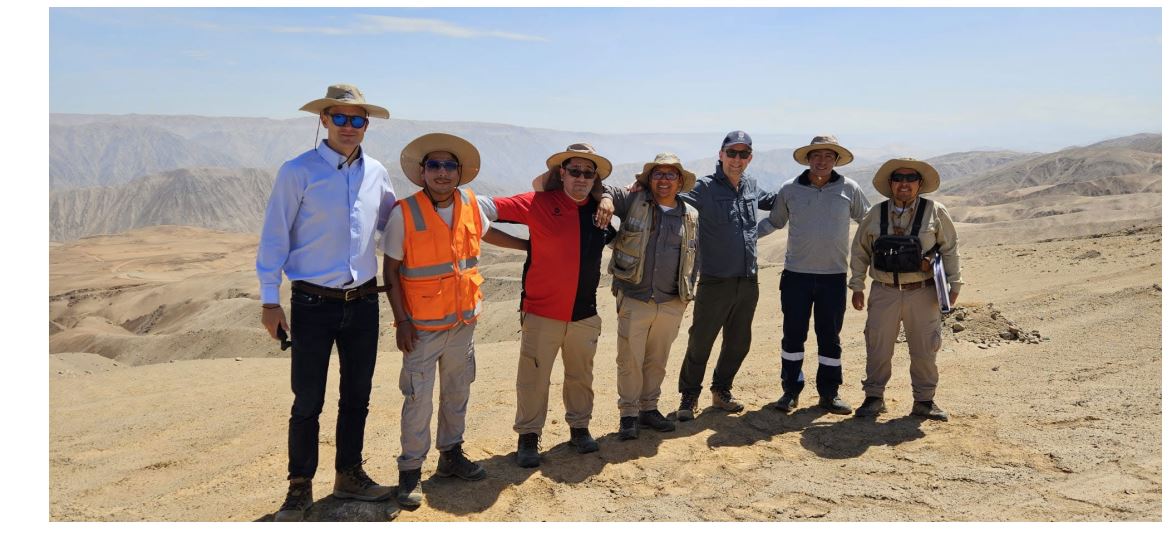
Solis Minerals’ exploration team and CEO Mitch Thomas with technical director Mike Parker during a site visit in April 2025, which included a visit to Cinto, Ilo Este and Chancho al Palo.