
- FTSE 100 rises 41 points to 8,317
- US stocks rebound after sharp drop yesterday
- Gold and bitcoin rally, after US dollar decline
- Bank of England rate cut expected next month
3.58pm: Stronger finish
The FTSE 100 is heading towards the close at its highest point of the session, up 0.5%.
Top risers are Bunzl, Experian and London Stock Exchange, while several retailers are not far behind including JD Sports, Sainsbury's and Tesco.
Fallers are led by DCC as it announced a £1 billion deal to offload its healthcare arm to double down on energy.
US-exposed Rentokil led the fallers, with Ashtead also down, as did investment trusts with a heavy focus on the US.
Losses in Europe have been turned around too, with the DAX and other indices now in green.
3.15pm: BoE rate cut expected in two weeks
It should be noted that markets are now 100% anticipating that the Bank of England will cut interest rates at the meeting next month.
Earlier this morning, markets had priced around an 82% likelihood of a cut to 4.25% on the 8 May meeting, down from the current 4.5% base rate.
But the doubt disappeared shortly after BoE rate setter Megan Green's remarks on inflation earlier.
2.57pm: Wall Street opens strongly
US stocks have opened in confident mood. The S&P 500 and Dow Jones are both up over 1.3% and the Nasdaq 1.7%
Topping the Nasdaq leaderboard is bitcoin investor Microstrategy, followed by Netflix, while on the S&P First Solar, Equifax and Invesco are top risers, with 3M also up there after posting earnings.
First Solar was up over 10% rise after the US slapped sharp tariffs on solar imports from several Asian companies.
2.07pm: IMF cuts growth forecasts
The IMF has downgraded its forecast for global growth, and most national economies, predicting that tariffs will disrupt trade.
For the whole world, economic growth is expected to slow to 2.8% this year, with growth rising to 3% next year.
After the global economy expanded 3.3% last year, the IMF had forecast a continuation of 3.3% growth in both 2025 and 2026.
US GDP is expected to rise 1.8% this year, well below the 2.7% forecast in January.
For 2026, the estimate has been cut to 1.7% from the 2.1% predicted three months ago.
For the UK, GDP is forecast to grow 1.1% in 2025, down from 1.6% forecast in January. For 2026, economic growth is seen at 1.4%, down from 1.5%.
"The swift escalation of trade tensions and extremely high levels of policy uncertainty are expected to have a significant impact on global economic activity," the fund says in its latest World Economic Outlook report.
Risks to global financial stability have also "increased significantly", said IMF Financial Counselor Tobias Adrian, "due to heightened economic policy uncertainty and rising market volatility".
He said the decline in investor confidence and the tightening of global financial conditions is "putting downside pressure on economic activity".
1.11pm: Impact of tariffs
New US tariffs create a burden of around a $780 billion on the global economy, or 2.5% of global GDP, according to new estimates by UBS, with the primary impact falling on China.
Despite earlier exemptions for tech products, China still accounts for 63% of total tariff value and now faces a 97% weighted average tariff rate. "With the current level of tariffs on China, trade could largely cease."
Inflation is expected to increase sharply in the US but not really anywhere else, UBS said, as virtually no country has retaliated and the currency depreciation against the US dollar has either been limited or absent.
12.35pm: Assets that have done best/worst since Trump's reciprocal tariffs
In his first day back after going on holiday for a couple of weeks, Deutsche Bank's Jim Reid has produced a nice chart showing which asset groups have done best and worst since Donald Trump's 'liberation day' on 2 Apri.
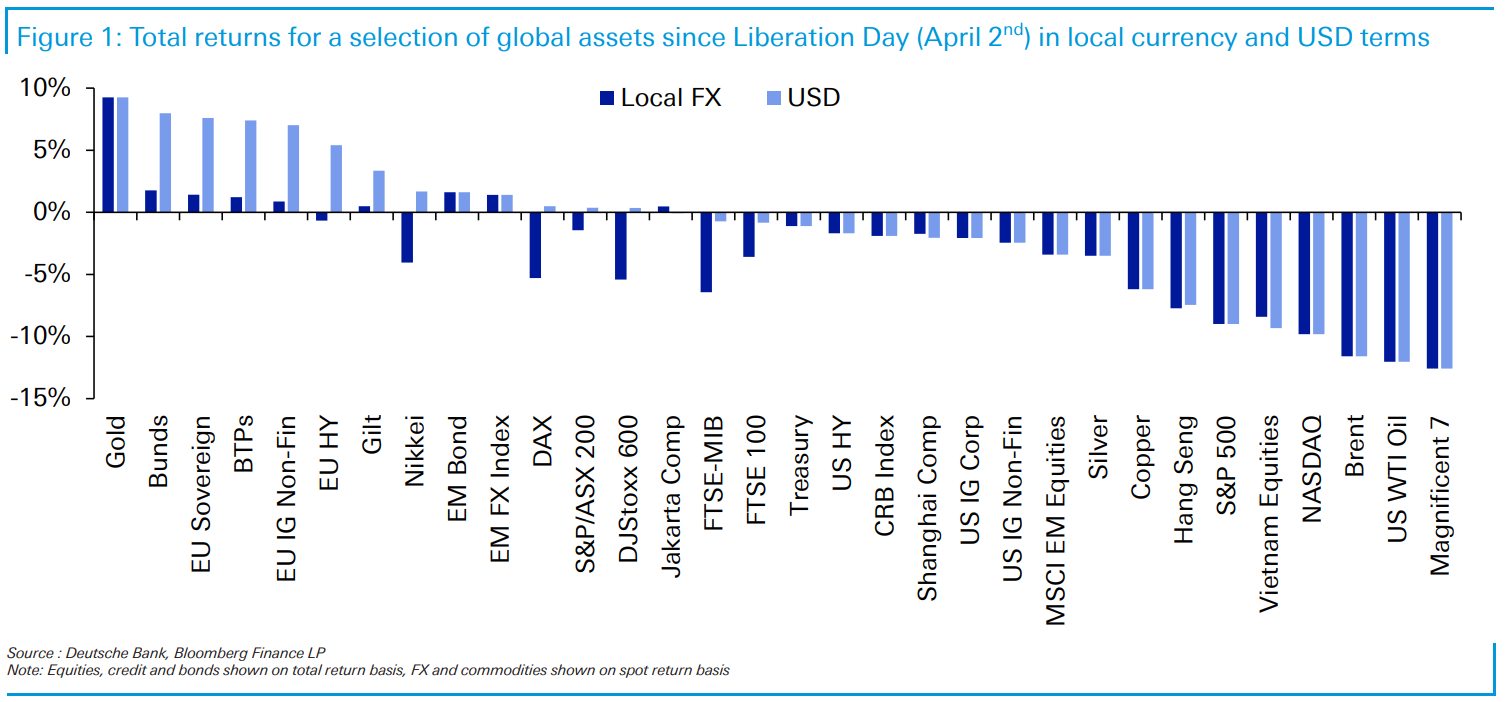
Total returns for a selection of assets (in dollar and local currency terms)
"Given that US assets went into Liberation Day as the most expensive in the world, and given that our previous work highlighted that US capitalism has benefited most from free trade globalisation, it’s not a surprise to see US assets generally at the bottom of the pile since the announcement," says Reid.
In the first quarter, US equity valuations were on a par with the all-time peak of 2000 before the bursting of the dotcom bubble, mainly driven by Nvidia and the tech sector.
Since Liberation Day, the 'Mag-7' are down 12.6% and bottom of this pile, down 24.6% so far in 2025 and "still historically expensive", says Reid.
Gold leads the way, with more gains this week.
German bunds have also been attracting flows, "mostly in relative terms to an underperforming US Treasury market". (The week after Trump's big reciprocal tariffs announcement saw the biggest weekly widening in the spread between 10yr US Treasuries and bunds since German reunification in 1990.)
The DAX and Stoxx 600 are both down just over -5% in local currency terms, but are now slightly higher in USD terms, which Reid says "shows the global portfolio reallocation that is continuing".
12pm: FTSE back to flattish
The FTSE 100 is just above flat now, having been up 41 points around an hour ago.
US futures have rallied, and that seems to be pulling money from London and Europe, with the DAX down 0.5% and CAC 0.3% lower.
Sainsbury's and Tesco are the top risers, up just under 3%.
Looking ahead to the Wall Street session, S&P 500 and Nasdaq futures are up 1%, while those for the Dow Jones are up 0.8%.
Tesla is up 0.85% pre-market, ahead of its earnings after the US close later.
11.04am: Bitcoin rallies too
As well as gold, bitcoin has also been rallying, climbed to its highest in almost a month.
The cryptocurrency has hit $88,516.25 morning, up from around $87K a day earlier.
It's up from lows of around $75K in early April, and now back at levels seen in late March.
This comes as the dollar has been in decline, with the DXY dollar index down to its lowest level since 2021.
10.31am: Could tariffs help lower UK inflation?
Bank of England monetary policy committee member Megan Greene says UK inflation is likely to be made lower rather than higher as a result of US tariffs.
Greene, who has previously cautioned about the persistence of inflation, said the government's decision not to retaliate to Donald Trump's tariffs meant the UK is likely to become a destination for cheaper goods from Asia and the European Union.
"The tariffs actually represent more of a disinflationary risk than an inflationary risk," Greene told Bloomberg.
Despite this potential disinflationary force, Greene said domestic supply constraints still pose upward pressure on prices, justifying a careful approach to interest rate cuts.
9.28am: Taking a breather...until later
As gold hits a new record high at $3,500, the yellow metal "is the only real safe haven" now, says market analyst Neil Wilson at Tip Ranks, since the dollar has been hit and Treasuries are selling off on a broad pullback from US assets.
He notes that Donald Trump's criticism of Powell was at 09:41am New York time on Monday, sending markets sharply lower.
"Loser monetary policy? Geddit? Well, I don’t think he will sack him - it actually makes sense to keep Powell around to use as a scapegoat, plus it’s going to be very tough to shift him...the fact it’s being talked about in the open is enough to unsettle markets," says Wilson.
He says bad news is "well baked in", but markets don’t know how bad a growth slowdown might be.
"Until we see the Fed pivot, the market is going to trade like this."
Kathleen Brooks, research director at XTB, says while yesterday was tumultuous across the Atlantic, volatility is turning lower this morning.
"European stocks are in the red, but losses are mild so far, and US equity market futures are pointing to a higher open later today."
Upwards pressure on US Treasury yields is also easing, while short-term bond yields in Europe are falling and the dollar is also picking up after lows in the Asia session, she notes.
"It appears that traders in the European session are taking a breather after a heavy day of selling in the US on Monday.
"However, the tone will likely be set during the US session. This is a news-driven market, and we will continue to watch what comes out of the White House as it has the power to deeply impact market sentiment."
9.05am: The Chancellor in Washington
If you missed it yesterday, Rachel Reeves is in Washington DC this week, on a mission to save UK exports from Donald Trump’s tariffs.
The chancellor will make a speech extolling the virtues of global free trade at the IMF’s spring meetings, and sit down with US Treasury Secretary Scott Bessent.
The UK is hoping to soften Trump’s 10% blanket levy (and an extra 25% sting on steel and cars) with what officials have told media are "pragmatic offers" and what others might call concessions, such as tax breaks for tech giants.
Said Reeves before she left: "Any deal that is able to be secured will always have front and centre British national interest."
8.44am: Gold hits new heights
The price of gold has risen to within a whisker of $3,500 this morning, up $500 in the past six weeks.
On the FTSE this is reflected in Endeavour Mining PLC (LSE:EDV, TSX:EDV, OTCQX:EDVMF) topping the leaderboard, rising 3.7%, followed by Fresnillo PLC (LSE:FRES), up 3.2%.
Sainsbury's, which kicked off its share buyback today, is next with a 2.74% gain. Tesco is also higher.
Utilities and defence companies are also in the mix, including Babcock, Vodafone and BT.
"There was no Easter surprise for European markets, opening with a cautious note this morning, taking cues from the broad risk-off sentiment spreading around the globe," says analyst Matt Britzman at Hargreaves Lansdown.
He says the FTSE 100's flat open comes after the index ended last week with its sixth consecutive session in the green.
"What was supposed to be a sleepy Easter Monday turned into anything but, as US markets bled red from the opening bell - light on volume but heavy on drama.
"With no fresh headlines to blame, the selloff seemed more like a crisis of confidence than of catalyst, as traders wrestled with a growing list of unknowns."
He says: "Markets are now itching for real progress on trade deals - posts from the President on Truth Social or X just aren’t cutting the mustard anymore. Investors want ink on paper, not just words, as a clear signal that movement is happening - and the clock is ticking.
"This lack of certainty is sending investors right into the arms of traditional safe haven assets, with gold and the Japanese yen both cashing in on the drama."
Brent crude oil has also clawed back some gains, up 1.2% to $67 per barrel.
Britzman says this "looks like a technical rebound more than anything else, with hopes of a sustained rally running on fumes amid looming US-Iran deal talks and recession fears.
"With OPEC+ set to boost output and demand prospects dimmed by economic uncertainty and trade tensions, the oil market’s outlook remains decidedly slippery."
8.14am: FTSE starts lower
The FTSE 100 has opened lower, down 7 points to 8,268.
Despite the talk of divergence, the index has not been able to break free of concerns hitting markets on the other side of the Atlantic yesterday.
Usual suspects are seen among the main fallers, including US-focused and tech investors such as Pershing Square, Polar Capital Tech, Scottish Mortgage and F&C Investment Trust.
Melrose and Rolls-Royce are also down.
7.56am: Divergence between European and US markets
With European markets poised to open higher following the extended Easter weekend, in contrast with the US, where futures are showing a mixed response after the sharp decline yesterday, market analyst Naeem Aslam at Zaye Capital Markets says there are two primary factors influencing this divergence.
"Firstly, significant capital outflows from US equity funds, totaling $10.6 billion as of April 16, have been redirected into European and Asian markets, with European equity funds receiving $11 billion.
"This shift suggests investors are seeking stability outside the US amidst political uncertainties.
"Secondly, the anticipation of upcoming economic data releases and corporate earnings reports, such as Tesla's results, are contributing to market volatility.
"Investors are closely monitoring these developments to gauge the economic outlook and adjust their strategies accordingly."
7.44am: AstraZeneca drug trials results
The calendar of news from big London-listed companies is a bit thin on the ground today in terms of financial results and trading updates (until Tesla's earnings tonight), but AstraZeneca PLC (LSE:AZN) has announced some successful drug trial results.
As Susan Galbraith, the executive vice president for oncology at the FTSE 100's largest company, says the results are "the first trial in more than a decade" to demonstrate superior efficacy than the standard drug regimen used by doctors in treating HER2-positive metastatic breast cancer patients.
The treatment used in the trial is a combination of Enhertu, jointly developed by AZ and Japan's Daiichi Sankyo, and pertuzumab (a drug made by Roche).
These results are just an interim analysis and the trial continues.
7.24am: US stock sell-off linked to Trump pressure on Fed
The broad US sell-off was triggered, says Deutsche Bank macro strategist Peter Sidorov, "by rising concerns over Fed independence as President Trump became increasingly critical of Fed Chair Powell".
"The White House rhetoric had initially escalated after Powell’s hawkish-leaning speech that exacerbated the market sell-off last Wednesday," he says.
"But while markets digested President Trump’s initial post that 'Powell’s termination cannot come fast enough' last Thursday relatively well, ongoing criticism saw renewed pressure on US assets on Monday."
In a post yesterday, Trump suggested it was time for "preemptive cuts" in interest rates, claiming that "there is virtually no inflation" and that the economy risks slowing unless the Fed lowers interest rates.
Sicorov says yesterday’s market moves "were the clearest sign yet of investor anxiety over the topic".
Tariffs also remained in news headlines, with Trump also claiming that "tariffs are going well, everybody wants to negotiate", but no agreements yet.
7.15am: FTSE 100 called higher as holiday-shortened week begins
The FTSE 100 is predicted to jump to a strong, Easter-egg-fuelled start to trading to the holiday-shortened week on Tuesday.
While much of Europe was closed due to public holidays on Monday, US markets were open and were certainly not in a holiday mood, with a widespread sell-off across assets.
The S&P 500 fell 2.4%, the dollar dropped to a new three-year low, bond yields rose, and gold extended its gains.
On the futures market, London's blue-chip index is predicted to rise 56 points.
Asian markets are mostly higher this morning too, save Japan's Nikkei.
Tuesday 22 April
The UK financial calendar is fairly quiet as markets get up and running after the long Easter weekend.
Attention will be focused on Tesla Inc (NASDAQ:TSLA) later in the day, with what has been popular with investors on both sides of the Atlantic in recent years beset by a sharp recent slide.
This has partly been due to the brand being hit by connections between boss Elon Musk and the White House, but recent “disaster” delivery numbers showed the problems may go deeper, even leading some of its most bullish supporters to turn on the EV maker…read more
Announcements due:
Finals: Arecor Therapeutics, Ebiquity
Overseas earnings: Verizon Communications (pre-market), Tesla, (after market close)
AGMs: AIQ, Beazley, Logistics Development Group, N4 Pharma, Woodbois
Economics announcements: Consumer Confidence (EU), Fed Redbook (US), BoE Breeden Speech (UK)