
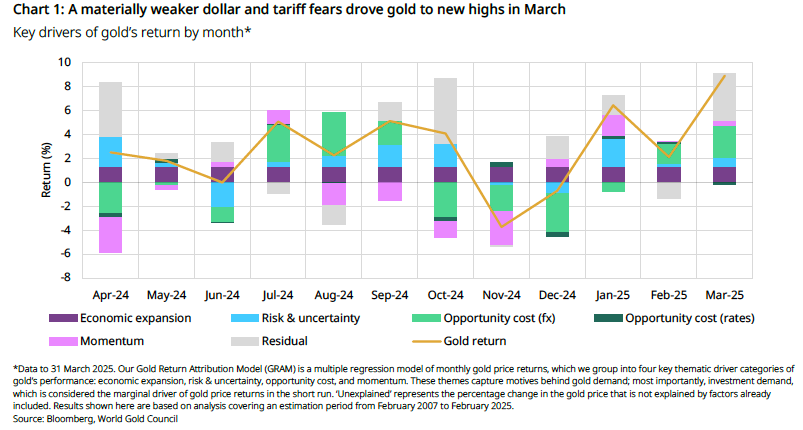
Gold surged to new record levels in March 2025, closing at US$3,115 per ounce—a 9.9% month-on-month increase—driven by a stronger euro, persistent tariff fears, and continued exchange-traded fund (ETF) inflows, according to the World Gold Council’s latest market commentary.
The World Gold Council’s Gold Return Attribution Model (GRAM) identified euro strength—and resulting US dollar weakness—as a key factor underpinning gold’s rally, alongside heightened geopolitical risk associated with tariff policy. Gold also recorded gains in all other major currencies.
ETF inflows remained robust during March, with global funds adding an estimated US$8 billion. United States-based ETFs led with US$6 billion (67 tonnes) in net inflows, followed by Europe and Asia at around US$1 billion each. However, positioning in COMEX futures declined marginally by US$400 million (5 tonnes), likely due to profit-taking.
Liquidity conditions in focus
Liquidity conditions are once again in focus. The commentary highlights parallels with 2022, when a sharp withdrawal of liquidity triggered rare joint declines in equities and bonds. While inflation today is sticky and growth is faltering—characteristics of a stagflationary environment—fundamentals continue to favour gold. Central bank buying remains strong and ETF investors, sidelined since 2020, appear to be returning.
Despite strong momentum, the World Gold Council warns of potential headwinds.
Rapid price gains may deter central bank buying and suppress near-term consumer demand. Elevated geopolitical risk is also contributing to a risk premium that could unwind if trade tensions ease.
Nonetheless, the Council maintains that structural support for gold remains intact.