
Magnetite Mines Ltd has filed a provisional patent for its proprietary saline water flotation process method, which allows for recovery of high-grade magnetite iron ore concentrates in abundantly available saltwater instead of costly fresh water.
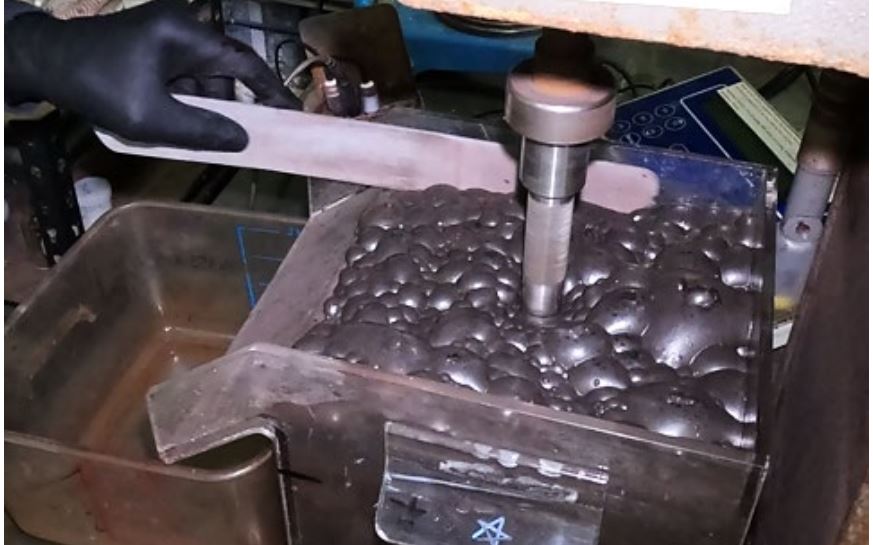
Bench scale flotation testwork at Bureau Veritas laboratories, Adelaide.
Abundant saltwater used
The process, which was developed in-house, means the company can produce direct reduction (DR) grade iron ore concentrates suitable for green iron production, using salt water, without compromising recovery or concentrate quality.
This method frees the company from reliance on fresh water in the processing of magnetite ore, which would remove the need for a large-scale coastal desalination plant.
Seawater supply is virtually unlimited, and the ability to use it for ore processing speaks to a sustainable and long life for operations at Razorback.
Securing the provisional patent and protecting the intellectual property associated with this innovative processing pathway is part of a broader strategy to develop a highly competitive and environmentally sustainable iron ore project at Razorback.
Cost and environmental savings
It means potential cost and environmental savings for the project and gives the company an important competitive edge in the field.
Magnetite managing director Tim Dobson said: “This provisional patent submission is another important step in our strategy to unlock the full potential of the Razorback Project as a leading source of high-grade, low-emission iron ore products.
“The ability to process our ores with saline water offers a significant environmental and cost advantage, while our continued focus on DR-grade product development positions Magnetite Mines at the forefront of global steel decarbonisation.
“Our innovative saline water flotation method provides a technological edge over projects in similar water sensitive jurisdictions, positioning Razorback as both a technically and environmentally superior DR-grade magnetite project.”
Additional samples from across the Razorback deposit are currently being tested to confirm the breakthrough processing method.
The company’s ability to produce DR-grade magnetite gives it a lead on supplying Australia’s green iron industry.
As the primary feedstock for DR iron, high-purity DR-grade magnetite concentrates are a key enabler of the global transition to low-carbon green iron and steelmaking.
Magnetite concentrates are typically produced in a process plant at the mine site, with the concentrate products exported to the downstream market and the remaining waste streams stored in a tailings storage facility at the mine site.
The use of froth flotation, a conventional minerals processing technique in widespread use, is included in the Razorback process flowsheet to reduce impurities and enable the production of premium, DR-grade magnetite concentrates.
The flotation process has to-date been carried out using fresh water – saltwater can interact with flotation reagents, which are sensitive to water chemistry, and compromise the end result and result in lower concentrate grades.
The process
Magnetite Mines’ team, working with reagent suppliers and metallurgical laboratory Bureau Veritas, last year struck upon a method that uses saline water to produce premium-grade concentrates suitable for direct reduced iron (DRI) production, with results similar to those achieved using fresh water.
The method uses a modified chemical reagent regime with minimal impact on the Razorback Project process flowsheet and proposed equipment.
The provisional patent application is an preliminary step towards protecting the IP of the saline water flotation methodology developed by the company and specifically relates to the combination and sequencing of flotation process reagents that enable effective processing of magnetite in a saline water environment at the flotation stage of processing.
It gives Magnetite a 12-month window to complete further testwork and technically refine the innovative process, before proceeding to full patent protection.