
Remember the WH Smith carpet? You do. Everyone does. Even if you haven’t stepped inside one in years, you’ve probably scrolled past a post from @WHS_Carpet — the cult social media account that catalogued the sad, sagging state of the nation’s most unloved retail flooring. A mix of 1980s patterns, mysterious stains, and existential despair, it became a symbol of a shop that once ruled the High Street but now seemed to be gently giving up.
But now the carpet – and the store above it – is going. WH Smith, the Victorian titan of newspapers, notebooks and novelty pens, is selling off its High Street stores to private equity firm Modella Capital. The new name? TGJones. It sounds like a budget cologne or a forgotten funk band, but it’s what will soon replace the WH Smith brand in 480 town centre and shopping centre stores across the UK.
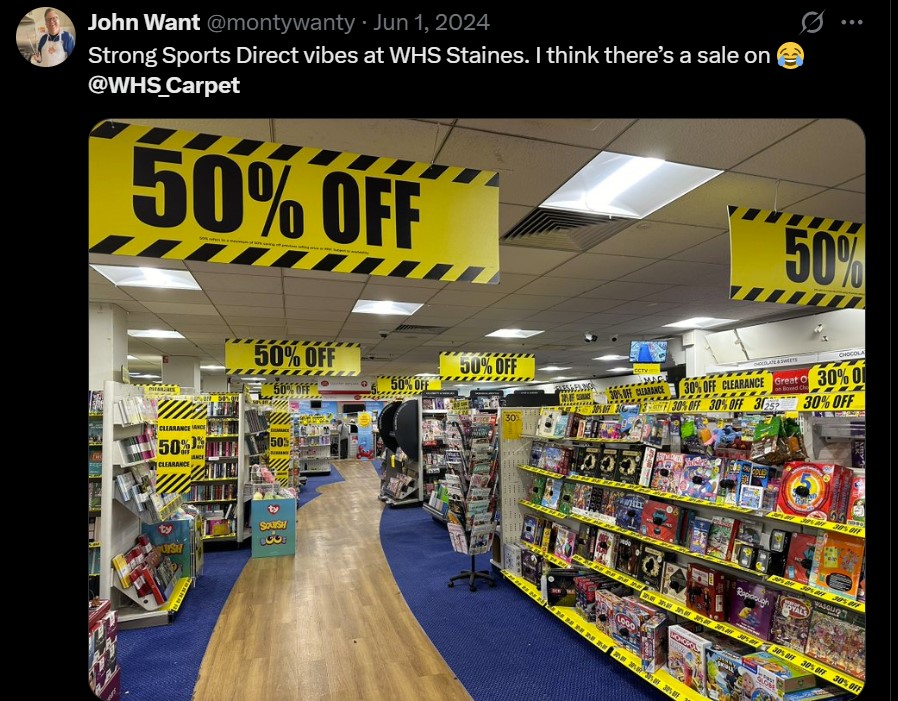
WH Smith isn’t dying exactly. Its travel business – those airport branches where you panic-buy bottled water, earplugs and the latest Jack Reacher novel – is thriving. But for the High Street version, the one with birthday cards, Biros in a locked case and shelves groaning with Toblerones, this is the last chapter.
Long and storied history
It’s hard to overstate just how significant WH Smith once was. Founded in 1792 by Henry Walton Smith and his wife Anna, the business started life in Little Grosvenor Street, London. By the mid-19th century, it was the place to get your news, having built a nationwide distribution empire that made newspapers accessible beyond the big cities. It opened its first railway station outlet at Euston in 1848 — inventing travel retail long before anyone called it that.
Then came the real heyday: the postwar boom, the golden age of the paperback, and those beige-and-orange years of the 1970s. WH Smith sold everything you could need: maps, manila envelopes, Trivial Pursuit, schoolbooks, Blue Peter annuals, printer paper, hole punchers, sudoku, sandwiches, Pritt Stick, and Smash Hits. If you couldn’t find it at Smith’s, you probably didn’t need it.
The great slide into... relevance?
But by the time the 21st century rolled around, WH Smith had started to feel out of time. Supermarkets stole its thunder on magazines and books. Online retail took care of the rest. The shops got smaller, dustier, and weirdly cramped. One of the last remaining joys — flipping through glossy mags or sniffing a new notebook — started to feel more like a guilty pleasure.
What WH Smith had, in the end, was inertia. It was always just there. In a world of rapid retail reinvention, WH Smith remained oddly static — or “cash generative”, as chief executive Carl Cowling put it when announcing the £76 million sale of the High Street arm. Which is corporate for: it’s still making money, but we don’t love it enough to keep it.
So now, it’s out with WH Smith and in with TGJones. Modella Capital, which also owns Hobbycraft, has promised to keep the Post Office counters and the Toys “R” Us corners, but wouldn’t say if jobs would be lost. “Business as usual,” they said, in that reassuring but slightly ominous way companies tend to do when people start wondering if their local branch is next.
What’s in a name?
The WH Smith name isn’t part of the deal - the travel shops keep it, for now. That’s the bit of the business that’s booming, contributing 85 per cent of the group’s trading profits. In airports, we’ll still see that familiar blue-and-white sign, reassuring us that we’re not quite out of reach of a crossword puzzle or a packet of Extra Strong Mints.
But on the High Street? That era’s over. It’s hard to imagine a generation growing up saying “Meet you outside TGJones”. It doesn’t roll off the tongue like WH Smith did. Then again, maybe we’re not meant to feel nostalgic for a shop. Maybe the shop was just a backdrop to our own lives — the place where you bought revision cards, picked up a passport photo, or quietly read a magazine without paying for it.
Still, when the lights dim and the final WH Smith sign is unscrewed from the wall of your local branch, don’t be surprised if you feel something. Not just for the name, or the shelves of celebrity autobiographies, but for the years of small rituals and quiet familiarity. And yes, maybe even for the carpet.