
Genflow Biosciences PLC (LSE:GENF, OTCQB:GENFF) CEO Dr Eric Leire talked with Proactive about a pivotal new direction for the company as it initiates a clinical trial focused on improving aging in dogs.
Leire described the trial as a natural evolution from Genflow's previous success in mice, noting the commercial appeal of the canine market. “There is nothing to improve really the quality of life of our ageing dogs,” he said, adding that the study meets a significant unmet need.
The trial will run for one year, with six months of treatment followed by six months of assessment. It's being managed by independent contract research organisation Syngene. Leire emphasised the scientific rigour of the trial, which is controlled, randomised and includes both aesthetic and biological endpoints. These include coat quality, mitochondrial function, and methylation clocks — all of which have potential crossover value for human applications.
Leire also highlighted the company’s differentiated approach compared to US competitors using repurposed drugs like metformin. Genflow, he said, is pursuing gene therapy with the potential for greater impact.
The investment supporting the trial, although limited in size, is seen as a strategic vote of confidence, bringing in credible investors from outside the UK, including the US. Leire described the initiative as a major step that could generate near-term revenue and redefine the company’s biotech positioning.
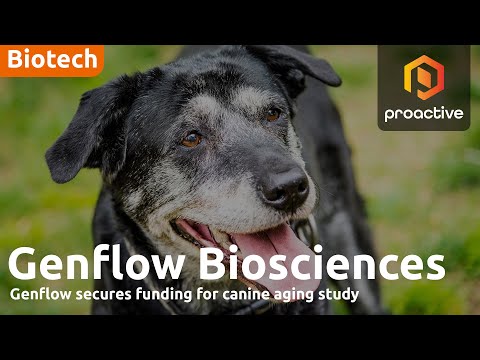
Proactive: Eric, very good to speak with you. You've secured a significant investment from a major institution to support your research into aging in dogs. Tell us more about the dog study.
Dr Eric Leire: Yeah, the dog seems to be a natural evolution. We got very good results with mice, and we want to replicate those results with dogs. The big difference is there's no market for improving the aging of mice. On the other hand, there's just a fantastic market regarding the aging of dogs.
Proactive: Tell us more about the market then for ageing of dogs.
Dr Eric Leire: Okay. You have a dog, I understand? I have a dog. So we all understand it's obviously a very large market. Dogs are now a part of our families. We want to take care of those dogs when they age. We can answer here a very significant unmet need. There is nothing to really improve the quality of life of our aging dogs and also to extend as much as possible the life expectancy of our dogs.
Proactive: So tell us about the clinical trial and what it's targeted at.
Dr Eric Leire: So we will run a trial that will last a year. It will be six months where we provide the treatment and then six months of assessment. It's run by an independent CRO. Syngene are very reputable, so it's not coming from us saying, “oh, our product is better.” It will be a lot of credibility. It's a very rigorous clinical trial. It's controlled. It's randomised. We look at different endpoints. Some endpoints are purely like the quality of the coat. Dogs when they age, they have some dermatitis, and the quality of the coat is important for dog owners.
But also there's an endpoint that can be used not only for the dogs but has some use for us for understanding the effect of our therapy in humans.
For example, we look at the biological age of the dogs, and there are now methylation clocks. And those methylation clocks are pan-mammalian. So if it works on the dog, it's very likely that with the same mechanism, it will work on the human.
Another endpoint where we can have extrapolation for human is the mitochondrial function. We look at the muscles, but further than the muscles, we look at how functional the mitochondria are. There's a lot of pathology in humans that is driven by dysfunction of mitochondria. Mitochondria is the energy source in our cells, and it's linked with multiple pathologies in humans. So this clinical trial will be a very good proof of concept that will be credible with potential application in human health.
Proactive: What sort of competition is there in the market for this? I assume Genflow Biosciences isn't the only company that is targeting this?
Dr Eric Leire: It's a good question. Of course, because it's such an unmet need, we're not the only company interested in trying to answer that. Most of our competition is in the US. The US focuses on repurposing of drugs, so they repurpose drugs like metformin and rapamycin, and they apply what we try to demonstrate in humans for those drugs to dogs.
We are obviously in a totally different category from this US competition, especially in terms of scientific innovation. We come with a new approach to gene therapy, something that's more likely to have a higher impact than these repurposed drugs. So we think we have the possibility to differentiate ourselves from the competition.
Proactive: So going back to the investment, Eric, tell us more about the investment, because it looks like a vote of confidence in your study.
Dr Eric Leire: Yes. It's a limited fundraise. As you know, we rely a lot on non-diluting grants from multiple sources. It reflects also how lean our organisation is. If Elon Musk came to our company, I don't think he would find a lot to cut.
But more seriously, this is very interesting because it brings a small amount of money, but it brings very serious investors from outside the UK. So that's a step up in our fundraising, especially if it brings some US investors that have deep pockets and will be able to support the company in the long run. So we're very excited about this investment round.
Proactive: Okay. So tell us just a little bit more on the next steps for the dog study.
Dr Eric Leire: This dog study is a proof of concept. We are not a vet company. We're good at developing drugs. But there are pharma companies specialising in the canine market. They have more expertise than us in how to commercialise these drugs. This one-year study is supposed to trigger a deal with one of those companies.
It's a major step in our company. We were a classical biotech company involved in human health. That means we were raising drugs. And it's very frustrating for investors because it's highly regulated and we have to go through multiple steps. You know, developing a drug for humans takes a long time.
But here, in the short term, we have the possibility to generate revenues. And that puts us in a totally different category. So it's a major step for the company. I think this is one of the biggest RNS I have issued because it's a change in our business model. We are not promising to have something in the long run. It's something that takes a lot of time, but we can generate revenues. Different category of company.
Proactive: Eric, I hope you'll keep us updated on any progress with that study. But thank you very much for taking the time to speak with us.