
One of the newest entrants in the eastern Australian antimony-gold space – which has produced standout stock market performers such as Larvotto Resources (up ~750% since August 2024) and Trigg Minerals (up ~400% since August 2024) – is Adelaide-based Resolution Minerals Ltd.
Resolution announced its arrival on the scene in early March, entering a binding agreement to acquire a suite of projects with high-grade antimony, gold and copper potential in New South Wales and Queensland.
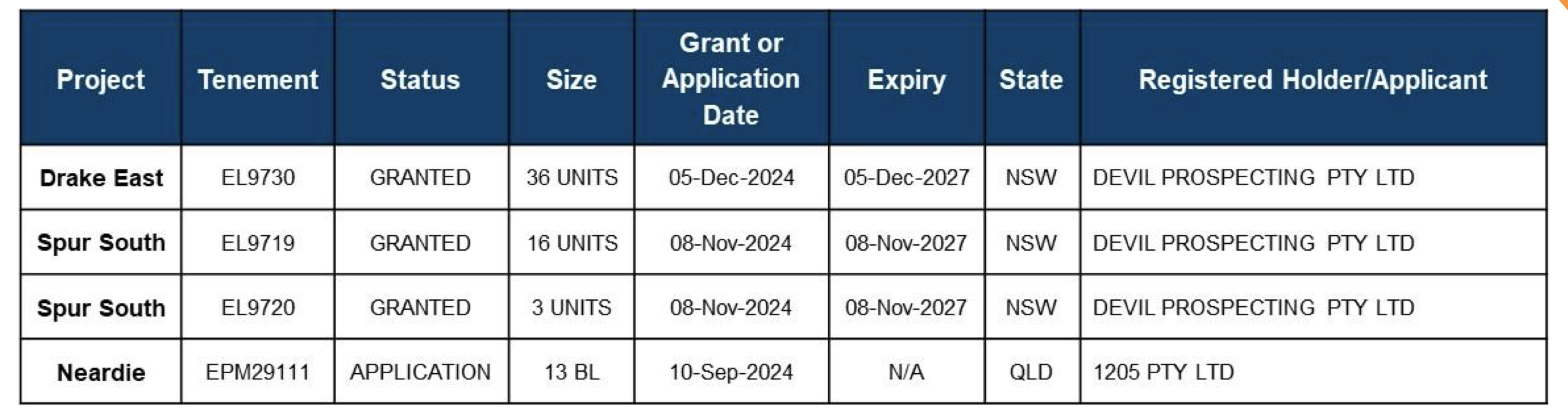
Although the three projects acquired by Resolution – Drake East and Spur South in NSW and Neardie in Queensland – all present as early-stage opportunities, few companies on the ASX currently offer cheaper exposure to the red-hot antimony and gold sectors.
Spur South adds copper, the price of which is also surging, into the mix.
Resolution’s market capitalisation sits at $3-4 million with $1.7 million in cash to come into the coffers following a strongly supported share placement executed in the week after the acquisition was announced.
The stock is tightly held with the top 20 accounting for 67.7% of the company’s issued capital and directors and management, including executive directors Mendel Rogatsky and Aharon Zaetz, holding 32.4%.
Therefore, it’s reasonable to expect that if fieldwork and drilling can deliver results anything like those returned historically from Drake East and Neardie, the Resolution share price should respond like a coiled spring.
Drake East shaping as immediate priority
Drake East comprises a single exploration licence, EL9730, and lies immediately adjacent to Legacy Mineral Holdings’ Drake project, which is developing into a major epithermal gold-copper system, in the New England Belt in northern NSW.
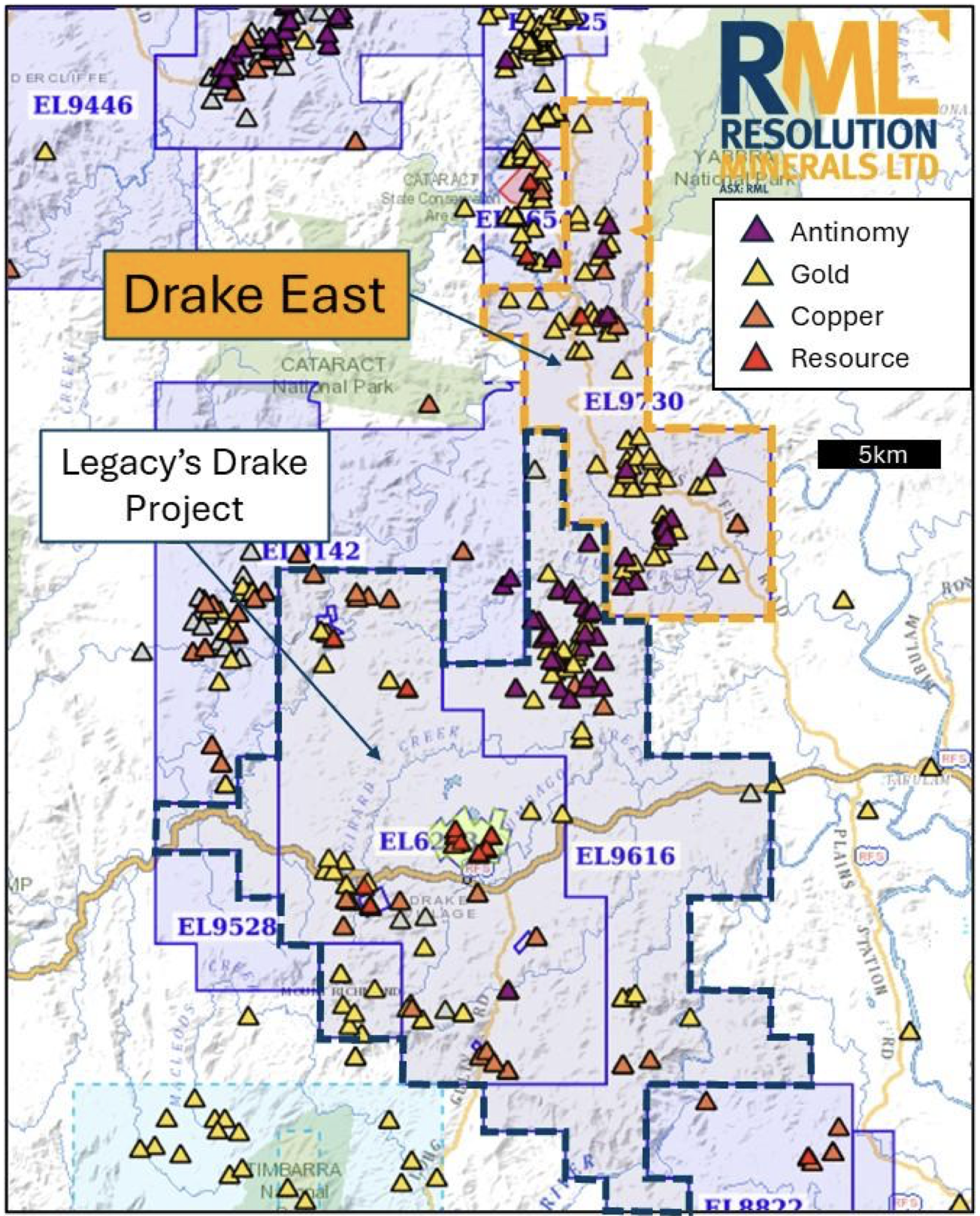
Location map sourced and modified from the NSW Government interactive MinView web map application. The Drake East Project area is shown with a orange dashed line. The Legacy Drake Project area is shown with a dashed dark blue line. The Drake/Drake East projects area hosts over a hundred antimony, gold, silver, and copper occurrences. Many of these are classified by the NSW Geological Survey as non-JORC Code resources.
Just a couple of days after Resolution announced the acquisition of Drake East, Legacy delivered an updated resource for Drake of 0.8 million ounces gold equivalent and 35 million ounces silver equivalent.
Of at least as much interest to Resolution though are the 24 antimony occurrences concentrated in the north-western corner of the Drake tenements, which are interpreted to be part of the same mineralised zone that extends for a strike length of more than 15km into the Drake East licence.
This is after all the part of the world that hosts Larvotto’s Hillgrove mine and Trigg’s Wild Cattle Creek deposit and in which antimony is commonly found in association with gold in epizonal orogenic systems.
Recent rock chip sampling at the Lunatic prospect at Drake, which is 2.2km from Drake East returned an assay of 30% stibnite (Sb), the primary ore of antimony, and 0.38 grams per tonne (g/t) gold.
Drake East itself hosts 14 known antimony occurrences, including the well-documented Mosquito Creek antimony-gold reef and the Ball & Smiths Lode, a historical mine that was in production in the 1870s. Historical sampling at Ball & Smiths returned assays up to 5.72% Sb.
Beyond the antimony, there are also 56 documented historical gold occurrences on the Drake East tenement, with assays returning up to 60.9 g/t at the Pine Gully prospect and historical production at Bucklands Reef of 100t grading 32.6 g/t Au.
Illustrating the speed with which Resolution intends to get on with meaningful exploration at Drake East, just a week after announcing its acquisition, the company told the market it had commenced a comprehensive LiDAR study over the project area to determine the extent of historical antimony workings and assist in developing drill targets.
A similar study was completed by Legacy next door, which resulted in a 100% increase in the number of known antimony workings on the Drake tenements.
“This program for Resolution will not only confirm existing targets but will generate possible new targets," executive director Zaetz said. “It would be our objective to map and sample these targets in the near term.”
RML will also explore the potential to monetise gold tailings at Drake East based on the high grades of historical production combined with an Australian dollar gold price that recently topped $4,800 an ounce.
Historical mines at Neardie point to larger prize
Given the presence of three historical stibnite mines with intermittent operations since the 1890s on the 40km2 Neardie tenement, which lies 20km north-northeast of Gympie, Resolution management is extremely eager to get on the ground there.
The only reason Neardie ranks behind Drake East in terms of priority is the Neardie exploration permit EPM29111 is yet to be granted, limiting the activities the company is able to carry out.
During peak production at the Neardie mines, ore grades ranged from 1.5-5% stibnite, with mining lode true thicknesses reported to be between a few inches to 15 feet (4.5m).
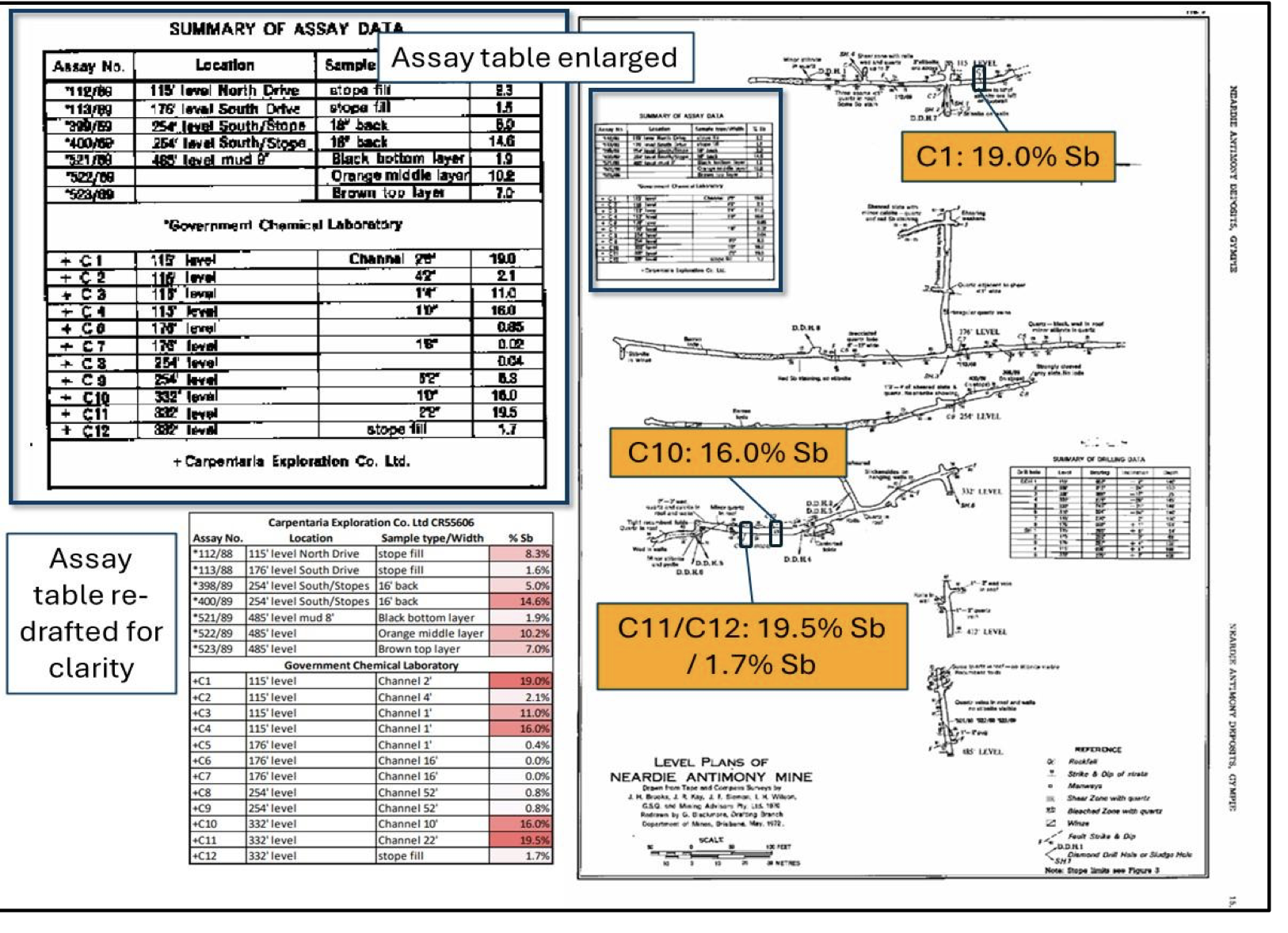
Copies of digitised plans from the Department of Mines “Neardie Antimony Deposits, Gympie”. (Geological Survey Queensland Data Portal Document Ref #: CR055606) showing the sample locations mentioned in an occupying table.
Neardie was closely examined in the early 1970s, with Carpentaria Exploration gathering rock chips that assayed up to 19.5% stibnite in 1971 and results of sampling, underground drilling, surface drilling and slope fill bulk sampling programs summarised by J.E. Siemon in a paper for the Queensland Department of Mines in 1974.
This work – particularly a conclusion reached by Siemon that the “prospects of finding additional ore shoots in parallel and faulted lodes are favourable” – has helped Resolution form a view that significant extensions of high-grade antimony might be readily discovered through further exploration at Neardie.
Spur South in the shadow of giants
The lure at Spur South, located as it is in the prolific Lachlan Fold Belt in central western NSW, is the prospect of a major gold-copper porphyry discovery.
The two project tenements, which cover a combined 46km2, are 15km south-west of Newmont Mining Cadia Valley Operations (>50 million ounces of gold, 9.5 million tonnes of copper) and 5km west of Waratah Minerals’ Spur Project.
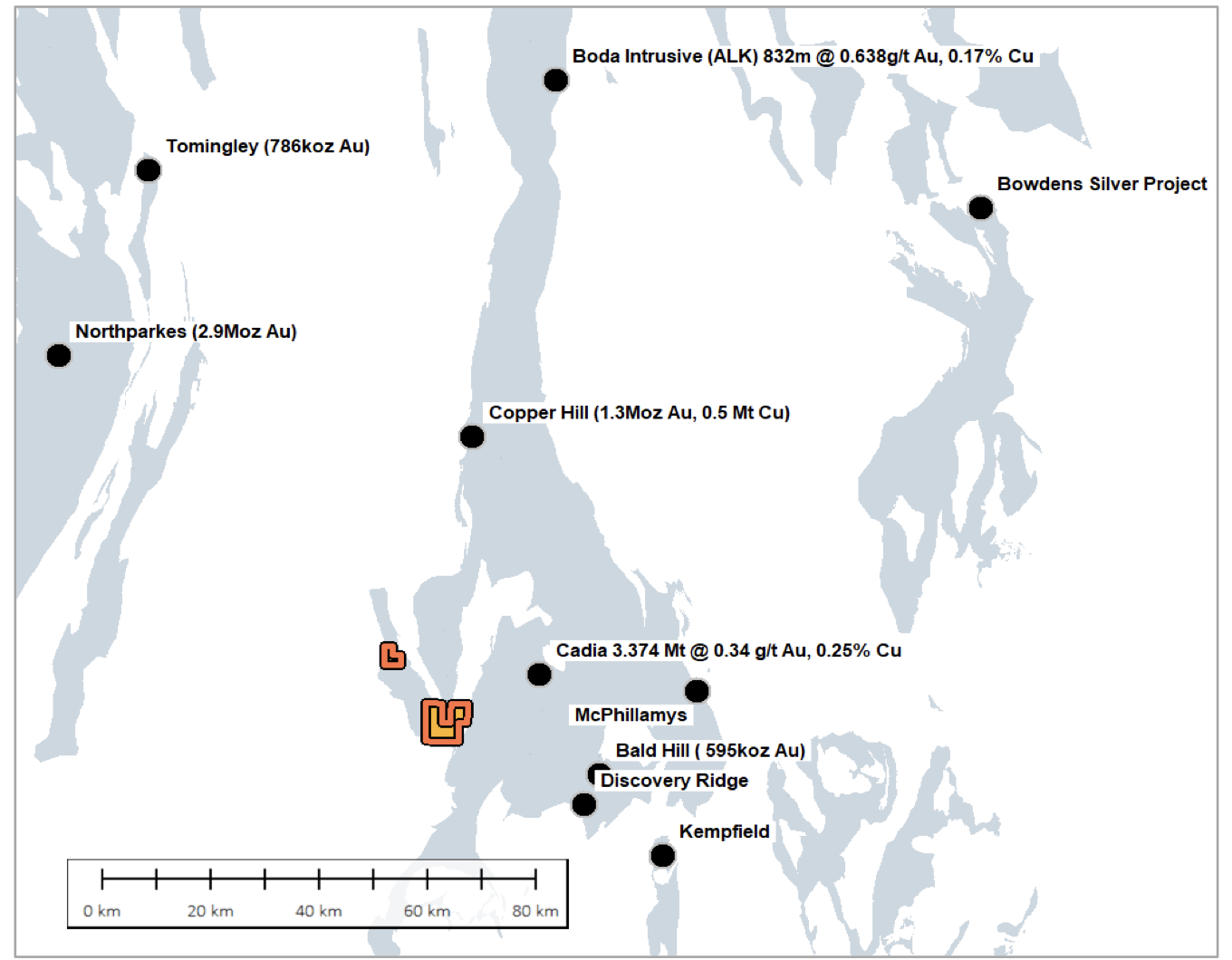
Regional plan showing the various mining operations in relation to the location of the Spur South tenements.
Other significant discoveries in the area include Evolution Mining’s Cowal mine (>11 million ounces of gold), Regis Resources’ McPhillamys project (2,3 million ounces of gold) and Alkane Resources’ Boda project (7.3 million ounces of gold).
Despite being surrounded by majors, the Spur South tenements remain significantly underexplored, with no exploration drilling conducted on them. Magnetics have been flown over the ground, however, highlighting more than 4km of strike potential and some significant anomalies that bear similar geophysical signatures to Cadia. These anomalies present as obvious first-up drilling targets.
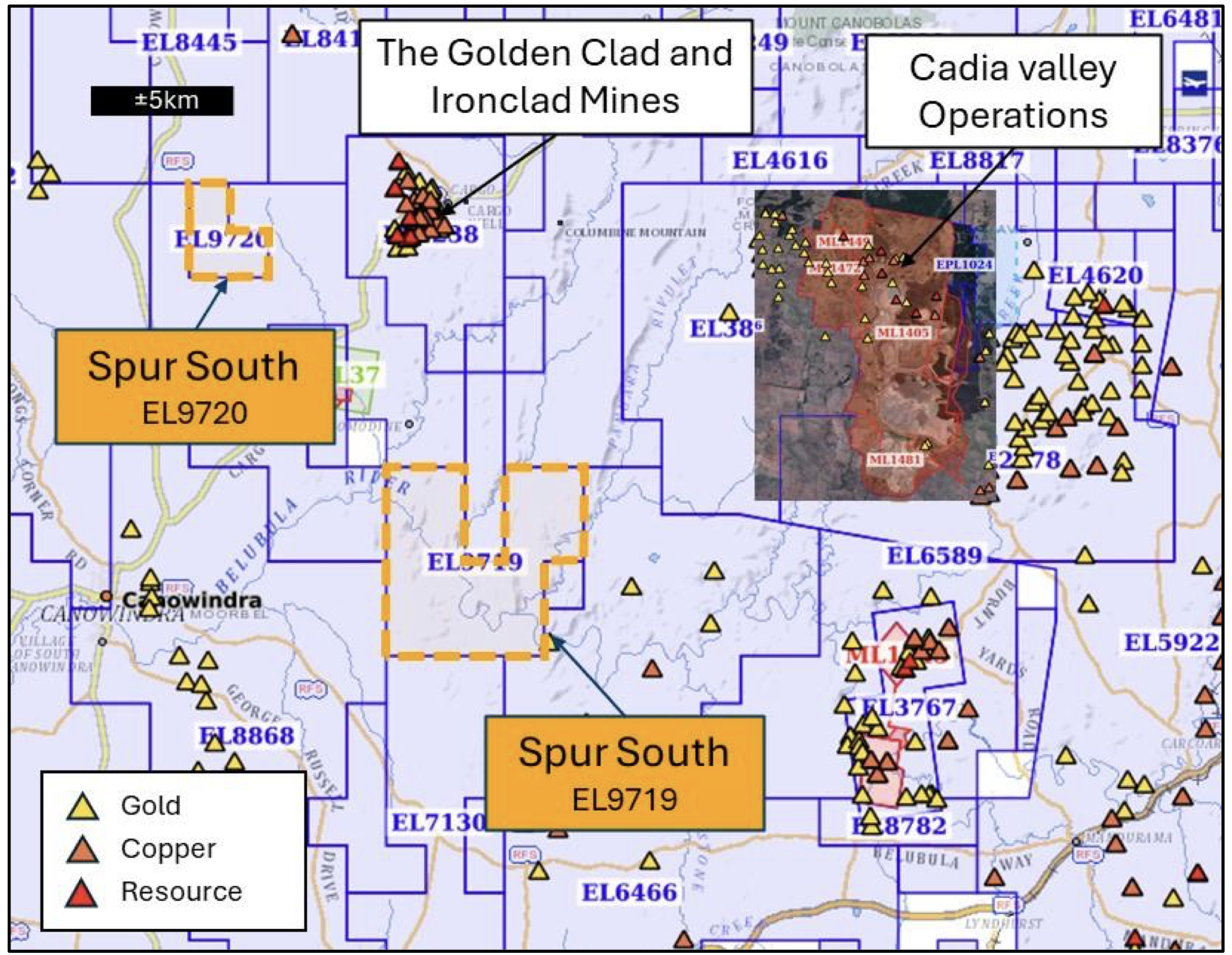
Cadastral map sourced and modified from the NSW Government interactive MinView web map application. The Spur South EL9720 and Spur South EL9729 Project parts are highlighted. Also highlighted are the known gold, copper and resource development projects in the vicinity. A satellite image is superimposed above the Cadia Valley Operations (to scale). Also highlighted is the Golden Clad and Ironclad Mines.
As Resolution runs lean, management has engaged the services of Ross Brown’s Rivere Minerals, a resource consultancy specializing in project evaluation and portfolio management, to assist on the technical front.
Brown has more than 40 years of mineral exploration and has founded multiple exploration companies that have either been bought out by ASX-listed companies or listed on the ASX in their own right.
The run-up in antimony prices to a record high in February of more than US$50,000 a tonne, driven by a combination of Chinese export restrictions, declining production from existing mines, rising demand from solar and defence sectors and depletion of strategic stockpiles, provided ample incentive for Resolution to pick up this suite of projects.
That the company was able to acquire them for a relatively modest sum - $70,000 cash and 25 million shares – is another feather in its cap.
The key now will be getting on with exploration and realising the potential that clearly sits within the portfolio.
RESOLUTION MINERALS INVESTOR SNAPSHOT
ASX CODE: RML
MARKET CAPITALISATION: $3.6 million (at 1.2c share price)
SHARES ON ISSUE: 298.26 million
CASH (at 31 December 2024): $229,000
ENTERPRISE VALUE: $3.37 million
KEY ASSETS: Drake East Antimony-Gold Project (New England Fold Belt, NSW), South Spur Gold-Copper Project (Lachlan Fold Belt, NSW), Neardie Antimony Project (QLD)
THE PROACTIVE TAKE
“Resolution’s new projects are early stage assets no doubt but they are in the right commodities in the right jurisdictions with mineralisation confirmed at Drake East and Neardie. The recent share placement provides funding to get on the ground and start building momentum. If you are looking for a cheap way to play the antimony and gold thematics with a bit of copper thrown in for good measure, this just might be the company for you.”