
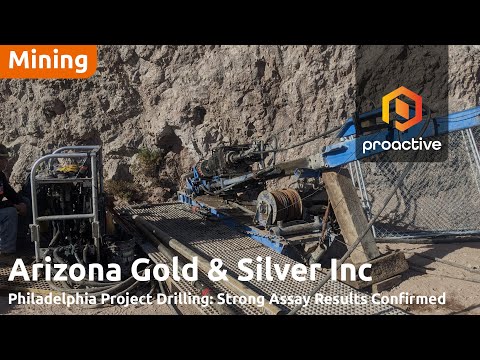
Arizona Gold & Silver Inc (TSX-V:AZS, OTCQB:AZASF) CEO Mike Stark joined Proactive to discuss the latest drilling results at the Philadelphia Project in Arizona.
Stark highlighted that the company has achieved an eight for eight success rate in its infill drilling program, demonstrating strong mineralization both along strike and down dip.
Looking ahead, the company remains focused on further drilling and analyzing upcoming assay results, which could influence the next phase of exploration.
Proactive: Hello, you're watching Proactive. Joining me today is Arizona Gold & Silver Inc. CEO Mike Stark. Mike, very good to speak with you. You’re here with the latest assays from core drilling at your Philadelphia Project in Arizona, and they look pretty encouraging.
Mike Stark: They are. Once again, this is now eight for eight, so we're extremely pleased. This is 100% success on infilling in an area where we previously didn’t have access. Now that we do, we have confirmed an extension of mineralization both along strike and down dip. From the surface, this is excellent—there's no strip ratio, so you can’t ask for a better scenario.
You’re particularly looking at the Rising Fawn target. How do these results compare to previous drilling at Rising Fawn?
That’s correct. The previous five holes we drilled in this area returned grades in the 1 to 1.5 grams per tonne range. The latest holes show the same consistency. High-grade, low-sulfide vein systems typically shrink and swell, so this level of consistency is significant. We’re seeing a 50-meter-wide zone, and we’ve now extended the mineralization to over 200 meters deep.
In your release, you mention that the objective at Philadelphia is to build a bulk-tonnage, low-grade, heap-leachable resource. Do these results support that goal?
Absolutely. This grade is exceptional for the area—higher than some nearby projects. That’s intriguing to us, and it raises more questions about the system’s feeder source. We may be getting closer to that answer with hole 136. Visually, it’s the best hole we’ve seen so far. Of course, the assays will confirm that, but we’re very optimistic.
What comes next for the Philadelphia Project?
We have a lot of news flow ahead. At the end of February, we saw warrant and option exercises that strengthened our treasury, which is great for ongoing drilling. In terms of exploration, we’ve just completed holes 137, 138, and 139. Hole 138 is already at the lab, and the other two will be sent out this week.
As for hole 136, once we get those results, it could guide additional drilling to better understand the feeder source. It’s the widest interval we’ve encountered with yellow quartz, which typically indicates higher grades. So, we’re eager to follow up with a focused drilling program.
Quotes have been lightly edited for clarity and style