
Light Science Technologies Holdings PLC (AIM:LST) CEO Simon Deacon talked with Proactive about the company’s strong financial results for 2024 and its strategic plans for the future.
The company reported a 29.5% increase in revenue, reaching £12 million, up from £9.3 million the previous year. Deacon highlighted an improvement in gross margin from 23.4% to 30.3%, which has helped drive the company closer to profitability.
Light Science has also expanded through acquisitions, integrating new businesses to strengthen its Agtech and passive fire protection divisions. The Agtech division saw significant growth, with revenue increasing by 250%. The company now offers a broad range of solutions, including lighting, sensors, irrigation, and control systems, with a £40 million quoted pipeline.
Deacon also discussed the company’s £50 million revenue target and its ambition for 20% of Agtech revenue to be recurring through software and live data services. He emphasised the company’s global strategy, forming partnerships like the recent Agrolux collaboration to expand internationally.
With increasing focus on food security, climate change, and sustainability, Light Science sees strong demand for its technologies in controlled environment agriculture and broader environmental monitoring.
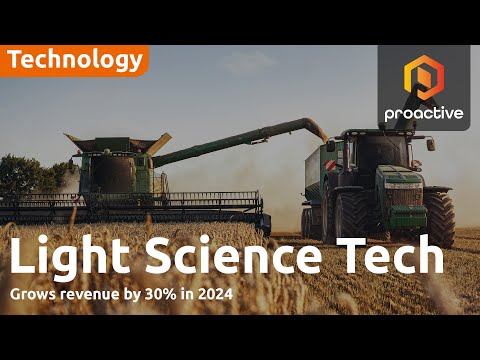
Proactive:. Simon, very good to speak with you this morning. Could you give us the highlights of today's announcements from your 2024 results?
Simon Deacon: Good morning, Stephen. Yeah, the highlights have been really strong, and we're really pleased with the results. We grew just over 29.5%, so nearly 30% in revenue for the year, which took us over £12 million, up from £9.3 million the previous year. So really strong revenue growth, which we're pleased about.
But also, I mentioned a while ago that we were focusing on gross margin, and I'm pleased to say that has increased from 23.4% to 30.3%. So a really good increase in margin, which has dropped down to making a profit. For the year, we made a small loss, nearly breakeven.
However, in H2 of last year, we started generating profitability, which is a really strong result. Another important factor is our cash generation and undrawn funds, which increased from £1.21 million to £1.87 million. This gives us strong growth potential and, more importantly, visibility.
Proactive: Simon, it's been a year of progress for Light Science. Can you talk us through the changes the company has seen?
Simon Deacon: The company has seen quite a lot of change. We completed two acquisitions and integrated them into the group. In the Agtech space, revenue grew by over 250%, and we now cover a broad range of products, including lighting, sensors, irrigation, control systems, and software.
This part of the business is growing both in the UK and globally. We now have a £40 million quoted pipeline in Agtech, which is driving growth and providing revenue visibility.
In addition, our passive fire protection (PFP) division saw strong traction in the second half of the year, with good margins and order sizes typically ranging between £500,000 and £1 million. This segment is growing as we continue expanding our product reach across the country.
Proactive: Your balance sheet has also been significantly strengthened. In the second half, you recorded gross profit. What work have you done to achieve this?
Simon Deacon: It’s really about levelling up our revenue streams. Historically, revenue was dominated by our contract electronics manufacturing (CEM) business. Now, both Agtech and passive fire protection are contributing more, helping us increase margins to over 30% and generate cash flow. This has strengthened our balance sheet.
Proactive: What was the rationale for rebranding CEA to Agtech?
Simon Deacon: As our technology evolves, we’re moving beyond controlled environment agriculture (CEA). We're not just providing lighting solutions, but also sensors, control systems, and software.
For example, we’re working with Dyson Farming to develop sensors that monitor carbon monoxide in soil and track environmental changes. This technology has applications beyond agriculture, moving into environmental monitoring. Rebranding to Agtech reflects our expansion into broader agricultural and environmental solutions.
Proactive: Have you now got the corporate structure to support the next phase of growth?
Simon Deacon: Yes, we continue to build our leadership team. Dr. Graham Cooley joined as non-executive chairman, and Richard Mills as non-executive director.
Richard brings extensive agricultural and controlled environment expertise, which is crucial for our global expansion. Graham has significant experience in the City and in scaling businesses. We also have a solid management team, and I’m really proud of the work they’re doing to grow the business.
Proactive: Can you outline the group strategy and what investors might expect this year?
Simon Deacon: We’re continuing our growth strategy through organic expansion and acquisitions where opportunities arise. Our three divisions—contract electronics, Agtech, and passive fire protection—remain our focus.
Global issues like food security and climate change are increasing demand for Agtech solutions. Partnerships, such as our recent collaboration with Agrolux, are key to our international growth.
My goal is to drive revenue to £50 million in the coming years, with 20% of Agtech revenue being recurring through our software platform and live data services.
Proactive: Finally, we’re seeing more coverage on population growth, water supply issues, and extreme weather. What could this mean for the UK, and how are your products evolving to meet these challenges?
Simon Deacon: This is a global issue, not just for the UK. Over the weekend, there were reports about the need for larger reservoirs and potential water rationing by 2030. Climate change is causing wildfires, droughts, and flooding, which all impact agriculture.
The future of farming is about localizing food production, reducing food waste, and improving soil health. Over 60% of farmed soil today lacks proper nutrients, which affects crop quality and sustainability.
By using our sensors and monitoring technology, we can help reduce waste, lower pollution, and improve crop yields, making agriculture more profitable and environmentally sustainable.
Proactive: Simon, I hope you’ll continue to keep us updated on your progress. Thank you for speaking with us today.