
Foresight Solar Fund Ltd (LSE:FSFL) fund manager Ross Driver talked with Proactive about the company's full-year results and its strong portfolio performance despite record-low irradiation levels in the UK. Driver highlighted that Foresight Solar generated over 1,000 gigawatt hours of renewable energy - enough to power approximately 370,000 UK homes.
He also discussed the company’s stable dividend policy, with an 8.0 pence per share dividend for 2024 and a planned increase to 8.1 pence per share in 2025. Foresight Solar’s active hedging strategy and capital allocation approach have supported steady shareholder returns, with £67 million returned to investors through dividends and buybacks.
Driver reaffirmed the company’s focus on capital efficiency, debt reduction, and strategic growth through its proprietary development pipeline. The company recently doubled its Spanish development pipeline to 400MW of battery storage, which he described as a key step in future value creation.
Regarding market challenges, Driver acknowledged high interest rates and sector outflows but emphasized the long-term strength of renewables, supported by government policies in the UK and Europe. "We remain confident in the portfolio's quality and our income and growth strategy to drive total shareholder returns," he stated.
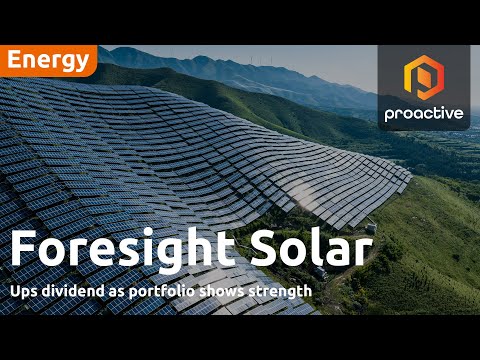
Proactive: Ross, very good to speak with you. You published your full-year results today. The operational solar farm assets performed well despite record-poor weather in your largest market.
Ross Driver: That's right, Stephen, and great to be with you again. Despite it being the year with some of the worst irradiation in the UK since Foresight Solar listed back in 2013, our portfolio has proven how resilient it can be. Globally, we generated more than 1,000 gigawatt hours of renewable energy this year. To put that into context, that’s enough to power approximately 370,000 UK homes for an entire year.
Our active power price hedging strategy is also contributing to cash flow reliability. That has given the board the confidence to declare our £0.08 per share dividend for the year, with a 1.4 times dividend cover. So, it's a well-covered dividend. Additionally, the board has announced an 8.1 pence per share dividend target for 2025, which is a little over a 1% increase. We believe the portfolio will generate more than enough cash to meet that goal.
Proactive: Over the last couple of years, you've been following a strict capital allocation policy. Has that changed?
Ross Driver: No, not at all. Our capital allocation approach remains focused on returning capital to shareholders in the current environment and paying down debt. Opportunistically, we are investing small amounts in development-stage opportunities that have the potential to deliver future growth.
We believe we have been delivering on all these fronts in 2024. Between dividends and share buybacks, we have returned £67 million to shareholders this year alone. We have also continued to pay down our long-term amortizing debt and actively managed our balance sheet to minimize financing expenses. We are in discussions with our lenders to refinance our revolving credit facility to reduce costs further.
At the same time, we are keeping an eye on future growth. While it’s not the right time to deploy large amounts of capital, we have doubled our proprietary development pipeline in Spain, which now includes up to 400MW of battery storage to support future expansion.
Proactive: How does your proprietary development pipeline contribute to your strategy?
Ross Driver: The operational portfolio has performed well for the last 11 years, generating consistent income. For early-stage assets, such as solar and battery development projects, we aim to develop them and improve returns over time.
Once they reach the ready-to-build stage, we have a few options: we can sell them at that point to capture returns and redeploy the cash elsewhere, or we can build them out ourselves—like we have done with some of our Spanish projects—and sell them when they become operational. Alternatively, they can be integrated into our existing yielding portfolio.
If you think about it in simple terms, it's like building a property. You start by purchasing land, then secure planning permission, which increases the land’s value. You can then construct the house, which creates something significantly more valuable than just an empty field. Each of these steps represents a value creation point for the projects.
Proactive: As part of your announcement today, you mentioned that you're exploring all options. What does that mean?
Ross Driver: Throughout the year, as the investment manager, we have worked closely with Foresight Solar’s board of directors to be proactive in this market. I have met with as many investors as possible to understand their concerns and priorities in the current environment.
We have heard differing views—some shareholders want capital returns, while others prefer to remain invested in the renewable energy sector. This is something the entire sector is grappling with, not just us. Our objective is to provide the best possible outcome for the majority of our shareholders in the most efficient and effective manner. More details will be released as we publish our annual report.
Proactive: Looking ahead, what’s the outlook for renewables and for Foresight Solar?
Ross Driver: The last couple of years have been challenging. High interest rates have increased the appeal of fixed-income investments, leading to outflows from the renewable investment trust sector.
To address this, we quickly implemented a disposal process to confirm valuations, generate cash, return capital, and pay down debt. Despite the turbulence in the market, we believe the long-term outlook for renewable investment in the UK and Europe remains incredibly strong. The sector is backed by supportive governments, and we are confident that our income and growth strategy at Foresight Solar is the right approach to driving total shareholder returns.
Proactive: I hope you'll continue to keep us updated on progress. Thank you very much for speaking with us today, Ross.