
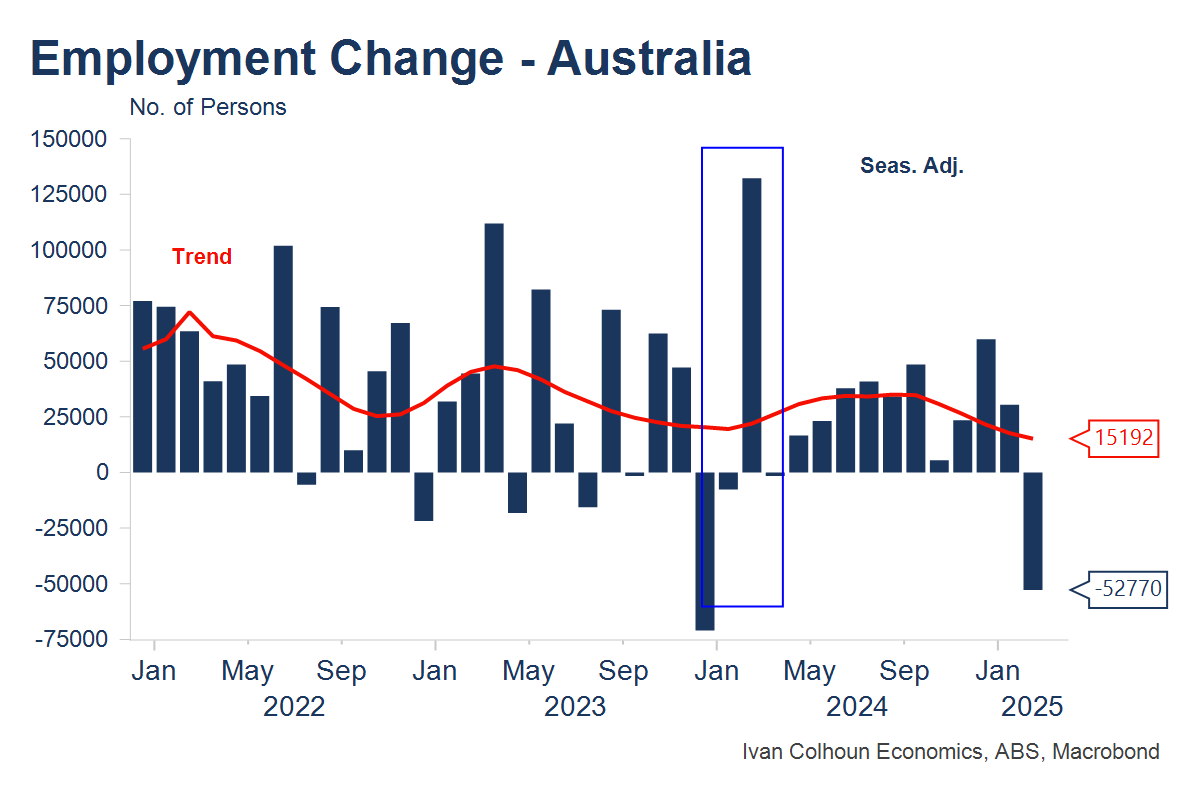
Australia’s labour market saw nearly 53,000 jobs lost in February. However, the unexpected drop in employment is unlikely to prompt the Reserve Bank of Australia (RBA) to implement a second consecutive cash rate cut when its board meets in under two weeks.
The Australian Bureau of Statistics (ABS) attributed part of the decline—the largest since December 2023 and well below economists’ expectations of a 30,000-job increase—to a lower number of older workers taking up employment.
Krishna Bhimavarapu, APAC Economist at State Street Global Advisors said of the figures, “Today’s employment data reminds us that the idiosyncrasies in the labour market remain in play despite the general agreement on its strength. The big drop in employment growth makes us wonder if seasonality played a part. We do not think this data will lead to any material softening in the RBA’s stance but, the fact that employment of those aged 55 or above declined in five of the last seven months warrants some caution.”
CreditorWatch's chief economist, Ivan Colhoun said they will be watching SEEK job ads very closely for signs of weaker business confidence emerging and affecting hiring.
“The unemployment rate signal for February this month was no change and still very low. We’ll be watching SEEK job ads very closely for signs of weaker business confidence emerging and affecting hiring,” Colhoun said.
“Job ads dropped 1.8% in February but haven’t changed that much over the past six months. I’m biased towards the RBA needing to reduce rates a little further next month or in May to combat weaker confidence effects and subdued retail spending in recent weeks.”
Unemployment steady, but optimism ahead
Despite the contraction, the unemployment rate remained steady at 4.1%, as a fall in workforce participation to 66.8% from 67.2% in January offset the job losses. Other indicators suggested the labour market remained tight, with the underemployment rate—measuring those employed but seeking more hours—edging down to 5.9% from 6.0% in the previous month.
“The unemployment rate was unchanged at 4.1% in February. That’s a very low unemployment rate and a good starting point as global economic uncertainty builds around US economic policies, including tariffs,” Colhoun said.
Ben Thompson, CEO, Employment Hero noted, "Our latest data gives Australians many reasons to be optimistic about the labour market. Although employment growth has eased from previous double-digit highs to 5.7% YoY, we’re still seeing steady gains across jobs, wages, and hours worked, suggesting the market is shifting from volatility to stability—good news for both employers and job seekers.
Casual employment remains the strongest driver of job growth at 10.2% YoY, reflecting businesses’ need for flexibility amid economic uncertainty. At the same time, full-time employment is holding firm, and wage growth—though slowing—remains well above inflation in most industries. Plus, first-time job seekers and uni grads are finally catching a break after a rocky few months, with Gen Z leading all age groups in wage and job growth.
“With the Reserve Bank’s recent rate cut and consumer confidence at a three-year high, we may see businesses gain more confidence in hiring decisions in the months ahead. The labour market is still adjusting, but the overall trend is one of resilience and cautious optimism as we move further into 2025."
RBA expects gradual softening
For the RBA, the data reinforces expectations that Australia’s labour market, which remains historically strong, will soften only gradually. The central bank projects the unemployment rate will rise to 4.2% by mid-2025 and remain at that level for at least two years.
“Employment fell 53,000 – a very surprising result. The ABS notes that far fewer older workers went back to work. Worth following if it’s the case – it also meant there wasn’t the flow through to unemployment as participation also dropped. I’m more inclined to put it down to changed seasonality that has been in evidence over recent Decembers and Januarys than a real signal,” Colhoun said.
“Providing support for this contention, the overall unemployment rate was unchanged (it tends to not be as affected by the vagaries in samples or seasonal adjustment), the underemployment rate fell further to 5.9% (-0.1ppts) and the youth unemployment rate was unchanged at 9.1%. Both of these rates are very sensitive to changes in the economy.”
At 4.1%, unemployment remains below the RBA’s estimated “full employment” level of 4.5%—the rate it considers consistent with keeping inflation within its 2–3% target range.