
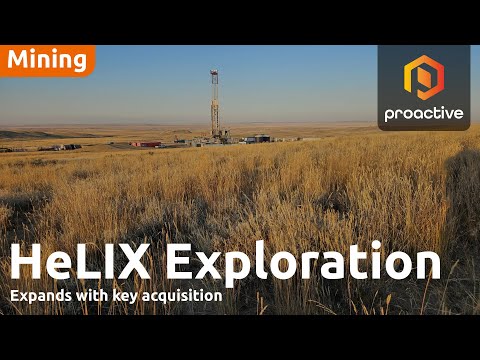
HeLIX Exploration PLC (AIM:HEX) this week announced a deal to acquire the Weil#1 well, in Montana, along with 640-acres, with the well expected to effectively double production capacity.
CEO Bo Sears told Proactive that the purchase was completed for $300,000, a fraction of the $1.3 million of what it would cost to drill a new well.
The Rudyard field has been known for its helium potential since Texaco’s 1960 drilling, but Sears said recent results show the structure is much larger than previously thought.
Bo joined the Proactive studio to talk us through the deal, along with other developments for Helix.
Proactive: I'm joined by Helix Exploration PLC CEO, Bo Sears. Bo, very good to speak with you.
Some positive news from Rudyard this morning—can you walk us through the acquisition of additional acreage?
Bo Sears: Yes, Stephen. So it's been a great couple of weeks. We just picked up the Weil#1 well and the associated 640-acre section around it, which effectively doubles our production.
We've basically doubled the size of our company with that one acquisition.
We purchased it for $300,000, while a new well would cost $1.3 million.
So you can see the real value there.
We have also contracted the drilling of the Linda#1 well, which is a mile south of the Darwin well. So all things are looking really good at Rudyard.
We're really excited to be moving quickly out there.
Proactive: Why have you identified this particular area and the Weil-1 well?
Bo Sears: This area was historically known as a helium discovery.
Texaco drilled a well here in 1960 and found helium, but since Texaco wasn’t interested in inert gases, they plugged that zone and produced from a shallower natural gas horizon.
The helium potential has been known for a long time, but it wasn’t until we drilled the Darwin-1 well that we realized the structure was much bigger than previously thought.
This means we can drill a lot of wells on the Rudyard anticline, which is quite large. So, there’s lots of room to grow here.
Proactive: Are there other targets you've identified within the acreage?
Bo Sears: Absolutely. Right now, this has become a development drilling program instead of an exploration program.
This means we've significantly reduced risk on each new drill.
Each new well should contain a lot of helium from the same horizon across every section of land we drill on.
Proactive: You've also announced that the second well, Linda#1, is due to spud in April. Can you tell us what work has been done so far?
Bo Sears: Yes. We're awaiting approval from the Montana Board of Oil and Gas.
Once we have that, we'll begin assembling the drill pad, moving the rig on site, and starting to drill.
We hope to begin in early April, though that depends on the weather. But we’re moving full steam ahead—we have the rig ready to go, and the crew is prepared to start as soon as we get the green light.
Proactive: Finally, on Rudyard and the Darwin#1 well, how close are you to commercial production?
Bo Sears: The Darwin well is ready for production as soon as the plant is in place and connections are made.
Once that’s done, all we have to do is turn the knob and feed it to the plant. It’s ready to go.
Proactive: Bo, you mentioned that the focus is currently on Rudyard. What does this mean for Ingomar?
Bo Sears: Ingomar is still in development. We tested the Charles formation, and while we got a gas sample, the volumes proved to be noncommercial.
However, we are still assessing the sample to determine what can be done with that particular reservoir.
We're also very excited about the Flathead formation, which we can only drill once the sage grouse stipulations lift in mid-June. So we’ll be looking at that opportunity later this year.
Proactive: I hope you’ll keep us updated on both projects. Thank you for the update.