
Resolution Minerals Ltd has turned its attention to antimony with gold and copper upside after entering into a Binding Agreement to acquire three highly prospective exploration projects in New South Wales and Queensland, covering a total of approximately 194 square kilometres.
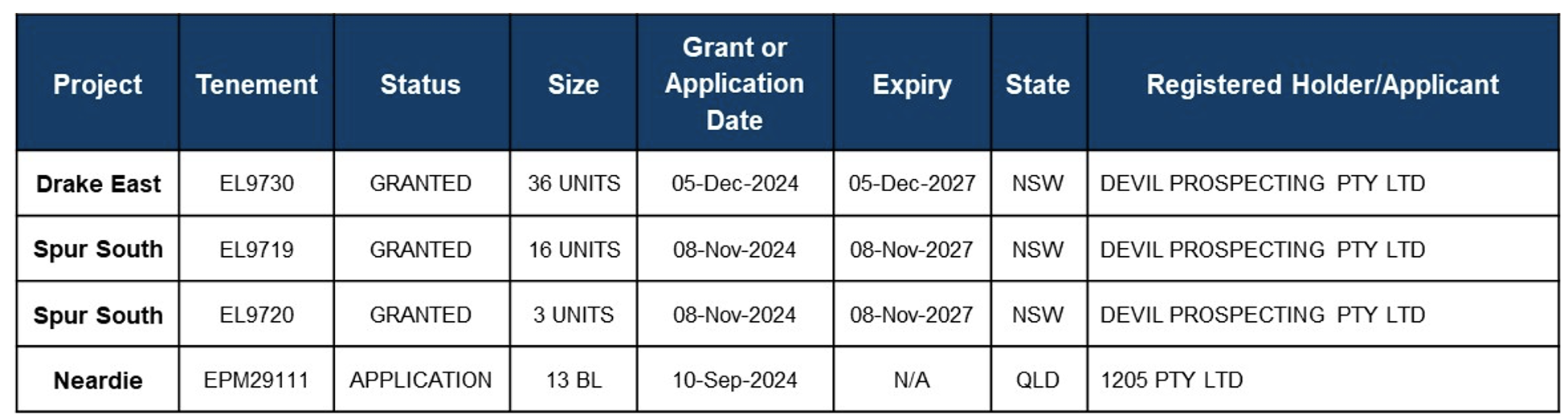
Resolution’s binding term sheet is with Devil Prospecting Pty Ltd and 1205 Pty Ltd to acquire 100% of their issued share capital and exploration licences EL 9730, EL 9719, EL 9720, and EPM 29111.
The company will issue 25,000,000 fully paid ordinary shares at $0.01per share in two equal tranches. The first tranche will be issued at settlement, while the second tranche will follow the completion of due diligence, within 30 days of execution. Resolution will also pay $70,000 in cash within 20 calendar days of the ASX transaction announcement.
The issued shares will be subject to escrow conditions, with 50% restricted for three months and the remaining 50% for six months from the settlement date. Transfers to nominees or associated entities are allowed under escrow terms, while transfers required by law will not breach restrictions. Any unauthorised dealings may be subject to legal action.
The acquisition is conditional upon obtaining necessary regulatory approvals, the absence of material adverse changes, and a 30-day due diligence period. Both parties will work to fulfil these conditions as soon as possible.
Project details:
Drake East Project (NSW) – Comprising Exploration Licence (EL) EL9730 (36 units), the project hosts high-grade antimony (Sb), gold (Au), and silver (Ag) mineralisation, including:
- 5.72% Sb (Ball & Smith’s Mine, NSW GS Sample #G00/363)
- 60.9 grams per tonne (g/t) Au (Pine Gully Prospect – Malachite Resources, 1998)
- 214 g/t Ag
- A non-JORC compliant placer gold deposit of 300,000 cubic metres at 1 g/t Au over a 750m x 100m area.
Spur South Project (NSW) – Comprising Exploration Licence Applications (ELAs) ELA6784 (37.6 square kilometres) and ELA6785 (8.6 square kilometres), the project is located within the highly mineralised Macquarie Arc and hosts a large magnetic anomaly, indicative of significant mineralisation potential.
Neardie Project (QLD) – Comprising Exploration Permit Minerals (EPM) application EPM29111 (40 square kilometres), the project contains high-grade antimony mineralisation, with peak values of 19.5% Sb.
"This acquisition marks a pivotal moment for Resolution Minerals, offering a unique opportunity to broaden our multi-commodity exploration activities in two of Australia’s most promising and proven regions for antimony, gold, silver and copper,” RML’s executive director, Aharon Zaetz.
“The Neardie, Spur South and Drake East projects present exciting prospects that align with our strategy to unlock value from underexplored, high-potential assets. We were able to secure the project portfolio for a very attractive price, with the vendors agreeing to take majority of their consideration in equity in RML.
“Global demand for antimony is rising quickly, and combined with supply shortage concerns, this has resulted in record-high prices for the commodity. With these projects in hand, RML is now poised to create substantial value for our shareholders and advance these projects toward their full potential."
Why antimony?
The company is acquiring high-quality antimony assets in response to strong growth forecasts for this critical metal, which has surged 250% in price in 2024 amid global supply concerns following China’s export ban.
While the following video has a US focus, it explains why antimony is so important and why countries need to reduce their reliance on China and Russia for this critical mineral.
The Drake East project in New South Wales and the Neardie project in Queensland that are now in Resolution’s hands, provide a low-cost entry into the critical metals sector. Both are brownfield assets with a history of antimony production. The company plans to review historical data, identify drill targets based on known mineralisation, and, if results are positive, work towards reopening the historic mines within a relatively short timeframe.
The projects in detail
Drake East Antimony-Gold-Copper Project
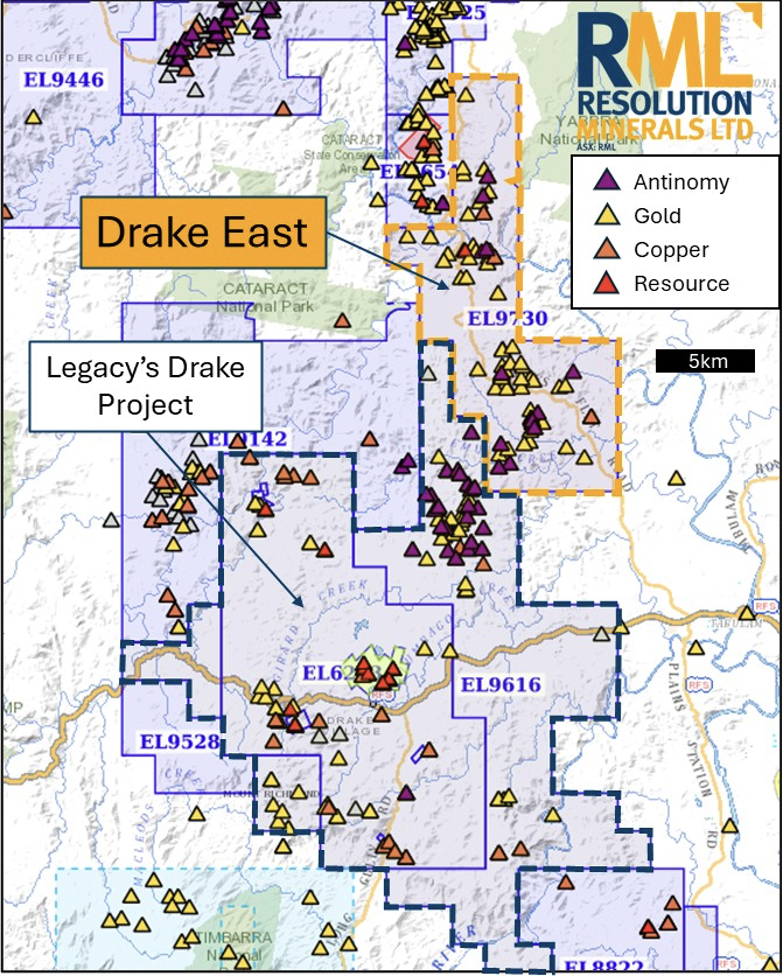
The Drake East Project is adjacent to Legacy Minerals’ Drake Gold-Copper Project, which hosts a large epithermal gold-copper mineralised system. The Legacy project area contains 24 documented antimony occurrences, with recent rock chip results showing up to 30% Sb and 0.38g/t Au at the Lunatic Prospect, 2.2km from Drake East.
Drake East itself hosts 14 known antimony occurrences, including the Mosquito Creek Antimony-Gold Reef, spread across a NW-SE strike length of over 15km. It also contains over 50 gold occurrences, including a placer gold resource at Lanikai West of 300,000 cubic metres at 1.0g/t Au. The Mosquito Creek Reef comprises a 1,000m vein system cutting through Emu Creek Formation mudstones and Jenny Lind Tonalite granites. Another major antimony occurrence, the Ball & Smiths Lode, is an 1870s historic mine with assays of 5.72% Sb and 0.26g/t Au.
Drake East is part of a region known for high-grade antimony mineralisation, including Larvotto Resources' Hillgrove Mine and Trigg's Wild Cattle Creek deposit. Resolution Minerals plans systematic exploration, including geophysics, geochemical sampling, and drilling, to assess the project's antimony, gold, silver, and copper potential.
The Neardie Project
RML's second antimony-focused project, the Neardie Project, is located approximately 20km north-northeast of Gympie, Queensland. The site includes the historic Neardie stibnite mines, which have intermittently produced high-grade antimony ore since the 1890s. Reported mining lode true thicknesses range from a few inches to approximately 4.5m. Sulphide minerals present include stibnite and pyrite, with quartz and calcite as gangue minerals.
The Neardie Mine was studied in the 1970s, with findings summarised by J. Siemon in a 1974 report for the Queensland Department of Mines (Geological Survey Queensland Data Portal Document Ref #: CR055606). The study involved sampling, underground and surface drilling, and slope fill bulk sampling. However, sample and drill hole locations were not documented in the report.
Historical results include a bulk sample from slope fill material, analysed by Mining Advisers, returning an average grade of 2.49% Sb. In 1971, Carpentaria Exploration Co. Pty Ltd conducted underground rock chip sampling, with results reaching up to 19.5% Sb. RML considers that significant high-grade antimony extensions may exist along strike, at depth, and in parallel systems, aligning with conclusions from the 1974 report.
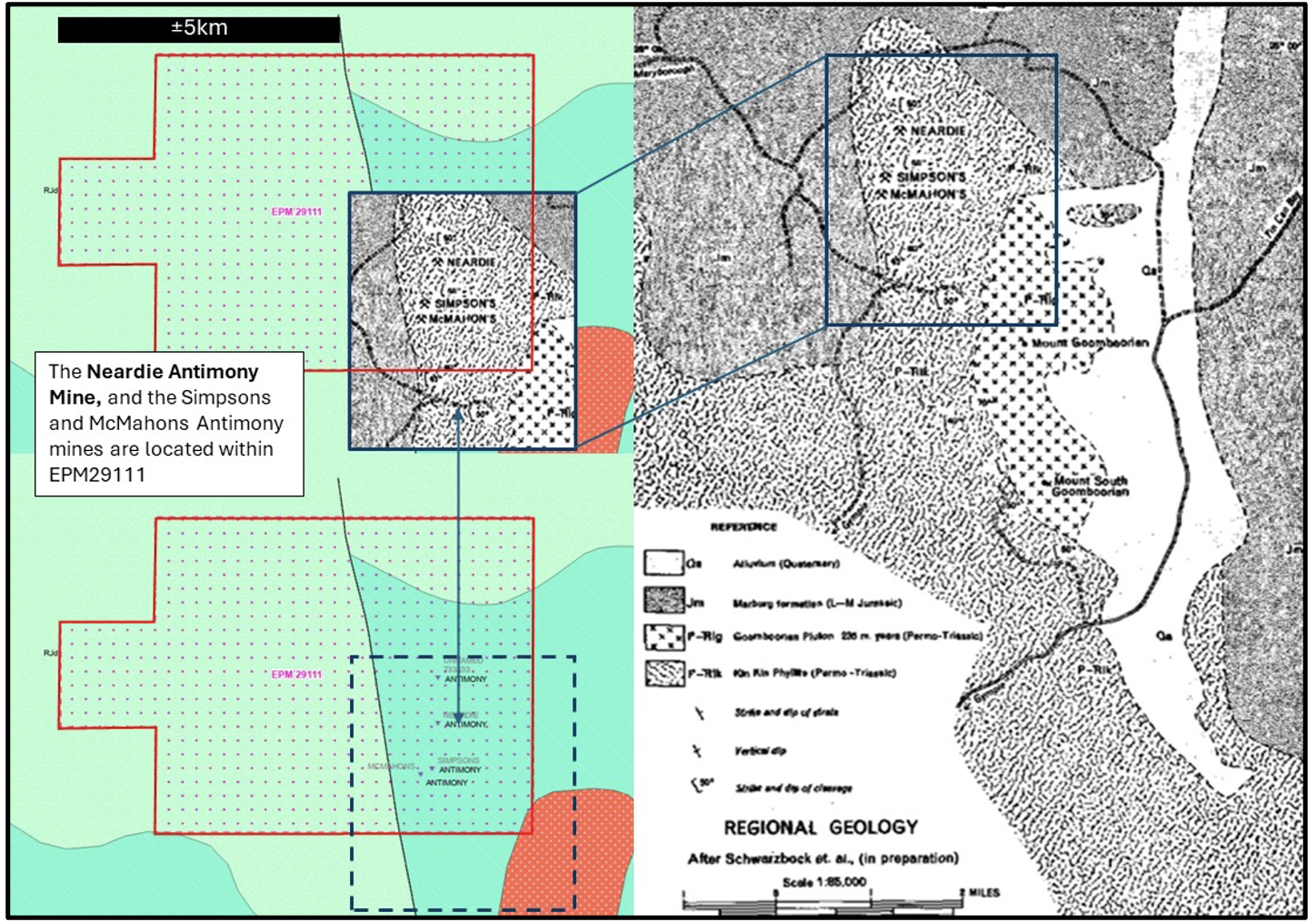
LEFT HALF: Tenement plan created using QLD government GeoResGlobe online resource data portal showing the locations of the antimony mines; RIGHT HALF: An antimony mines location plan copied from Department of Mines “Neardie Antimony Deposits, Gympie”. (Geological Survey Queensland Data Portal Document Ref #: CR055606).
Gold-copper upside: Spur South positioned for success
Resolution has acquired the Spur South Project, a gold-copper project with significant potential. The project consists of two granted Exploration Licences (EL9719 and EL9720) within the Macquarie Arc Metal Belt, which hosts multiple world-class gold-copper deposits. The belt contains 25 known porphyry systems, including six major mines and 17 significant deposits. Spur South is located approximately 15km south-west of Newcrest Mining’s Cadia Valley Operations and 5km west of Waratah Minerals’ Spur Project, within the Molong Belt’s Late Ordovician geology.
Surrounding deposits include Newmont’s Cadia (>50Moz gold, 9.5Mt copper), Evolution’s Cowal (>11Moz gold), Regis Resources’ McPhillamy’s (2.3Moz gold), Alkane’s Boda (7.3Moz gold), and Argent’s Kempfield (65.8Moz silver, 125k oz gold). Waratah’s Spur Project has reported 108m @ 0.55% copper. The company’s acquisition aligns with its exploration strategy, leveraging the region’s mineral potential and existing geophysical targets. The project’s strategic location, along with the mineralised systems nearby, supports its potential for future exploration and development.
Spur South Project (EL9720)
Exploration Licence EL9720 is situated approximately 25 kilometres west of the Cadia Valley Operations and seven kilometres west of the Golden Clad and Ironclad Mines (Figure 5). The project area encompasses regionally faulted volcanic rocks of varying composition, from felsic to intermediate, along with associated Silurian-age sedimentary rocks. Additionally, the area hosts Ordovician-age mafic rocks, including basalt, basaltic andesite, latite lavas, and intrusions, as well as associated sedimentary formations (Figure 6).
The Manildra and Belubula faults, which are oriented NW-SE to NNW-SSE, traverse the project area. Notably, these regional mineral-system-controlling faults, combined with a prominent total magnetic anomaly (high), make Spur South EL9720 a compelling exploration target. The Cadia Valley Operation and the Golden Clad/Ironclad gold and copper deposits are also associated with total magnetic highs, further underscoring the area's prospectivity (Figure 6).
Spur South Project (EL9719)
Exploration Licence EL9719 is situated approximately 15 kilometres southwest of the Cadia Valley Operations and 10 kilometres south of the Golden Clad and Ironclad mines (Figure 5). The project area hosts regionally faulted volcanic and sedimentary rocks, ranging from felsic to intermediate compositions of Silurian age, as well as mafic rocks—including basalt, basaltic andesite, and latite lavas—with associated Ordovician-age sedimentary sequences (Figure 7). The northwest-southeast to north-northwest-south-southeast trending Manildra and Belubula faults traverse the tenement, representing key structural controls.
Of particular significance is the presence of these regional mineralisation-controlling faults alongside a large total magnetic anomaly (high), which is a primary exploration target at Spur South. Notably, the Cadia Valley Operation and the Golden Clad/Ironclad gold and copper deposits are associated with similar total magnetic highs (Figure 7).
Despite being surrounded by major mining operations, the Spur South tenements remain significantly underexplored, with no recorded exploration drilling. Magnetic surveys indicate over four kilometres of strike potential, highlighting a key target zone for future exploration.
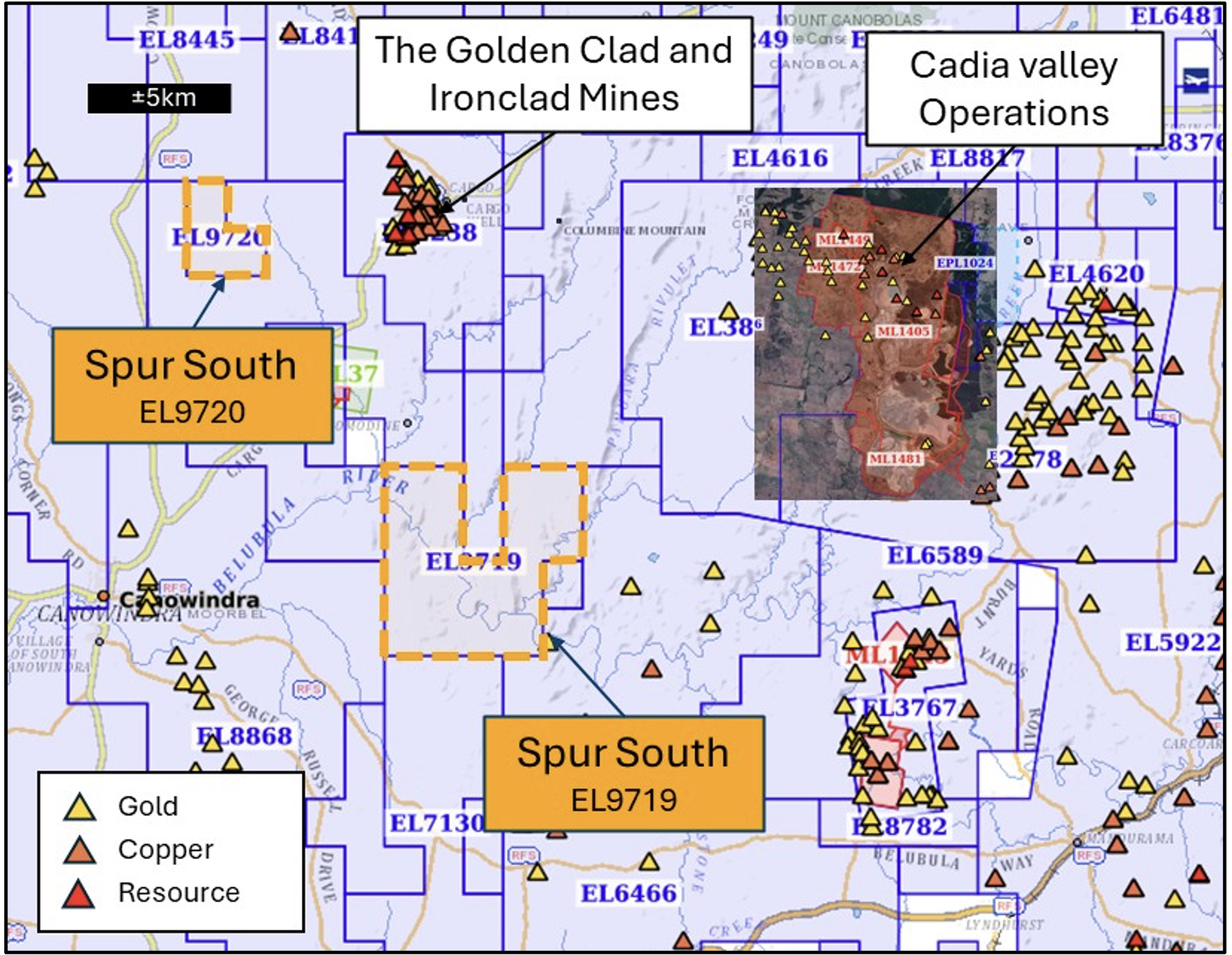
Cadastral map sourced and modified from the NSW Government interactive MinView web map application. The Spur South EL9720 and Spur South EL9729 Project parts are highlighted. Also highlighted are the known gold, copper and resource development projects in the vicinity. A satellite image is superimposed above the Cadia Valley Operations (to scale). Also highlighted is the Golden Clad and Ironclad Mines.
“The Spur South EL9720 and EL9719 Project areas both hosts geophysical anomalies that constitute a clear and compelling target. This is particularly interesting when considering the similarity of the geophysical signatures on our ground compared to the nearby world-class tier-1 deposits of the Cadia Valley,” Zaetz said.