
Far East Gold Ltd has finalised its 2025 exploration and drilling plans for its key assets, the Idenburg orogenic gold project and the Trenggalek copper-gold project. The company aims to expand the existing 540,000-ounce gold resource at Idenburg and test high-priority porphyry and epithermal targets at Trenggalek.
The planned drill programs are designed to advance these assets towards near-term development in collaboration with strategic partners. Results will be published as they come in.
Drilling program highlights
Idenburg (Orogenic Gold)
Total: 32 diamond drill holes, 3,670 metres.
- Sua prospect (1,120m, 5 holes) – Targeting east-west extensions of the current resource.
- Bermol prospect (1,050m, 8 holes) – Testing known extensions to build on the existing resource.
- Mafi prospect (500m, 7 holes) – Assessing mapped extensions of a previously defined resource.
- Kwaplu prospect (1,000m, 12 holes) – First drilling in this area, with potential for new discoveries.
Trenggalek (Porphyry Copper / Epithermal Gold)
Total: 18 diamond drill holes, 5,740 metres.
- Sumber Bening (High-sulphidation / Porphyry target) – 2 holes (1,450m) testing alteration zones and geophysical anomalies.
- Singgahan (Porphyry target) – 2 holes (1,550m) testing porphyry targets identified through surface sampling and 3D modelling.
- Buluroto (Porphyry-related target) – 2 holes (900m) following up on historical intersections, testing depth extensions and high-magnetic bodies.
- Buluroto (Epithermal vein target) – 12 holes (1,840m) drilling a 500m-long untested vein system.
The Idenburg drilling campaign will focus on resource expansion at Sua, Bermol, and Mafi, while also conducting scout drilling at Kwaplu, located southwest of Sua.
FEG’s aggressive exploration strategy is aimed at unlocking further value, with results expected to guide future development plans.
A more detailed look at the plan
IDENBURG - Gold project drill plan
The upcoming drill program aims to expand the inferred resources at the Sua, Mafi, and Bermol prospect areas, where a recent JORC 2012-compliant estimate outlined a total resource of 540,000 ounces of gold at an average grade of 4.1 grams per tonne (g/t). A total of 20 drill holes, covering 2,670 metres, are planned to test the continuity of mineralisation along strike and at depth.
Additionally, the program will include initial scout drilling at the Kwaplu prospect, located southwest of the Sua prospect. Kwaplu hosts a significant gold-in-soil geochemical anomaly, with ongoing surface mapping underway to refine drill targets. A total of 12 holes, covering 1,000 metres, are planned to assess the resource potential of this area.
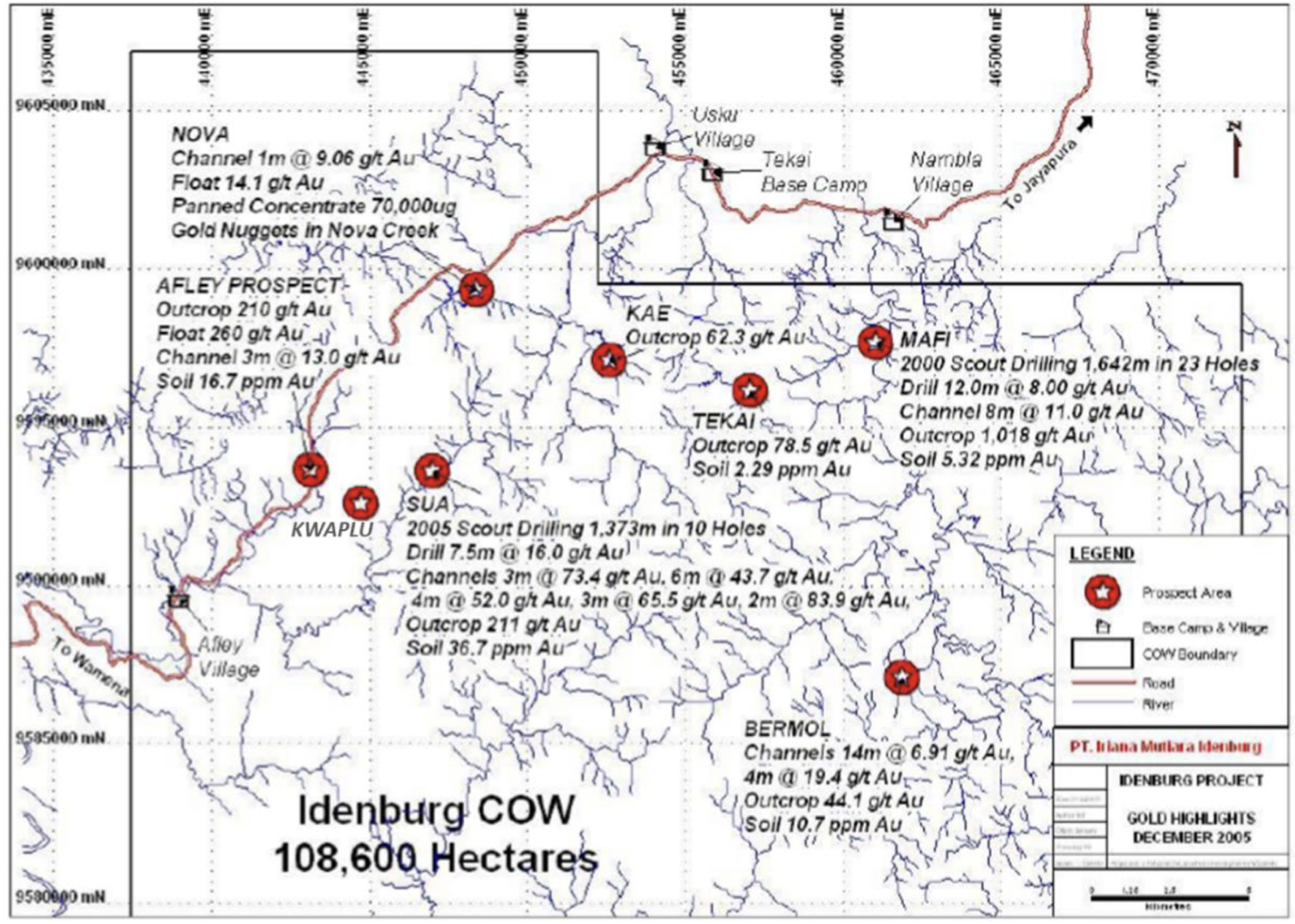
Map showing prospect and resource areas within the Idenburg COW tenement. The planned holes will attempt to expand current defined gold resources within the Sua, Mafi and Bermol prospects and complete initial drilling at the Kwaplu prospect area southwest of Sua.
Sumber Bening drill plan
The Sumber Bening prospect was identified by the Anglo-American exploration group as the top-priority drill target at Trenggalek. It features a broad, north-northeast-trending advanced argillic alteration lithocap, delineated through detailed mapping and surface rock sampling. The lithocap extends along strike for 5 kilometres, with a central 1.6-kilometre zone of vuggy quartz and an advanced argillic alteration assemblage comprising alunite, pyrophyllite, diaspore, dickite, and hypogene kaolinite. This alteration is spatially associated with several deep, high-magnetic bodies, which may indicate the presence of buried porphyry systems.
The drill program will consist of two holes, totalling 1,450 metres, targeting high-sulphidation alteration zones mapped at the surface that coincide with interpreted induced polarisation (IP) geophysical anomalies. The holes will also test deeper porphyry targets identified through 3D magnetic inversion modelling.
Buluroto drill plan
Previous drilling at Buluroto in 2010 intersected a broad zone of dilational crackle breccia with a fine-grained quartz matrix and disseminated pyrite-chalcopyrite mineralisation. In drill hole TRDD025, the breccia was encountered from 95.8 to 162.75 metres down-hole, returning an intercept of 24.55 metres at 0.51 grams per tonne (g/t) gold (Au) and 0.21% copper (Cu) from 138.55 metres, including 1.05 metres at 0.47 g/t Au and 1.12% Cu. The breccia is located adjacent to a large high-magnetic body, and planned drilling will test for its downdip extension and the potential for porphyry-related copper-gold mineralisation. Two holes, totalling 900 metres, are planned.
An additional 12 holes, covering 1,840 metres, are planned to test a 500-metre section of the Buluroto epithermal vein system that remains untested. The targeted vein system extends northeast from the porphyry drill target.
Singgahan drill plan
The Singgahan prospect hosts multiple porphyry copper-gold (Cu-Au) targets, identified through surface mapping and sampling coinciding with high-magnetic anomalies from 3D magnetic inversion modelling. Historical drilling intersected silica-magnetite-chlorite-epidote-altered diorite intrusive rock with fracture-controlled pyrite, minor chalcopyrite, and trace arsenopyrite and sphalerite.
The upcoming drill program will test additional magnetic targets associated with porphyry-style alteration and Cu-Au mineralisation. Two holes, totalling 1,550 metres, are planned to assess key porphyry targets defined by surface rock sampling and geophysical modelling.
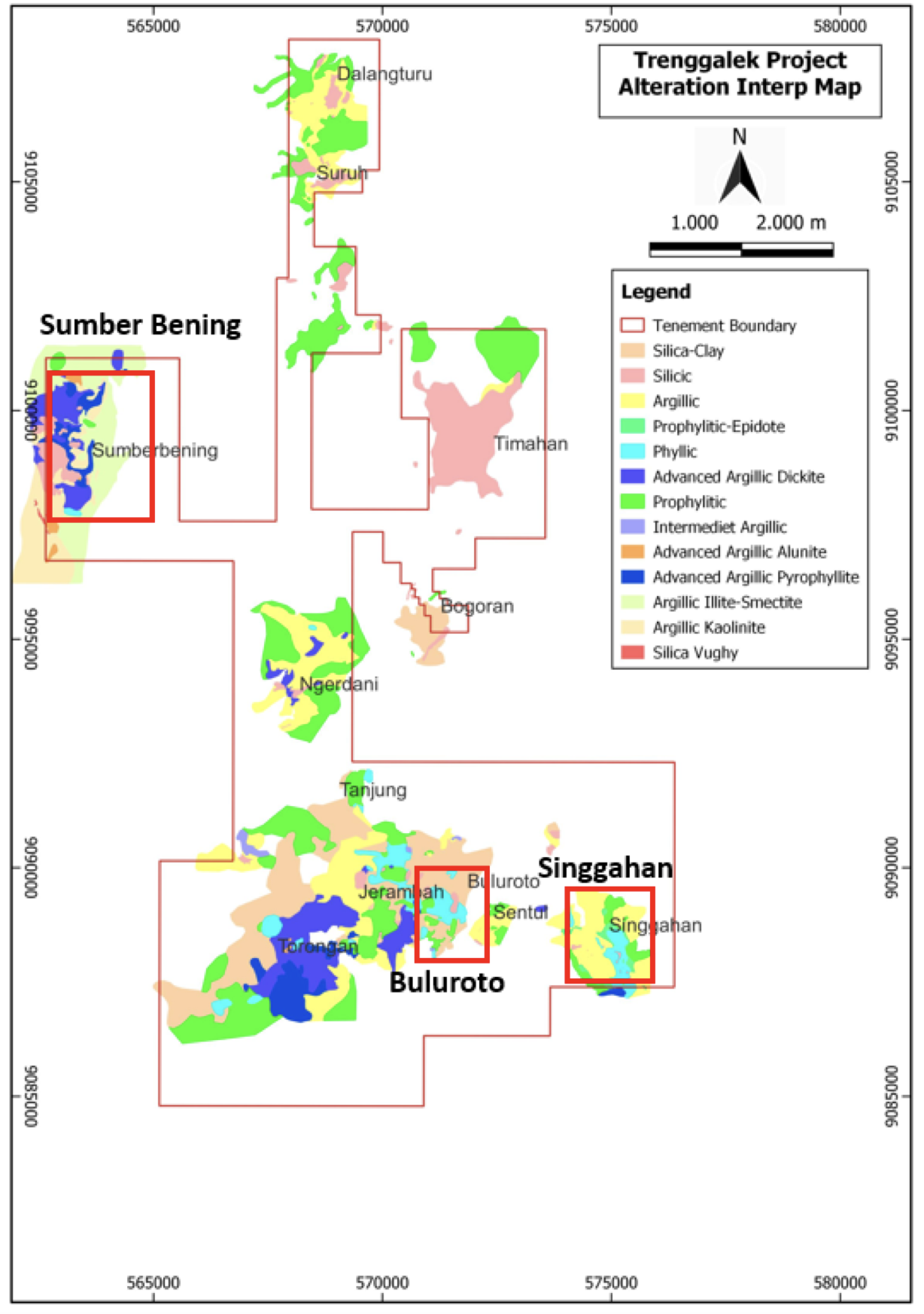
The Trenggalek IUP-OP property contains numerous areas of alteration and mineralisation. Three of the prospect areas have been identified by the company as priority drill targets. These include porphyry-type mineralisation at Singgahan and porphyry-related mineralisation at Buluroto and high-sulphidation-type, advanced argillic alteration at Sumber Bening.
Woyla Project drill plan
At the Woyla Project, five diamond drill holes, totalling 500 metres, are planned for initial scout drilling at the Kareung Reuboeh prospect.
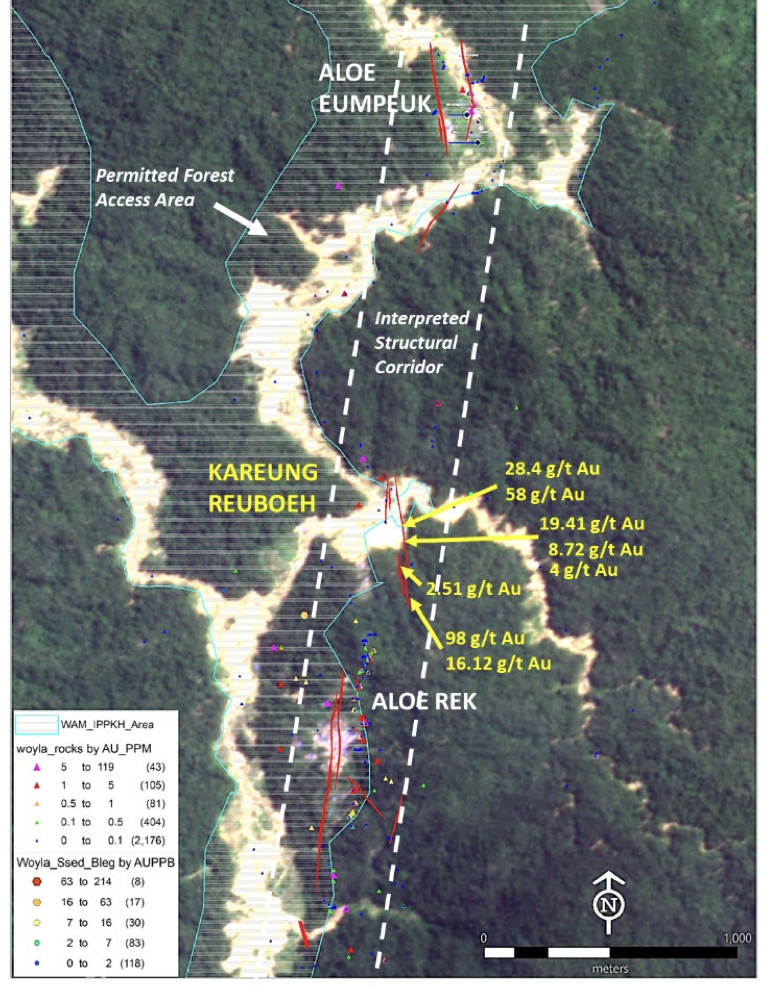
Plan map showing the location of exposed vein systems within the interpreted 6km long structural corridor that extends from Aloe Rek in the southern to Rek Rinti in the north. The high-grade Kareung Reuboeh veins are located approximately 500m north of the Aloe Rek veins previously drilled. Previous surface sampling has confirmed the occurrence of high-grade mineralisation within the Kareung Reuboeh veins. The Kareung Reuboeh veins have not been drill tested.
Surface mapping has delineated three separate veins, each up to 9 metres wide. Chip and grab samples from exposed veins have returned high-grade gold values.
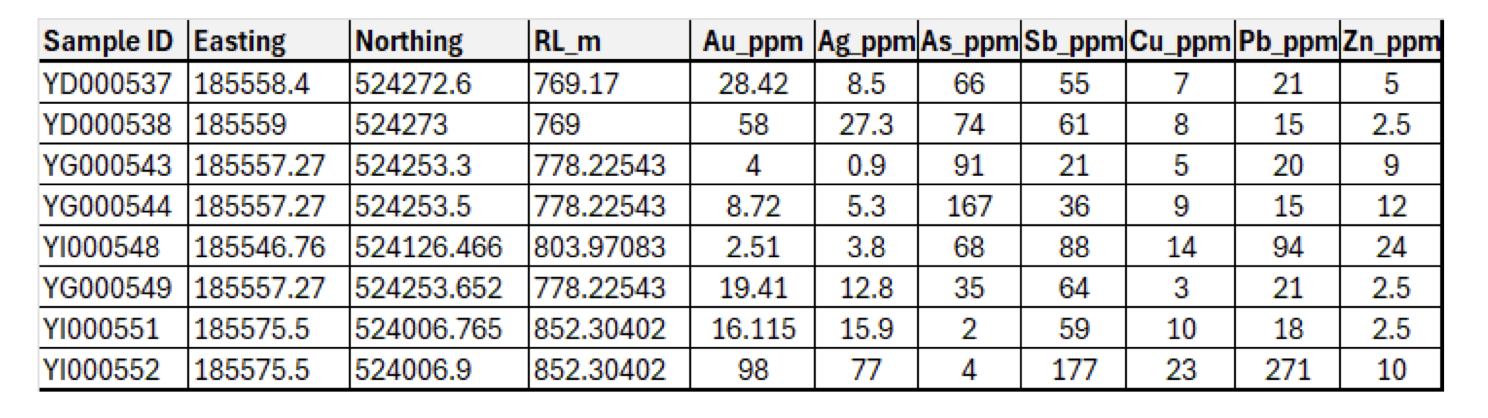
Assay results of samples of exposed quartz veins in the Kareung Reuboeh prospect area.
These veins remain untested by drilling, and the program aims to test them along a 250-metre strike length and to a depth of approximately 50 metres.