
Sovereign Metals Ltd has confirmed that coarse flake graphite from its Kasiya Rutile-Graphite Project can be successfully purified to high levels, demonstrating its suitability for premium applications.
Testwork conducted by ProGraphite GmbH achieved 99.95% purity using acid purification and 99.98% using alkaline purification, surpassing the typical >99.0% loss on ignition (LOI) target.
The results highlight the potential of Kasiya’s coarse flake graphite for high-margin applications such as powder metallurgy, isostatically-pressed refractory products, and high-grade expanded graphite products. Additionally, the success of both purification methods suggests potential benefits for future downstream customers, including reduced reagent consumption and waste generation.
“These are truly outstanding results – effectively achieving battery grade purities of +99% and less than 0.05% ash under conditions that typically result in under 1% ash. For our future customers, this has the potential to significantly reduce reagent consumption and waste generation in the production of high-purity flake or targeted high-end applications,” Sovereign managing director and CEO Frank Eagar said.
“This is yet further confirmation that Kasiya graphite concentrate is a premium graphite suitable for the anode, refractory, expandables and now also the high-purity powder metallurgy markets. We are delighted with the significant commercial optionality it brings to the Kasiya Rutile and Graphite Project.”
Exceptional purity achieved in Kasiya Coarse Flake Graphite: a step towards high-value applications
High-quality coarse flake graphite typically achieves grades of 97%–98% in minerals processing. However, certain applications require a loss on ignition (LOI) purity exceeding 99%, with ash content below 1%.
Purification methods
To meet this high-purity standard, coarse flake graphite is typically purified using one of two methods:
- Acid purification – Utilises hydrofluoric (HF) acid as the primary reagent to remove silicates and other impurities.
- Alkaline purification – Replaces HF with sodium hydroxide (NaOH), or caustic soda, to dissolve silicates before washing and acid leaching to remove residual metals.
The conditions required to achieve >99% purity are generally less aggressive than those needed for battery-grade graphite (>99.95%).
Testwork results
ProGraphite conducted purification tests on coarse (>180 microns) flake graphite from Kasiya under conditions typically used to meet the >99% purity target. The test results, summarised in Table 1, show that:
- A single-stage HF purification achieved ≥99.95% LOI purity, effectively reaching battery-grade levels.
- Alkaline purification delivered an exceptional 99.98% purity, under standard conditions that usually yield >99% purity.
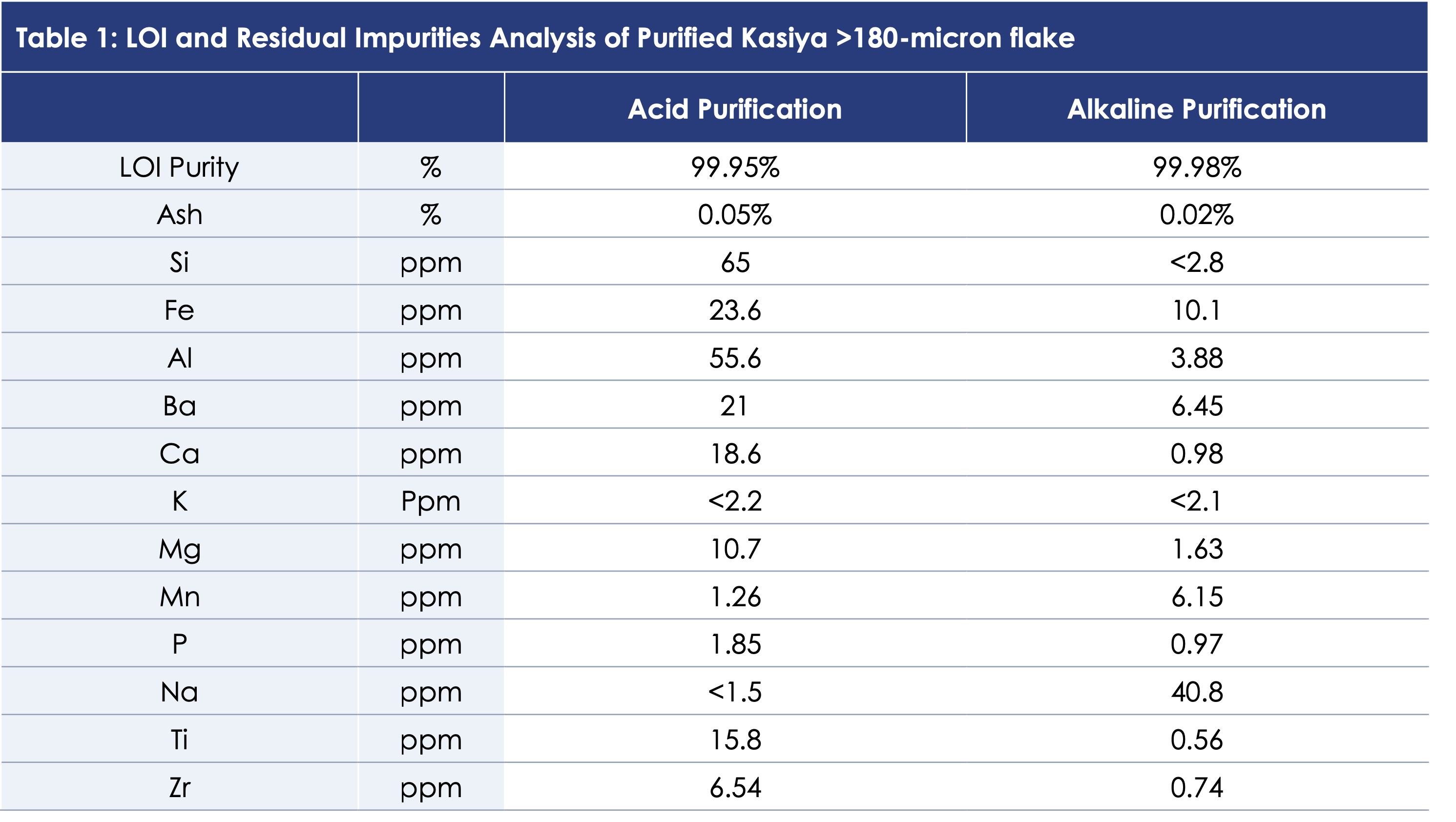
These results highlight Kasiya’s saprolite-hosted graphite’s suitability for alkaline purification, offering potential advantages such as reduced dependence on HF—a costly and hazardous reagent.
Commercial implications
The findings suggest that downstream customers could optimise reagent consumption for standard >99% purity products or, depending on market demand, produce ultra-high-purity coarse flake. High-purity coarse flake graphite is commonly used in applications such as:
- Powder metallurgy
- Isostatically pressed refractory products
- High-purity expandable graphite (e.g., foils and sheets)
These results enhance Kasiya’s commercial potential by demonstrating its adaptability for high-end industrial applications.