
Graphene Manufacturing Group Ltd (TSX-V:GMG, OTCQX:GMGMF) CEO Craig Nicol talked with Proactive about the company’s latest developments in battery technology.
GMG, an Australian company listed on the Toronto Stock Exchange Ventures, specializes in producing graphene from natural gas, which it uses across four key product lines, including coatings, lubricants, and batteries.
Nicol discussed GMG’s collaboration with Rio Tinto and the University of Queensland to develop graphene aluminum-ion batteries. The company has now partnered with the Battery Innovation Center (BIC) in Indiana, USA, to scale up its technology.
Proactive: Welcome back inside our Proactive newsroom. And joining me now is Craig Nicol. He is the CEO of Graphene Manufacturing Group. And Craig, it's great to see you again. How are you?
Craig Nicol: Great to be here. Thanks.
Excited to have you along. I know you've had some pretty significant news, and we'll talk about that in just a second, but remind everyone a little bit about what the company is all about.
Thanks. GMG is an Australian company listed on the Toronto Stock Exchange Ventures. We produce graphene from natural gas—one of the few companies in the world doing that. We then incorporate that graphene into four products. One is a graphene coating that improves heat reduction and prevents corrosion. Another is a graphene lubricant, which we recently announced can deliver up to 8.5% fuel savings.
At the end of last year, we introduced a graphene battery slurry for lithium-ion batteries. And our fourth product is a graphene aluminum-ion battery, which we're developing in partnership with Rio Tinto. That’s what we’re discussing today.
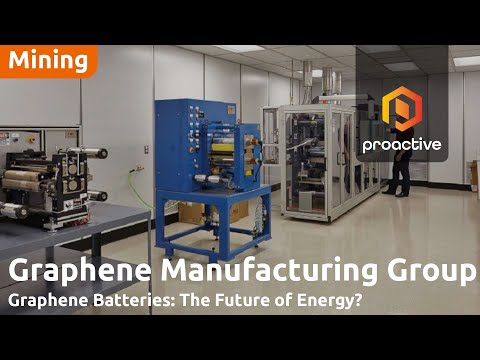
So in collaboration with Rio Tinto and the University of Queensland, you’ve signed a deal with the Battery Innovation Center in Indiana, USA. Tell me about who they are and why this is a great opportunity for GMG.
Our graphene aluminum-ion battery is at Technology Readiness Level 4. To scale up to mass production, we need to advance through levels five to eight. There are two options: invest heavily in a facility before fully optimizing the technology or partner with an established group. We chose to work with the Battery Innovation Center (BIC), a world-class organization in battery research and development.
We’re fortunate to have Bob Galyen on our board. He’s a highly respected battery expert who was the second employee at the world’s largest battery company. He helped us connect with BIC, which has extensive industry experience. Over the last 13 years, they’ve completed 500 development projects, making them an ideal partner.
The partnership helps you save costs too, right?
Exactly. We estimated that building our own plant could cost between $10 million and $20 million. Plus, since our battery technology is brand new, the risk of getting the setup wrong is high. By working with BIC, we’re using existing infrastructure, saving time and money while optimizing our process.
Our battery charges and discharges extremely fast—much faster than lithium-ion batteries. We can produce and test new prototypes in about two days, compared to a month for lithium-ion. That rapid cycle allows us to iterate and improve much more quickly.
And what’s the timeline for this project?
We’re currently working on optimization. We’ll be sending materials to BIC soon, and we expect to see performance updates throughout the year. The goal is to start producing test cells for third-party validation and customer testing.
There are many ways to optimize this battery since it’s a brand-new technology. Different customers will have different needs, so this year will be focused on refining our product to suit those requirements.
Quotes have been lightly edited for clarity and style