
Apollo Minerals Ltd’s Phase 2 drilling and exploration activities at the 100%-owned Salanie Gold Project in Gabon is progressing well. The campaign comprises approximately 2,000 metres of drilling and is focused on extending the known A1 mineralisation and testing new targets at key prospects A2, A3, and P6.
Five holes have been completed to date, totalling 520 metres. Two of these holes have now been submitted for analysis. The drill rig is currently positioned at the A3 historical pit, targeting extensions of high-grade mineralisation previously identified within a quartz-vein structure.
In parallel, earthworks are ongoing to prepare additional drill pads at P6 and the regional targets of Mikouma and Binda, supporting the broader exploration strategy.
Apollo is well-funded following the successful completion of a A$2 million Shortfall Offer, which was underpinned by a strategic investment from Capital DI Limited and its key backers.
This latest drilling campaign follows exceptional results from the 2024 Phase 1 program, which confirmed the project’s high-grade gold potential. Key intercepts included 5.8 metres at 8.2 grams per tonne (g/t) gold from 15.5 metres downhole within a broader 11.7-metre zone at 4.3 g/t gold from 9.6 metres, as well as visible gold in quartz veining assaying up to 124 g/t gold.
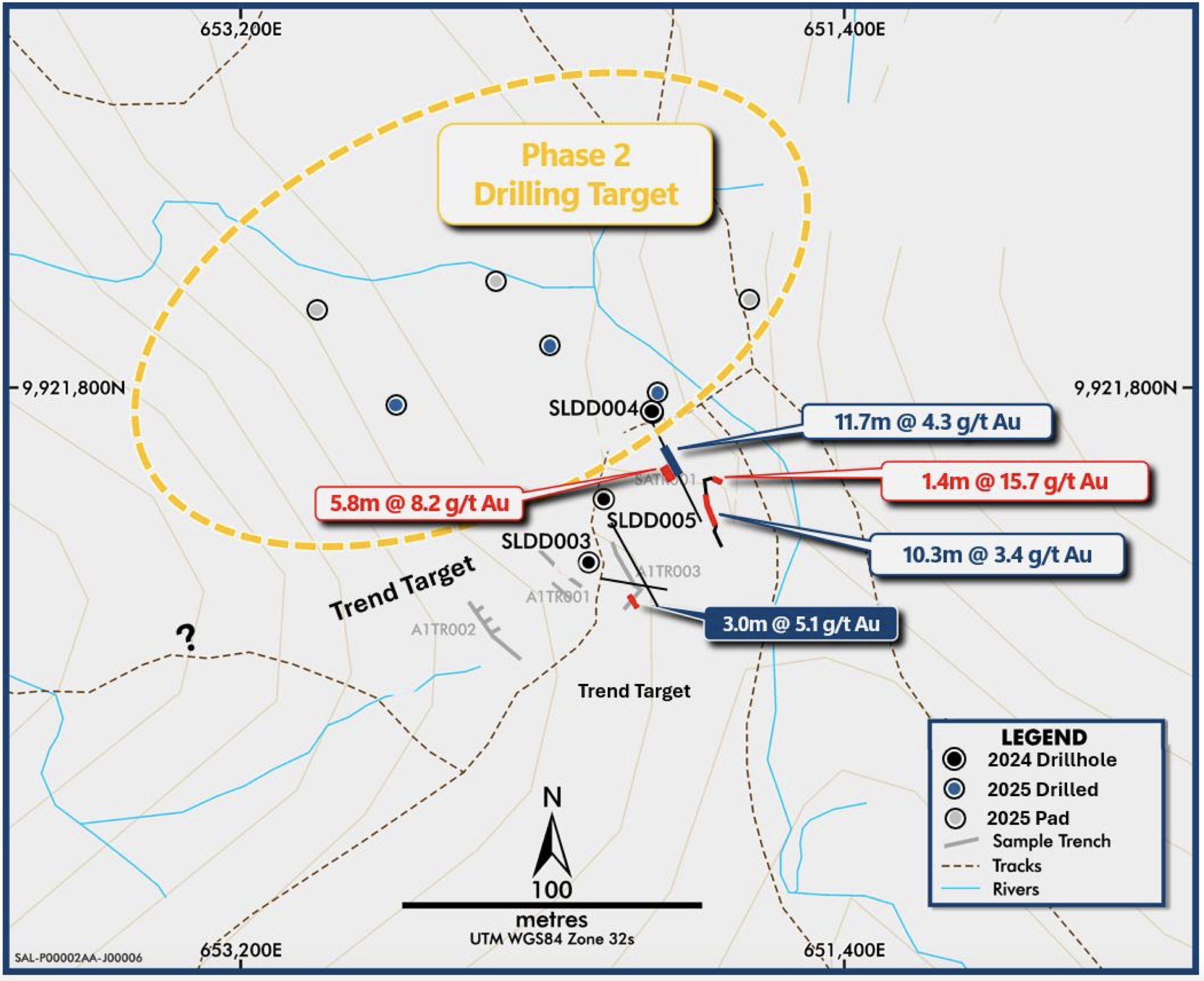
A1 drilling for 2025 and previous results from 2024.
The results highlight the underexplored potential of Salanie’s 12-kilometre prospective greenstone belt.
“We are extremely pleased with the progress made to date on the Phase 2 drilling campaign at Salanie, which is allowing us to efficiently test our three key prospects of A1, A3 and P6 and also expand regionally,” Apollo Minerals’ managing director, Neil Inwood said.
“Drilling is expected to be completed in early April and we are excited to be testing these historical high-grade producing areas with the first modern exploration in over 70 years.”
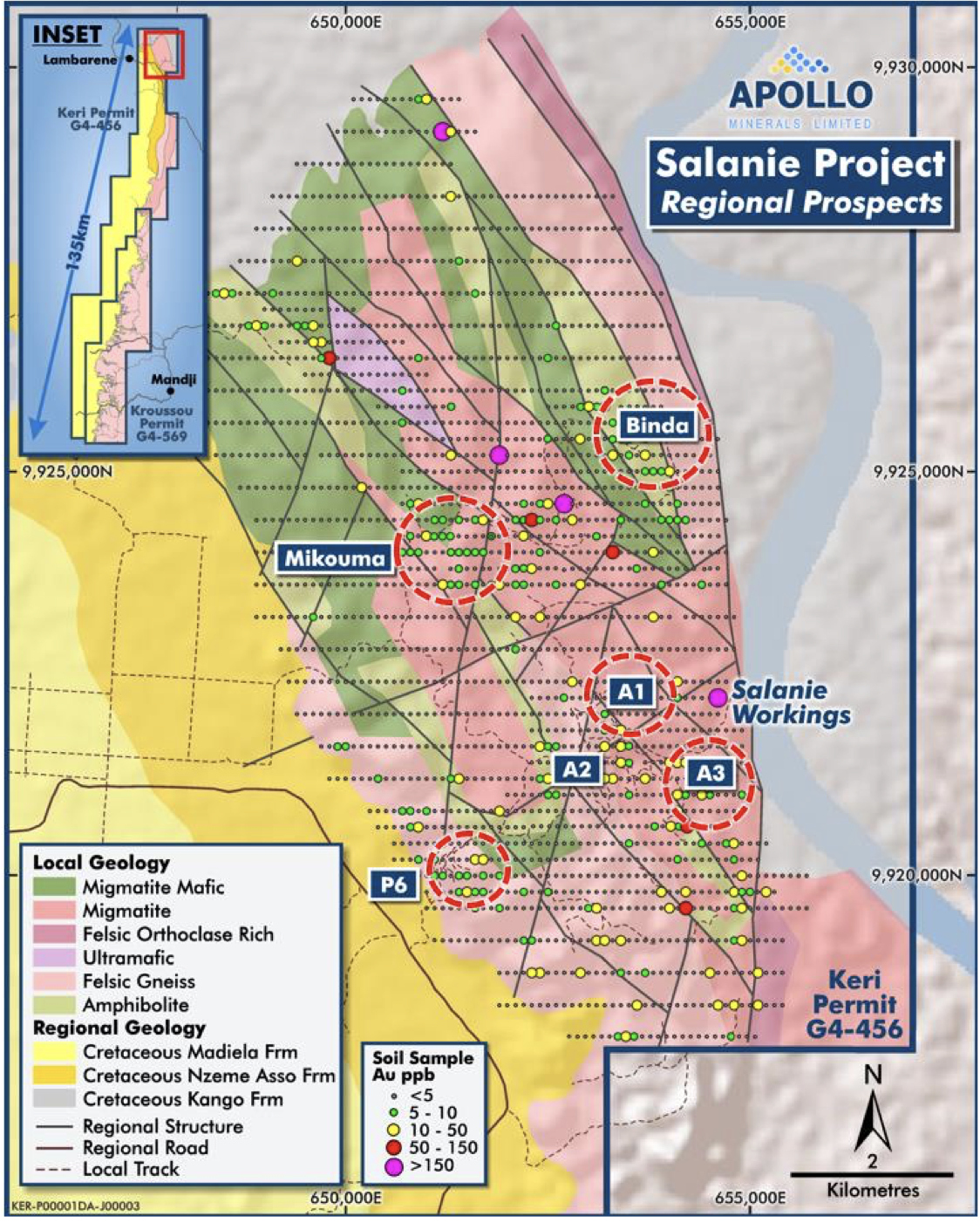
Salanie displaying key drilling prospect areas.
About Salanie
The Salanie Gold Project is 16 kilometres from Lambarene, a major town, and less than 2 kilometres from the sealed N1 highway. It lies within the company’s 100%-owned Keri Permit (G4-456) and is accessible by road, approximately 3.5 hours from the capital, Libreville.
Historical mining activity at the project dates back to the mid-1950s, with reported production exceeding 20,000 ounces of gold at an average grade of 12 grams per tonne (g/t) gold (Au). Mining primarily targeted outcropping quartz veins, with additional extraction from alluvial and eluvial deposits.
The project lies within an underexplored greenstone belt composed of Archaean migmatites, amphibolites, and granitic porphyry intrusions. It is within the Lambarene Horst, an area of metamorphosed Archaean rocks bordered by the Cretaceous sediments of the Cotier Basin to the west.
Structurally, the dominant trends align with the regional Ikoy-Ikobe Shear, following a north-northwest to south-southeast (NNW-SSE) orientation. Mapping conducted to date has identified sheared felsic gneiss, granitic units, amphibolites, and minor ultramafic formations, confirming details from historical geological surveys.