
Qantas Airways Ltd shares surged to $9.41 during today’s session, buoyed by the airline’s strong financial performance and the announcement of its first shareholder payouts since 2019.
As of 3:30 pm AEDT, shares were trading 4.27% higher at $9.27, following last month’s record high of $9.64.
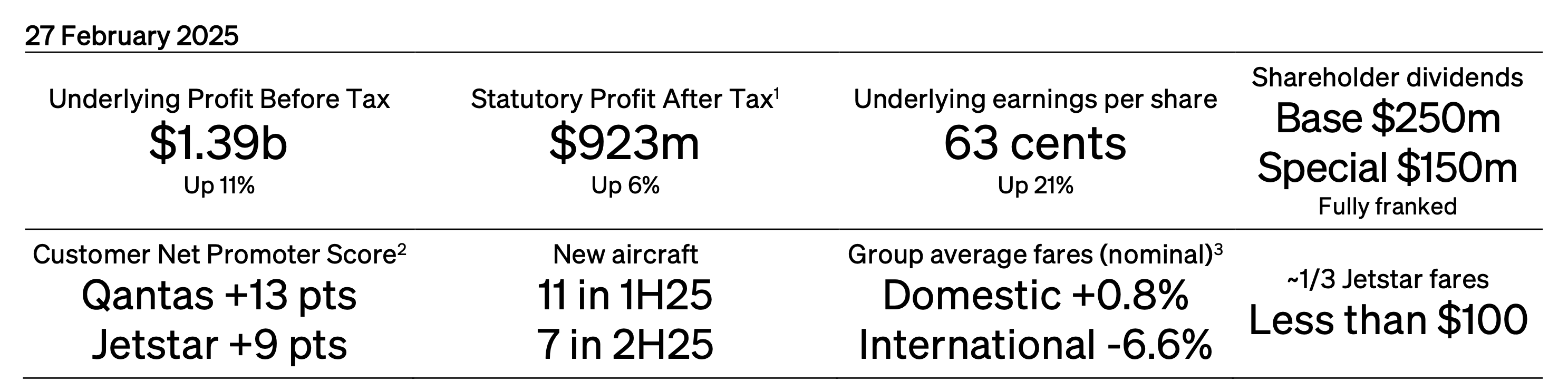
The airline reported its second-best financial result on record, posting an interim underlying profit of $1.39 billion for the six months to December 31—a 6% increase from the prior corresponding period.
Statutory profit rose to $923 million from $869 million a year earlier. Qantas declared its first dividend in six years, issuing a 16.5-cent per share payout alongside a special dividend of 9.9 cents, both set for payment on April 16.
“Having a strong business means we can invest in our customers and our people, including our largest ever fleet renewal and cabin overhaul programs,” Qantas Group CEO Vanessa Hudson said.
“Qantas and Jetstar made travel possible for more Australians, carrying 28 million customers, with around one third of Jetstar customers travelling for under $100 at a time of ongoing cost of living pressures.
Strong demand continues
Qantas continued to see strong demand in premium and corporate travel, while Jetstar carried a record number of passengers despite a high cost-of-living environment. Approximately one in three Jetstar travellers flew for under $100.
The airline is advancing its fleet renewal strategy, with 11 new aircraft and five mid-life aircraft added during the half. A key highlight was the contribution of Jetstar’s Airbus A321LRs and A320neos, now totalling 21 aircraft, delivering improved fuel efficiency, network expansion, and enhanced customer satisfaction.
Qantas’ fleet renewal is also progressing, with five Airbus A220s now in operation. However, the transition costs of introducing a new fleet type outweighed benefits in the half due to the fleet's small scale.
Investment in new aircraft will be complemented by a major cabin upgrade for existing planes. Qantas announced plans to refurbish 42 Boeing 737 aircraft, installing next-generation Business and Economy seats and larger overhead lockers.
Qantas Loyalty performed well, with active member engagement driving an 11% increase in cash inflows from partners and an 18% rise in partner contributions. A key initiative was the expansion of reward availability through the rollout of Classic Plus.
While customer satisfaction improved across all segments, Qantas remains focused on enhancing key service areas, including on-time performance, inflight service, and frequent flyer rewards. In December, 27,000 non-executive employees received a $1,000 recognition payment.
Ongoing transformation efforts helped offset inflationary pressures, including rising airport fees, supply chain constraints, and increased wage costs under Same Job Same Pay legislation.
For the first time since FY19, Qantas will pay dividends, including a fully franked $250 million base dividend and a $150 million special dividend, equating to 26.4 cents per share.
“The Group’s performance highlights the benefits of having both a premium and a low fares airline and a strong loyalty program,” Hudson said.
“With a growing fleet of new aircraft, Jetstar went from strength to strength delivering a better experience for customers and an improved financial performance. Importantly, Jetstar was able to help more Australians take a holiday for less.
“Qantas Domestic revenue grew strongly and, like Jetstar, will see significant benefits as its fleet renewal ramps up, starting with the arrival of the A321XLR in the coming months.
“We’re seeing progress from the investments we are making for our customers and people but we know there’s more work to do to consistently deliver in the moments that matter. This is a key part of rebuilding trust and continues to be our focus.
“Australians have always loved to travel and continue to prioritise it over other spending options. Looking forward, we continue to see intention to travel from leisure and corporate customers remaining high.
“Our financial strength means we are now in a position to pay our shareholders dividends for the first time in almost six years.
“The dedication of our people and the continued loyalty of our customers underpin our success, and I want to sincerely thank them.”
Shareholder returns
As of December 31, 2024, net debt remained at $4.1 billion, reflecting the acquisition of new aircraft and capital returns to shareholders through on-market share buy-backs. By the end of FY25, net debt is projected to be within or below the mid-point of the target range of $4.7–$5.8 billion. Capital expenditure for the year is forecast at $3.8–$3.9 billion, with spending weighted towards the second half.
The Group closed the half-year with liquidity exceeding $11.5 billion, comprising $2.3 billion in cash, $1.2 billion in committed undrawn facilities, and more than $8 billion in unencumbered fleet and other assets.
With sufficient franking credits available, the Board has approved a fully franked base dividend of $250 million (16.5 cents per share), expected to be sustainable through market cycles. Additionally, a fully franked special dividend of $150 million (9.9 cents per share) has been declared. Both dividends are scheduled for payment on April 16, 2025.
During 1H25, the Group completed $431 million in shareholder returns through previously announced on-market share buy-backs. A strong balance sheet and anticipated future growth will continue to support fleet investments, customer and employee initiatives, and future shareholder returns.
Outlook
The Group anticipates strong travel demand across its portfolio in the second half of the financial year.
- Group Domestic unit revenue is expected to rise by 3–5% year-on-year.
- Group International unit revenue is forecast to remain stable.
- Net freight revenue in 2H25 is expected to increase by $10–$30 million compared to the previous year.
The Group is managing the impact of US dollar strength through hedging, natural revenue offsets, and network flexibility. Key financial projections include:
- Fuel costs: Approximately $5.22 billion, including hedging and a gross carbon cost of around $70 million.
- Depreciation and amortisation: Estimated at $2.03 billion.
- Net finance costs: Expected to be $250 million.
- Transformation initiatives: Targeting $400 million in FY25 to offset inflationary pressures, incorporating cost and revenue measures.
- Same Job, Same Pay legislation: Expected to have a gross impact of $65 million in FY25, with plans to mitigate through revenue and cost efficiencies.
- Fleet-related costs and inefficiencies in 2H25 vs 2H24:
- Entry into service (EIS) costs of $22 million ($30 million for FY25).
- QantasLink fleet inefficiencies expected to moderate to $17 million ($41 million for FY25).