
Terra Metals Ltd has received high-grade titanium results in addition to high concentrations of copper, platinum group metals (PGMs) and vanadium which extend the strike at Reef 1 North within the Dante Project in Western Australia’s West Musgrave region.
Results from nine reverse circulation (RC) drill holes at Reef 1 North have extended the discovery strike by an additional 1,200 metres to a total strike length of approximately 4,200 metres.
The potential for a large-scale, high-grade polymetallic deposit has been highlighted over ~4.2 kilometres from the surface at Dante, with mineralisation remaining open in multiple directions.
Reinforce potential
Managing director and CEO Thomas Line said: “These outstanding results further reinforce the scale and high-grade potential of Reef 1 North.
"Extending the strike by another 1.2 kilometres to a total of ~4.2 kilometres, while consistently intersecting high-grade titanium, copper, PGMs and vanadium, underscores the significant polymetallic opportunity at Dante.
"With mineralisation remaining open and assays pending from an additional 11 drill holes at Reef 1 North, we are confident that the project's potential will continue to grow. We look forward to delivering further results as they become available.”
Shares higher
Investors have also welcomed the progress at Dante with shares 14.29% higher in the first hour of ASX trading to $0.032.
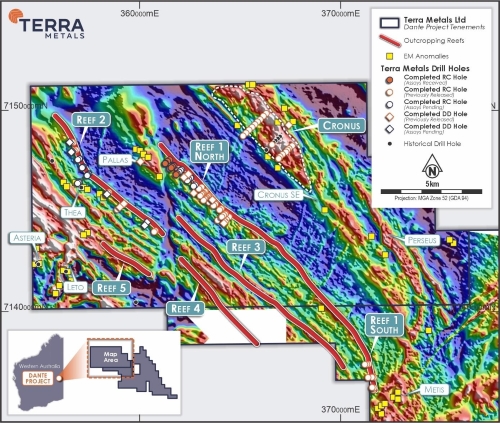
TMI image showing prospects in the western portion of Dante Project Reef 1 and Reef 2 discoveries.
Selected new high-grade intercepts at Reef 1 North include:
- 6 metres at 16.9% titanium (TiO2), 1.02 g/t PGM, 0.22% copper (Cu) and 0.69% vanadium (V2O5) from 64 metres, including 3 metres at 20.7% TiO2, 0.93 g/t PGM, 0.36% Cu and 0.78% V2O5 from 64 metres;
- 9 metres at 15.5% TiO2, 0.53 g/t PGM, 0.20% Cu and 0.57% V2O5 from 111 metres including 4 metres at 21.9% TiO2, 0.90 g/t PGM, 0.31% Cu and 0.82% V2O5 from 113 metres;
- 7 metres at 17.9% TiO2, 0.66 g/t PGM, 0.21% Cu and 0.70% V2O5 from 142 metres including 4 metres at 22.4% TiO2, 1.00 g/t PGM, 0.23% Cu and 0.93% V2O5 from 144 metres; and
- 9 metres at 17.6% TiO2, 0.62 g/t PGM, 0.24% Cu and 0.64 V2O5 from 165 metres including 4 metres at 23.7% TiO2, 1.07 g/t PGM, 0.36% Cu and 0.91% V2O5 from 167 metres.
Further assays are pending from an additional 24 drill holes, including 11 drill holes at Reef 1 targeting further shallow high-grade mineralisation.
Terra Metals remains highly encouraged by the consistency of the mineralisation and the scale of the opportunity at the Dante Project.
With ongoing exploration efforts, the project continues to demonstrate significant potential.
Similarities to Bushveld
The Dante Reefs are a series of stratiform mineralized layers hosted within the Jameson Layered Intrusion, a large mafic intrusion geologically analogous to South Africa’s Bushveld Complex – the world’s largest source of PGMs, vanadium and chromite, mined for more than a century.
Similar to Bushveld, the Jameson intrusion contains mineralized reefs enriched in platinum, palladium, gold, copper, vanadium and titanium, highlighting its potential to host a significant critical minerals deposit.
Recent assays from Reef 1 South (Oceanus), 11 kilometres along strike from Reef 1 North, confirm extensions to mineralized zones, further supporting the project’s potential.
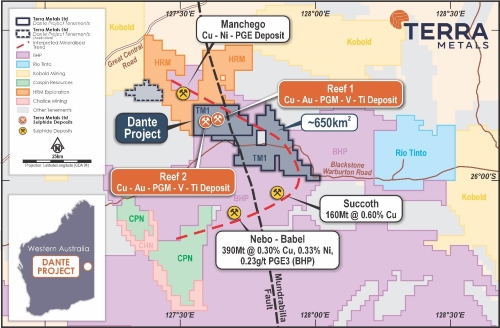
Dante Project location map displaying surrounding companies’ tenure and major deposits.
Proximity to Nebo-Babel
The Dante Project is in the same geological complex and in close proximity to one of the world’s largest mining development projects, BHP’s Nebo-Babel deposit.
The Giles Complex is hosted in the broader Musgrave block covering 140,000 square kilometres in central Australia and is at the junction of three major crustal elements - the West Australian, North Australian and South Australian cratons.
The discovery of the Nebo-Babel nickel-copper-PGE sulphide deposit in the western portion of the Musgrave block was considered to be the world’s largest nickel-copper-PGE sulphide discovery since Voisey’s Bay prior to the discovery of the Julimar-Gonneville deposit in 2018.