
Brightstar Resources Ltd has fielded strong metallurgical results from 2024 definitive feasibility study (DFS)-level test-work at the 303,000-ounce Cork Tree Well (CTW) deposit, part of the Laverton Gold Project (LGP) in WA.
The results indicate gold recoveries exceeding 90% across various rock types, with high gravity gold content ranging from 25% to 60%.
Metallurgical recoveries from the DFS test-work include:
Dolerite-hosted mineralisation (Delta, Cork Tree Well North):
- Oxide - 90-98%;
- Transitional - 90-98%; and
- Fresh - 90-95%.
Sediment-hosted mineralisation (Cork Tree Well South):
- Fresh chert - 91-96%; and
- Fresh shale - 90-94%.
Test-work was conducted at a coarse grind of P80 106 µm, with leach times ranging from 24 to 48 hours.
The study confirmed that Brightstar’s chosen processing flowsheet — a conventional Carbon in Leach (CIL) circuit — can be optimised based on these results. Additionally, low levels of deleterious elements were observed, with minimal impact on metallurgical recoveries.
“The results from our test-work program have proven that Cork Tree Well recovers exceptionally well across all rock types and oxidation states,” Brightstar’s managing director Alex Rovira said.
"Material feeding the test-work programs were from our 2024 diamond drilling program, with comprehensive leaching and comminution test-work being assessed by our DFS metallurgical consultants, IMO.
"Based upon these positive results, we have elected to expedite an RC program at Cork Tree Well to commence by early March 2025, with the view of targeting dolerite-hosted mineralisation at the Delta pit to generate additional oxide and transitional material being assessed in the DFS.
“We look forward to sharing the completed metallurgical results for our remaining projects being studied within the DFS, with all sample material in the lab and being processed through the various test-work programs.
"In parallel with the metallurgy workstreams, our geotechnical and mining consultants are finalising the open pit and underground mine designs & schedules, our processing engineers are in the final stages of process plant design and our TSF engineering consultants are nearing completion on an in-pit tailings deposition solution for a technically robust and low capital tailings storage facility.”
Metallurgical test-work on key holes
Brightstar's metallurgical test-work program was conducted by Independent Metallurgical Operations Pty Ltd (IMO). The test-work utilised previously announced metallurgical drill holes CTWMET001 to CTWMET004, with geological details on these holes disclosed in earlier releases.
CTWMET001 and CTWMET002 targeted sediment-hosted mineralisation, including chert and shale, near historically mined open pits, while CTWMET003 and CTWMET004 focused on dolerite-hosted mineralisation in unmined areas to the north.
As outlined in the test program, sufficient rock mass from half- and quarter-cut PQ and HQ drill core was logged and assayed before sampling for metallurgical analysis.
The material was divided into Master and Variability composites to support leaching, comminution, gravity recovery and reagent optimisation test-work.
Dolerite oxide, transitional and fresh samples were prepared as both Master and Variability composites, while Shale and Chert samples were analysed as Master Composites only.
Geochemical analysis of these composites confirmed low levels of deleterious elements such as non-carbonate carbon, copper, antimony and tellurium. Notably, the Shale and Chert samples showed minimal impact on gold recoveries.
Additionally, no evidence of 'preg-robbing' — a phenomenon where gold is lost to tailings instead of being recovered through the carbon-in-leach (CIL) process — was detected across any of the rock types tested.
The results provide further insight into the metallurgical characteristics of Brightstar’s mineralisation and will inform ongoing processing and optimisation studies.
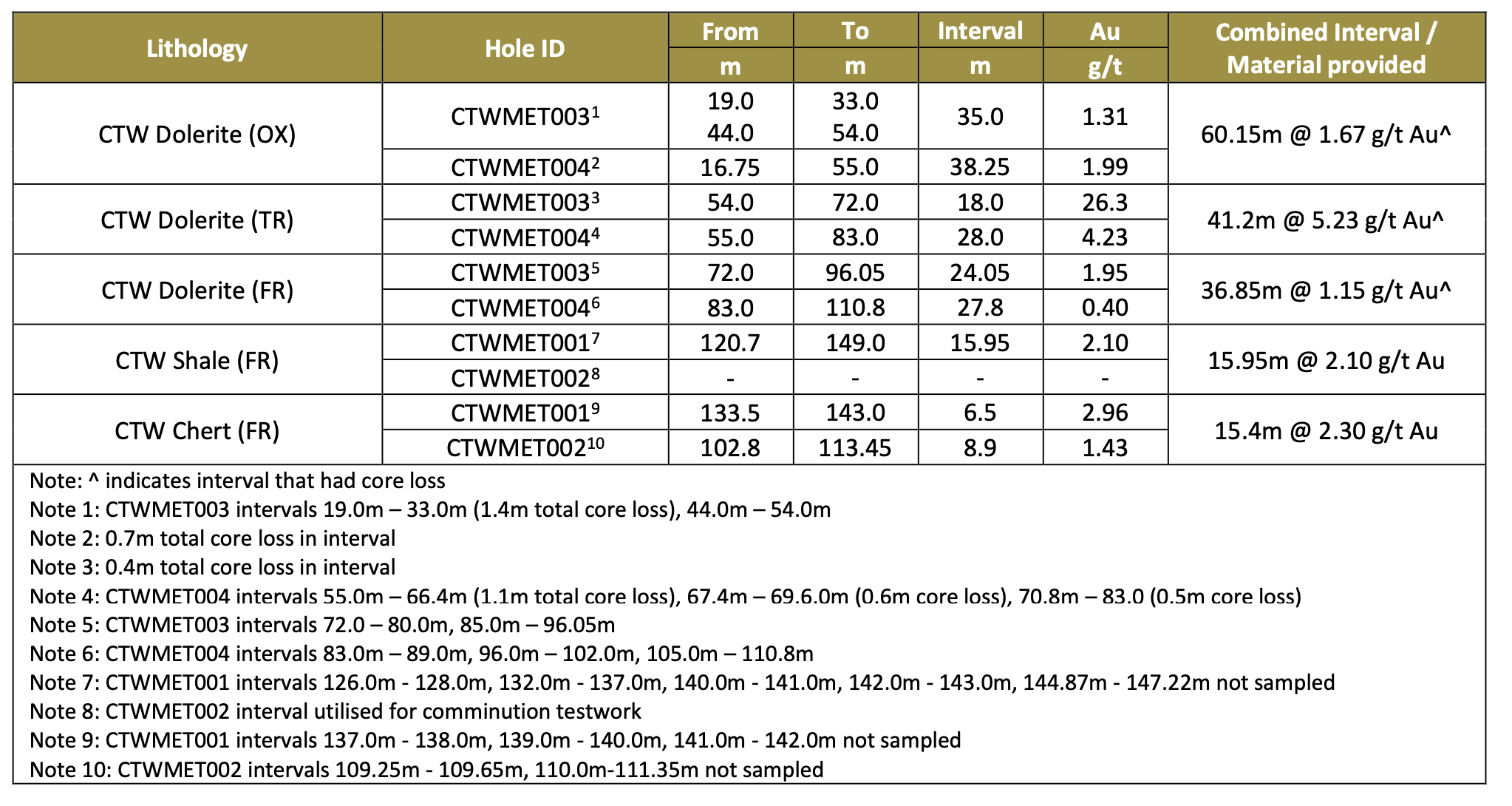
Metallurgical test-work sample provenance (leach test-work).
Metallurgical test-work continues
Further metallurgical test-work is progressing on Brightstar’s other assets, including Lady Shenton (Menzies), Fish and Lord Byron (Jasper Hills), with completion expected in the coming months.
Meanwhile, an expedited reverse circulation (RC) drilling program is underway to infill dolerite-hosted mineralisation at Delta and target high-grade plunging lodes below shallow historic pits.
What’s next?
Technical workstreams within the definitive feasibility study are advancing well, while near-term development of mining operations at the Jasper Hills project continues.
Onsite activities include upgrades to haul road signage and preparations for ore haulage from historic low-grade stockpiles.
Director resignation
Brightstar has also announced the resignation of non-executive director Matthew Bowles, effective immediately, as he pursues other business interests.
“Brightstar wishes to thank non-executive director Matthew Bowles for his contribution to Alto Metals Ltd and Brightstar throughout the recent Scheme of Arrangement,” Rovira said.
“Matt was managing director of Alto since 2020 and has resigned from the board of Brightstar to pursue full-time opportunities within the Australian natural resources sector. We wish Matt well with his new endeavours.”