
Fincraft Group this week spoke to Proactive about its strategic shift toward critical minerals and renewable energy.
Company president Kenges Rakishev outlined how the company is balancing traditional oil and gas investments with a growing focus on resources essential for the global energy transition.
The company is prioritizing lithium, nickel, and cobalt investments to align with the rising demand for electric vehicles and battery storage. Rakishev explained that Fincraft’s model ensures long-term resilience by incorporating next-generation resources while continuing to develop oil and gas projects.
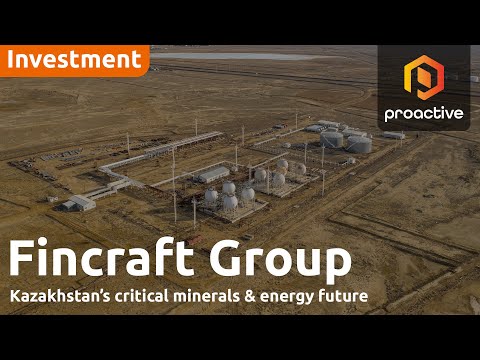
A key element of this strategy is natural gas. The company is currently constructing a gas plant in the Mangistau region to produce LNG and LPG for export.
Here, we look at what was said.
Proactive: Joining me today is Fincraft Group president Kenges Rakishev. Kenges, very good to speak with you again.
Can you start by telling us what makes Kazakhstan and Central Asia a promising region for energy and resource investments?
Kenges Rakishev: First of all, thank you very much for inviting me again. I'm happy to be here with Proactive.
The question is very important because the region is not only rich in hydrocarbons but is also emerging as a key supplier of critical minerals essential for the energy transition.
Kazakhstan is investing in the renewable sector, particularly wind and solar, to complement its oil and gas industry and strengthen long-term energy security.
Its strategic location between China, Europe, and Russia makes it an important logistics hub. This is just the beginning of this strategy.
Proactive: How has Fincraft’s strategic approach and diversified investments helped shape the local energy sector?
Kenges Rakishev: Fincraft’s model balances traditional energy -oil and gas - with next-generation resources like nickel, cobalt, and renewables, ensuring long-term resilience.
The company invests in infrastructure and technology to reduce emissions, increase efficiency, and enhance Kazakhstan’s role in the global energy market.
Supporting local supply chains and sustainable energy projects aligns with global energy trends and ESG expectations.
Proactive: You have invested in projects like Equus Petroleum and Tethys Petroleum. Can you shed light on their role in your overall strategy?
Kenges Rakishev: Yes, these assets are part of a larger energy transition strategy, ensuring a stable oil and gas supply while reinvesting in new energy opportunities.
We want to invest in projects related to Kazakhstan or those with a strong Central Asian component.
Investments in cleaner extraction and refining technologies help meet the growing global demand for low-carbon hydrocarbons.
At the same time, we are focusing on gas, which is a very clean and green energy source. We have started a major project to construct and complete a gas plant.
Proactive: You've already divested from ARK Petroleum and Nomad Oil. What is your investment strategy, and how does it contribute to building a global resources portfolio?
Kenges Rakishev: Capital has been redirected to projects that align with global trends in critical minerals, low-carbon energy, and sustainable extraction, rather than focusing solely on oil.
The strategy involves building a resource portfolio that includes lithium, nickel, and cobalt, which are essential for the renewable energy sector.
As for ARK Petroleum, Nomad Oil, and others like Equus and Tethys, we have plans to create a major holding for oil and gas, as well as a separate holding for critical minerals such as lithium, nickel, and cobalt.
Proactive: How does the development of Beineu Petroleum contribute to boosting both economic growth and energy security in Kazakhstan?
Kenges Rakishev: Beineu Petroleum helps secure Kazakhstan’s energy independence by ensuring domestic oil and gas supply while integrating with new energy infrastructure.
This is critical to our long-term goal of building a strong, clean energy industry based in Kazakhstan.
Beineu Petroleum has a great opportunity now, and we have already signed contracts to export oil and gas to Europe.
One of our strategic priorities is to complete the gas plant in the Mangistau region, which will produce LNG and LPG for export.
Proactive: With major players like China and the US influencing the energy markets, how do you position your investments in Kazakhstan to remain competitive and secure?
Kenges Rakishev: Kazakhstan can bridge East and West by balancing partnerships with China and, most importantly, the United States and Europe while maintaining energy independence.
Unlike traditional oil exporters, Kazakhstan is investing in critical minerals and renewables, positioning itself as a future leader in the green energy supply chain.
Kazakhstan is also important for rare earth materials.
Strategic investments in battery metals and grid storage make the country a key player in the global shift toward electrification.
There is a major discussion in Kazakhstan now about the next step in energy transition, which will include not only renewables but also nuclear energy.
Proactive: For those new to the sector, what key trends in Kazakhstan’s oil and gas industry should they be aware of as indicators of future opportunities?
Kenges Rakishev: Carbon capture and low-emission oil production are becoming priorities as Kazakhstan aligns with global climate policies.
The country is strengthening its pipeline network for energy exports to Europe and China, as demand grows for stable, non-Russian energy sources.
Investments in critical minerals like nickel, cobalt, and lithium are increasing to support the electric vehicle and battery storage industries. Rare earth materials are also a focus.
For Fincraft Group, our main focus remains on oil and gas, particularly gas, which we see as a pure and green energy source. At the same time, we are investing in lithium, nickel, and cobalt.
Proactive: Kenges, I hope you'll keep us updated on your progress and energy journey. Thank you very much for speaking with us today.