
A hotter-than-expected US inflation reading sparked an initial sell-off of US stocks and lifted the dollar to put pressure on the pound and other currencies.
The rebound in inflation lowered or even ended the potential for the Federal Reserve to cut interest rates this year, economists said.
The US consumer price index for January rose 0.5% over the month, which was higher than the 0.3% that economists expected and up from 0.4% in December.
Year on year, CPI was up 3.0%, up from 2.9% in December, with economists forecasting it would remain at 2.9%.
Core CPI, which excludes more volatile prices like energy and food prices, rose 0.4% on the month, versus 0.3% expected, while on a yearly basis core CPI climbed 3.3%, up from 3.2% and higher than the 3.1% consensus estimate.
Following the reading the dollar rose 0.5% against the pound to $1.2385, while gaining 0.3% on the euro to $1.0327.
US government bonds, especially longer-dated Treasuries, were sold, sending yields climbing. The 10-year, for example, rose to 4.85% from 4.75%.
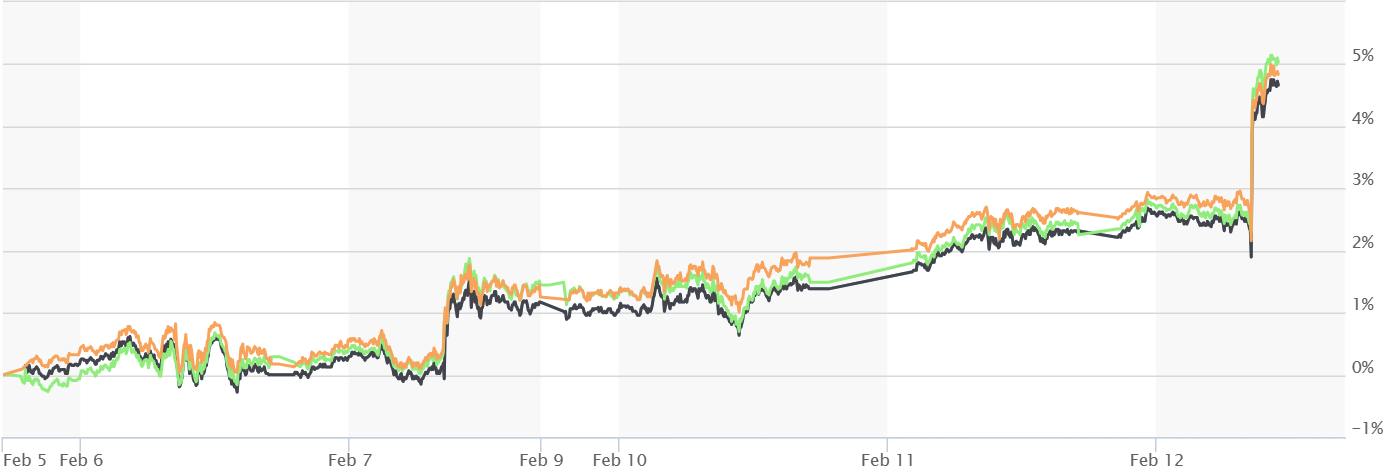
Yields on 10Y, 20Y and 30Y Treasury bonds
Producer price data on Thursday will confirm it, but economist Paul Ashworth at Capital Economics said the data "lends support to our view that, with President Trump threatening to impose wide-ranging inflationary tariffs, the Fed won’t resume cutting interest rates this year."
Core CPI inflation has been hanging around 3% for some time, he said, and "clearly isn’t coming down decisively any more".
"The upshot is that markets are now only pricing in one 25bp rate cut by the Fed this year. We still think that’s too dovish. With tariffs likely to keep core PCE inflation close to, or above, 3% this year now, the Fed will stand pat for at least the next 12 months."
James Knightly at ING said US inflation coming in well ahead of expectations, prompted the market "to dramatically reprice the prospect of rate cuts".
"Potential tariffs add upside risk to inflation in coming quarters."
However, Samuel Tombs at Pantheon Macroeconomics said the sharp increase in the core CPI is "less alarming than it first appears", due to disruption from the seasonal adjustment procedure at the turn of the year, showing it canbe "dangerous it is to extrapolate from one month’s data".
"We recommend waiting for February’s data, when the new seasonal factors look set to dampen the seasonally adjusted index more than in previous years, before judging how the underlying trend has evolved."
He provisionally forecasts that the core PCE deflator increased 0.4% in January, though tomorrow’s PPI data will help to refine such forecasts.
"This forecast, as well as the likely revisions to January 2024’s data, suggest that core PCE inflation probably edged down to 2.7% in January, from 2.8% in December.
"If as we expect, the trend continues to slow over the coming months, we still think the FOMC will ease policy again in June."