
Alberta-based agricultural technology firm Replenish Nutrients Holding Corp (CSE:ERTH, OTC:VVIVF) is setting itself up for a breakthrough year as the agricultural industry faces increasing pressure to adopt sustainable and regenerative farming practices.
The company, which specializes in regenerative fertilizers, is entering 2025 with a stronger position, armed with a solid strategic plan, a scaled-up production facility, and an in-demand product.
As CEO Neil Wiens explained, the company focused on critical groundwork in 2024 despite what may have seemed like a quiet year externally. “From the outside, it may have seemed like things weren’t progressing, but we weren’t sitting idle,” Wiens told Proactive. “We were hard at work making sure our SG&A wasn’t ballooning, finishing off our intellectual property, and ensuring that all the necessary efficacy pieces were in place.” These efforts, he added, helped the company avoid going back to investors for additional funding during the final stages of its research, an outcome that saved the company $1.5 million.
Laying the groundwork
For Wiens, 2024 was all about laying the foundation for future growth. He highlighted a pivotal cost-saving decision in the company’s upgrade of its production facility. Originally budgeted at $2.5 million, Replenish’s Beiseker facility—which started as a pilot and R&D site— is expected to be brought online for approximately $1 million through strategic equipment sourcing. “The money is largely going toward the basic facility now,” Wiens explained. “The additional six months and the $1.5 million we saved will ultimately benefit the company and our shareholders in the long run.”
This cost efficiency is paying off, as the company is expected to have a much larger production capacity than originally planned. “We were originally aiming for a two-ton-per-hour facility, which would have given us around 10,000 to 12,000 tons per year,” Wiens explained. “But after a closer look, we realized that a lot of the high-priced equipment we installed is actually capable of handling five tons per hour. So now, instead of a two-ton-per-hour system, we’re set up for a five-ton-per-hour system, which makes a huge difference. That means we can potentially reach a 24,000-ton capacity, which is far more relevant in the fertilizer industry.”
Scaling up
In a market where scalability is key, this upgrade positions Replenish for long-term success. While 10,000 to 12,000 tons per year would have been considered a small operation in the fertilizer business, a 24,000-ton facility brings the company into the realm of real scale. According to Wiens, this shift from a pre-commercialization facility to a fully commercialized one is crucial because it allows the company to operate with a solid margin, which will ultimately generate free cash flow.
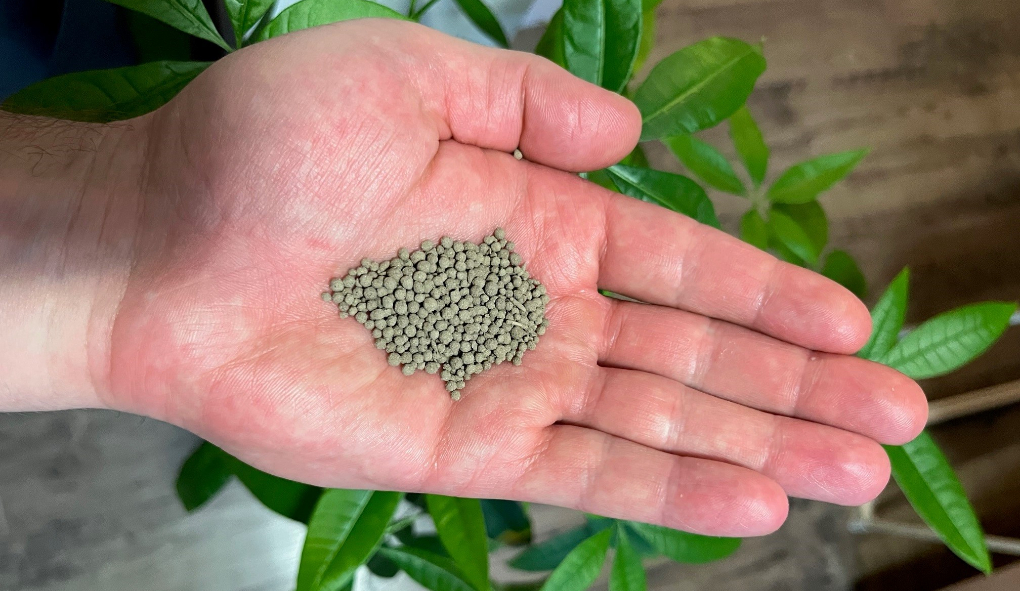
The key to Replenish’s success is its product. Unlike traditional fertilizers, which often lose nutrients to leaching or volatilization, Replenish’s regenerative fertilizer is designed to keep its beneficial microbes alive and ensure that nutrients stay in the soil until the plants need them. “Our patents not only provide mineral nutrients that don’t leach during heavy rain events or volatilize when it’s sunny and dry for weeks, but also ensure that when we apply our product to the ground, it stays there until the plant needs it,” Wiens said.
The company’s product offers a wide range of indigenous microbes that remain alive in granule form. This approach contrasts with many competitors, who rely on just a few microbes that may only survive for 48 to 72 hours once mixed with liquid or powder. Wiens likened this to the human gut, saying, “Imagine if we only introduced two or three microbes to our gut flora—it wouldn’t end well. The same principle applies to soil. Our product ensures a healthy, thriving microbial environment in the soil.”

Meeting growing demand
Replenish’s target market is large-scale commercial farming operations, with Wiens noting that 99% of the company’s customers farm 5,000 acres or more. “Last year, for example, we spread our product on 400,000 acres of land,” he said.
Scalability is key to the company’s growth plans. “Can we produce more of our product? 100%. Everything we use is off-the-shelf feed products. For example, elemental sulfur is a byproduct of the oil and gas industry, and we incorporate that into every formulation because sulfur is essential for plant and human protein production.”
The company’s global reach is evident as well, with sources of rock phosphate being sourced from across the globe, including northern Ontario, Idaho, Montana, Florida, and even Egypt.
Sustainable solutions for the future
With the Beiseker facility expected to produce 2,000 tons per month, Replenish already has purchase orders in place for the first three months, totaling 6,000 tons. “We’re sold out for the first three to four months,” Wiens said, adding that distributors have already indicated they need more than the 24,000 tons initially produced.
Looking ahead, Replenish is optimistic about its future. With its scaled-up production, existing purchase orders, and a promising product that aligns with the shift toward sustainable farming practices, the company is positioned for growth. “When people see it, all those who were skeptical will realize, ‘Oh, it’s all here. The peels are gone, it’s on the ground, and guess what? It grew,’” Wiens said. “We grew wheat that ended up in your bread, and let me tell you, that bread tastes good.”