
Agitation leach studies for the Lo Herma ISR Uranium Project of GTI Energy Ltd demonstrate that mineralisation is amenable to the alkaline in-situ leach process (ISL or ISR) with recoveries of approximately 75%.
This is consistent with other ISR projects in the Southern Powder River Basin of Wyoming, USA, and is the method used successfully at other deposits in this region.
These leach test results along with upcoming outcomes from permeability testing will be key inputs into a scoping study which is underway and is expected to be delivered in the first half of 2025.
Focus on scoping study
GTI Energy executive director Bruce Lane said: “Following the recent major uplift in Lo Herma’s uranium resource, now 50% larger at 8.57 million pounds plus a significant exploration target, our immediate focus is to complete a scoping study.
"These positive metallurgical study results confirm, as expected, that the uranium mineralisation at Lo Herma is amenable to the alkaline leach chemistry commonly used at nearby productive deposits in Wyoming’s Southern Powder River Basin.”
Hydrogeological testing
Drilling to facilitate hydrogeological testing is now complete with the drilling of the third and final groundwater monitor well.
This drilling has recovered additional core material which has been submitted for permeability testing with detailed drilling results to be provided in due course.
"We now look forward to completing the hydrogeologic analysis for the scoping study,” Lane added.
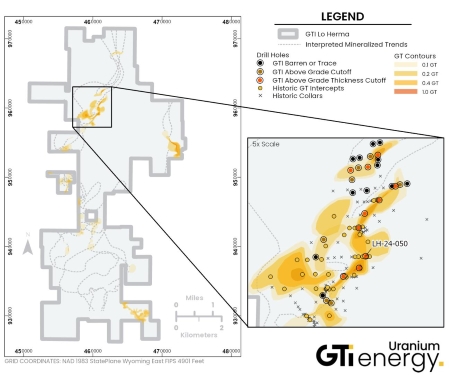
Plan showing the location of drill core samples at Lo Herma.
Agitation leach testing
GTI’s consultants and scoping study managers BRS, Inc. (BRS) engaged Wyoming-based specialist consultants R and D Enterprises (RDE) to perform agitation leach studies on core from the Lo Herma Project.
RDE worked in conjunction with Pace Analytical (PA) to perform the required test-work, and analysis of solutions and residual solids.
Leach amenability studies were conducted to demonstrate that Lo Herma uranium mineralisation is capable of being solubilized using conventional alkaline in-situ recovery (ISR) chemistry.
The studies evaluated uranium extraction rates and efficiencies from Lo Herma mineralisation samples.
Testing details
Core composites, prepared by BRS, were submitted to PA for bicarbonate-based agitation leach testing.
The testing protocol utilised reagent water fortified with 2g/L sodium bicarbonate and 1g/L hydrogen peroxide to generate the leach lixiviate.
These lixiviants used were consistent with those commonly used by Southern Powder River Basin Wyoming ISR producers.
Two core splits were prepared and leached concurrently to ensure the agitation leach test procedure and the requested analytical testing was consistent.
The standard operating procedure for agitation leach testing is typically based on 30 pore volumes (PV) for resource recovery.
After each ~24-hour sample agitation, fresh lixiviant representing 5 - PVs each, were exchanged.
The two paired leach tests successfully recovered between 70% and 80% of the available uranium resource.
Peak uranium grades of 200 mg/L U were achieved with average uranium grades of ~45 mg/L U [53 mg/L U3O8].
As expected, other species were marginally solubilized by the leach process including calcium, sulphate, arsenic and selenium with these presenting at concentrations within normal and expected levels for ISR operations in the district.
GTI Energy welcomes the outcomes with Lo Herma mineralisation responding well and demonstrated to be amenable to the alkaline in-situ leach process with uranium recoveries at ~75%.