
NGX Limited has taken a significant step forward in unlocking its value-add process for the Malingunde Graphite Project in Malawi by producing spherical graphite from previously rejected fines material.
An innovative process, developed in collaboration with international technology partners, gives NGX the potential to increase production yields of Active Anode Material (AAM) and produce higher-value anode products.
The technology, which is part of NGX’s anode development program, focused on prequalifying anode material derived from natural flake graphite from the Malingunde Project.
By converting low-value fines into high-value pre-cursor anode material, NGX and its partners have boosted yields beyond industry standards, unlocking significant value.
Potential to boost economics
NGX’s executive director Peter Fox said: “NGX is making excellent progress on its downstream strategy for the production of active anode materials.
"We are excited with our technical team's advancements on this innovative process, which aims to increase both the volume and value of the spherical graphite derived from flake graphite concentrate.
"This technology could significantly enhance project economics by converting rejected fines - typically a low-value stream from the shaping process - into high-value spherical graphite.”
As part of NGX’s ongoing downstream flake graphite program, the company is working with leading technology partners worldwide to enhance the production of AAM from NGX’s high-quality natural graphite for the growing lithium-ion battery market.
Transforming low-value waste
In collaboration with a technology company, NGX is exploring ways to turn low-value waste fines generated in the spheronisation process into additional high-value spherical graphite in order to boost production efficiency and improve sustainability.
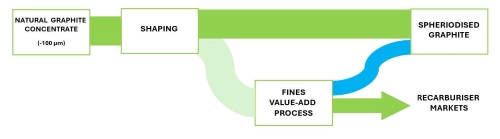
Flowsheet of the initial phases of the downstream process - additional feed from the process in blue.
Initial test-work has produced spherical graphite SG that already meets the required industry benchmarks for SG, achieving a D50 of 16.7 microns, a 0.985 tap density and a BET-specific surface area of 7.3 m²/g, with a yield of 43%.
Ongoing optimisation efforts are expected to deliver even more significant improvements.
By introducing a new value-added process, NGX aims to produce finer-sized spherical graphite (D50: 10.7 microns) from low-value fines material, increasing yield and improving the potential economics and marketability of graphite from Malingunde.
Highly sought after
Finer spherical graphite (D50: 8-12 microns) is highly sought after for high-power and fast-charging battery applications, often commanding a price premium over larger-sized SG material.
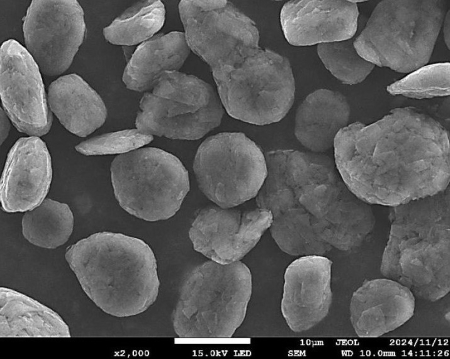
SEM of spherical graphite produced from fines.
Scanning Electron Microscopy (SEM) images of the pre-cursor AAM produced in the process highlight the typical ‘potato-shaped’ structure of spherical graphite and show the material to be agglomerates of smaller particles. Conceptually, this is expected to improve lithium diffusion.
The particle size distribution (PSD) of the fines feed to the process is shown below, with the majority of material between 1-10 microns, with a D50 sizing of 4.9 microns.
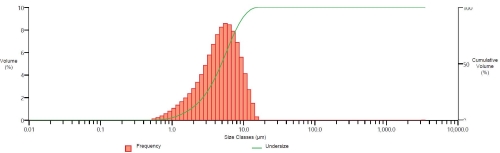
Particle Size Distribution (PSD) of the fines feed.
The PSD of the SG product (below) shows a shift to a larger D50 sizing (10.7 microns) and a more normal distribution.
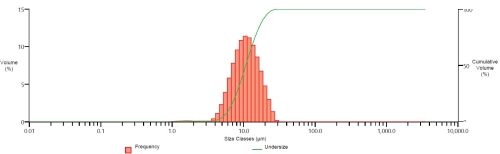
PSD of the spherical graphite produced from the waste fines material.
Significant value-add
The ability to produce this material from what otherwise would be low-value fines, which is typically sold as a low-value recarburiser used in steel making, is a significant value-add for NGX.
Fines processing increased overall yields by 24% and based on the test-work conducted to date on this process, there is room for further optimisation, targeting an increase in overall yield and enhanced production of high-value smaller diameter spherical graphite. The first batch of finer-sized SG samples has already been sent for purification testing, with the results expected later this quarter.
"We look forward to results from further optimisation work to maximise shaping yields and assess the electrochemical performance of the material," Fox added.